
The Unclosed Door · RFK series
California Dream Ends — The 1968 Primary Season
Part V-A of The Unclosed Door
1. Introduction: The Empty Chair
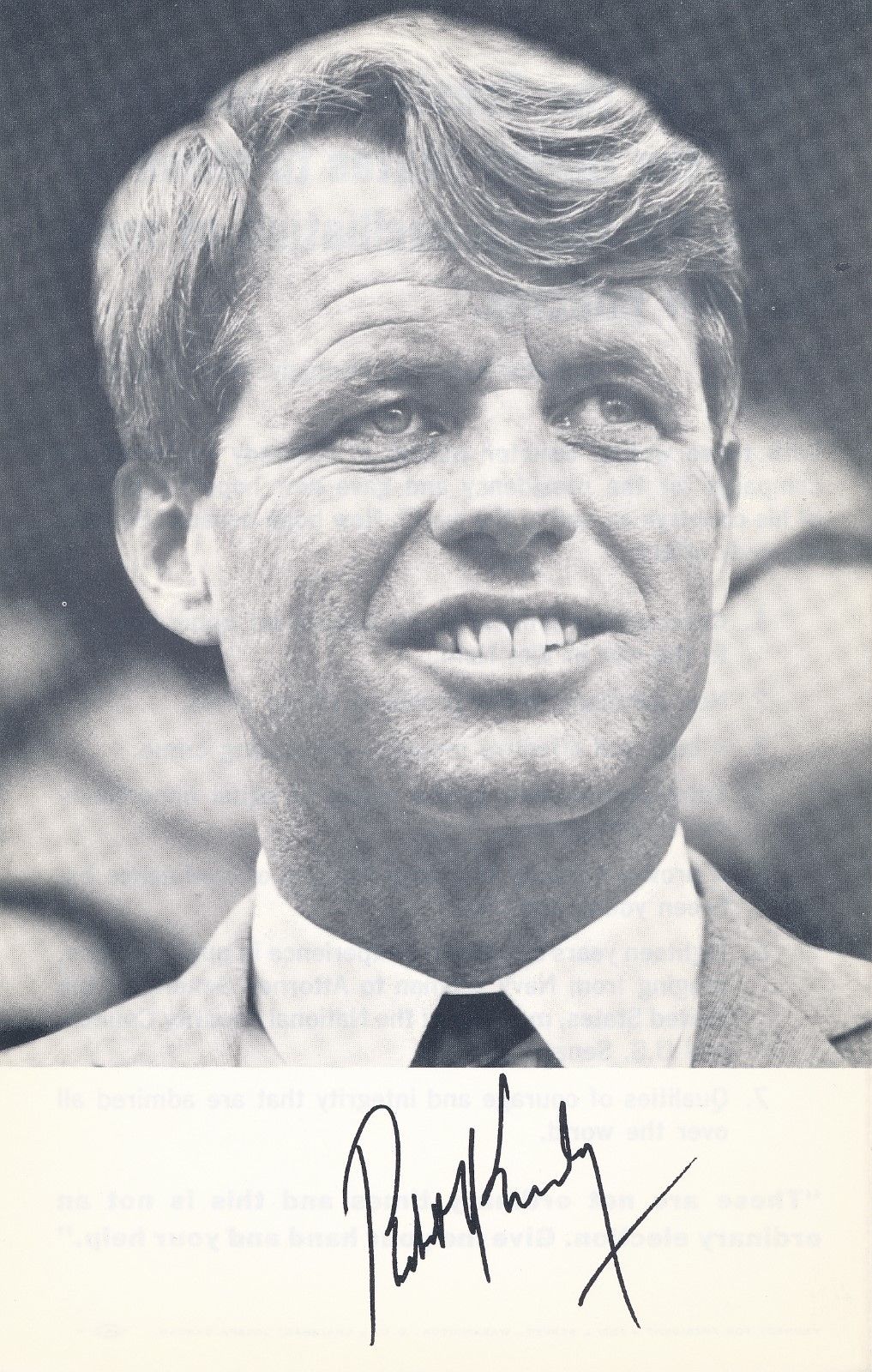

The 1968 campaign did not begin with a candidate. It began with a vacancy.
Before Robert Kennedy entered the race, there was only a movement looking for a body — Allard Lowenstein's "Dump Johnson" insurgency, hatched in a West 82nd Street apartment, recruiting county chairmen in New Hampshire and Wisconsin while the man they wanted stayed silent {NM-C08-¶050; NM-C08-¶078}. Kennedy felt the pull and the guilt of refusal. He had quoted Dante to students for years — the hottest places in hell are reserved for those who keep silent in times of moral crisis — and yet he waited, "hoarding his political strength, rationing his rage against injustice" {NM-C01-¶012}.
He knew what the entry would cost. His brother Teddy, who had worked the Rocky Mountain states in 1960, told him there was no support there {NM-C09-¶081}. Steve Smith canvassed the governors and found exactly one favorable name in the country {NM-C09-¶081}. Teddy believed Lyndon Johnson had a lock on the nomination — and that 1972 would belong to Bobby outright if he only waited {TA-C01-¶009}.
Waiting was the one thing history refused to allow. The Vietcong came into the American Embassy in Saigon. McCarthy's cool campaign struck fire in New Hampshire. "And so he raced to catch up with history and his followers" {NM-C01-¶012}.
2. The Decision: March 16
"I'd rather run than not run," he told his aides in the final deliberation. "And, if one more politician says yes, I'll do it" {NM-C09-¶081}. That night at dinner he told his sisters: "This is going to cost you a lot of money" {NM-C09-¶081}.
On March 16, 1968, in the same Senate caucus room where his brother had announced eight years before, Robert Francis Kennedy declared for the presidency.
The isolation was immediate and almost total. Mayor Daley and Governor Hughes reaffirmed their loyalty to Johnson. The Senate's own doves — Clark of Pennsylvania, Morse of Oregon — declined to endorse him. The liberals who had built the Dump Johnson movement stayed with McCarthy. "Kennedy was starting on the head of a pin, too late for the liberals, and too liberal for the rest of the party" {NM-C10-¶094}.
There was no machine. The "well-oiled" apparatus of 1960 was a legend without substance; a week into the campaign there was no headquarters, no plane, no manager {NM-C11-¶040}. What existed was a man, a cause, and a crowd that would not stop growing.
3. The Shock: The Emperor Abdicates
On March 31, fifteen days into the campaign, Lyndon Johnson went on television and ended an era: "Accordingly, I shall not seek, and I will not accept, the nomination of my party for another term as your President" {NM-C11-¶079}.
For Kennedy, the abdication was a strange defeat. The enemy who had organized his campaign's meaning was gone — "he lost his cause and he lost his enemy. For the rest of the campaign he seemed lost and drifting without direction" {NM-C01-¶013}. Into the vacuum stepped Hubert Humphrey, the administration's heir, and into the open field came Richard Nixon, the beneficiary of every Democratic wound.
The geometry of power shifted that night. RFK was no longer running against a president. He was running against the settlement — the entire arrangement of Cold War liberalism, war economics, and party machinery that Humphrey embodied and Nixon promised to preserve.
4. The Coalition That Terrified Power
What followed had no precedent in American politics and has had no successor.
The Kennedy coalition was not assembled from party blocs. It assembled itself — Black and white poor, farmworkers and students, the dispossessed who came to him "as if he were a faith healer" {NM-C01-¶013}. In the final month of his life he was "becoming engaged, at newer and deeper levels, with the cause of the black and white poor… becoming emancipated from his brother's legend" {NM-C13-¶001}.
Indiana, May 7: he won. Nebraska, May 14: he won again — against an absent McCarthy, a write-in Humphrey, and a non-candidate Johnson still on the ballot {NM-C13-¶008}. The receptions elsewhere in the country were "nothing like the California madness" {NM-C11-¶066}.
This was the precise composition of the threat. A candidate who could hold Black voters and white workers in the same hand dismantled the Southern Strategy before Nixon could play it. A candidate promising withdrawal from Vietnam severed the war economy's artery. And a candidate with an independent mind on the Middle East unsettled interests that had begun to treat American policy as settled territory {WJ-C08-¶001}.
5. Oregon: The First Defeat
The campaign's only electoral loss came where it was least expected. "Liberal Oregon turned out to be Robert Kennedy's Dunkirk" {NM-C13-¶011}.
He had misread the state completely — confident McCarthy would be finished by then, that Oregon's antiwar liberals would fall to him naturally {NM-C13-¶011}. Instead, on May 28, Oregon handed him the first electoral defeat any Kennedy had ever suffered in a primary. He arrived in California "with a map of unhappy Oregon etched into his worn-out face" {NM-C01-¶013}.
The loss clarified everything. California was no longer a contest for delegates. It was survival.
6. The Grip Tightens
"After January, 1968… with the quickening pace the grip of American Zionists on the contestants began to tighten. On no other candidate did this grip tighten more uncomfortably than on Robert Kennedy" {WJ-C08-¶001; WJ-C08-¶002}.
Jansen's account — written in 1970, the earliest book in the collected source materials — documents the bind: RFK's 1948 dispatches from Palestine, his support for Israel's security, and yet his independence; his brother Ted's 1966 tour of Palestinian refugee camps and endorsement of the U.N. repatriation resolution, which "greatly upset the Israelis and American Zionists" {WJ-C08-¶003}. Add to this the buried 1962 file — the Attorney General's attempt to register the American Zionist Council under FARA [EXTERNAL — needs sourcing] — and the silhouette becomes legible: the likely Democratic nominee was the one candidate the emerging U.S.–Israel axis could not manage.
He was, simultaneously, the one candidate the war economy could not afford, the one the party machinery could not stop, and the one Nixon most feared to face. California would settle all of it.
7. June 4: The Last Victory
The Embassy Room of the Ambassador Hotel, past midnight. Kennedy, "looking out over a jungle of microphones, and flanked by his wife and brother-in-law, began his exuberant victory speech" {NM-C14-¶073}. He promised to heal "a nation torn apart by injustice, inequality and war" {TA-S02-¶003}. He closed with the line his staff had waited eighty-one days to hear:
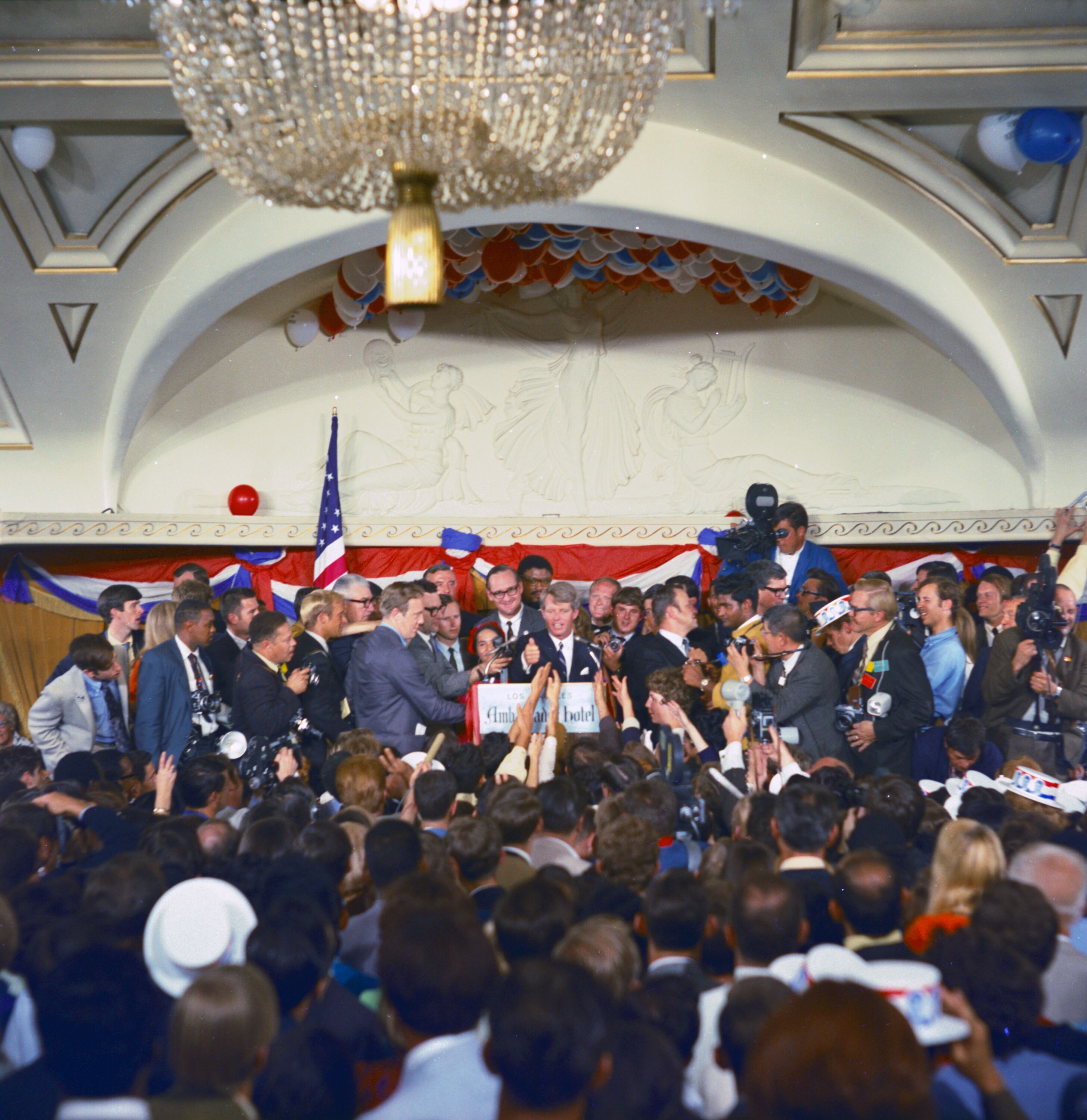
"Mayor Yorty has just sent me a message that we've been here too long already. So my thanks to all of you, and on to Chicago, and let's win there" {NM-C14-¶082}.
He flashed the V-sign. The crowd chanted "We want Kennedy" {NM-C14-¶082; TA-S02-¶005}.
Then he turned, stepped off the platform, and was led — by a maître d' and a moonlighting security guard — through the swinging doors of the kitchen pantry.
The primary season was over. The twentieth century's last open door was about to close.
8. Dramatic Schema
Set: A map of America in light, state by state igniting — New Hampshire in white, Indiana in gold, Nebraska in gold, Oregon in black, California in blinding gold that gutters and dies.
Sound: The chant, "We want Kennedy," swelling with each primary — until, at the pantry door, it cuts to a metronome.
Device: At each victory, an offstage phone rings in an empty office — unanswered, insistent. No one ever picks it up.
Final image: The map in darkness. Only Los Angeles lit — a point, pulsing, like a heart monitor.
9. Closing Reflection
The 1968 primary season lasted eighty-one days. In those days, a man who had been the system's own prosecutor became the vessel of its victims; a coalition was assembled that the architects of the coming order could not permit to exist; and a chronology was fixed — March 16 to June 5 — inside which every beneficiary of the status quo could read their own obituary or their reprieve.
They chose.
Anchor appendix (added 2026-11-21, verification pass): {NM-C01-¶012} · {NM-C01-¶013} · {NM-C03-¶010} · {NM-C08-¶050} · {NM-C08-¶078} · {NM-C09-¶081} · {NM-C10-¶094} · {NM-C11-¶040} · {NM-C11-¶066} · {NM-C11-¶079} · {NM-C13-¶001} · {NM-C13-¶008} · {NM-C13-¶011} · {NM-C14-¶073} · {NM-C14-¶082} · {TA-C01-¶009} · {TA-S02-¶003} · {TA-S02-¶005} · {WJ-C08-¶001} · {WJ-C08-¶002} · {WJ-C08-¶003}. External-source flag: AZC/FARA 1962.
More from the Chomsky Analytical Desk
- The Unclosed Door — Visual Index 23 November 2026
- The World RFK Inherited 22 November 2026
- Robert Kennedy’s Political Awakening 22 November 2026
- 1962 – RFK, AIPAC, and the Foreign Agent That Never Was 22 November 2026