
The Unclosed Door · RFK series
Judicial Theater – The Trial of Sirhan and the Death of Justice
Part IX of The Unclosed Door
1. Introduction: A Trial Without Truth
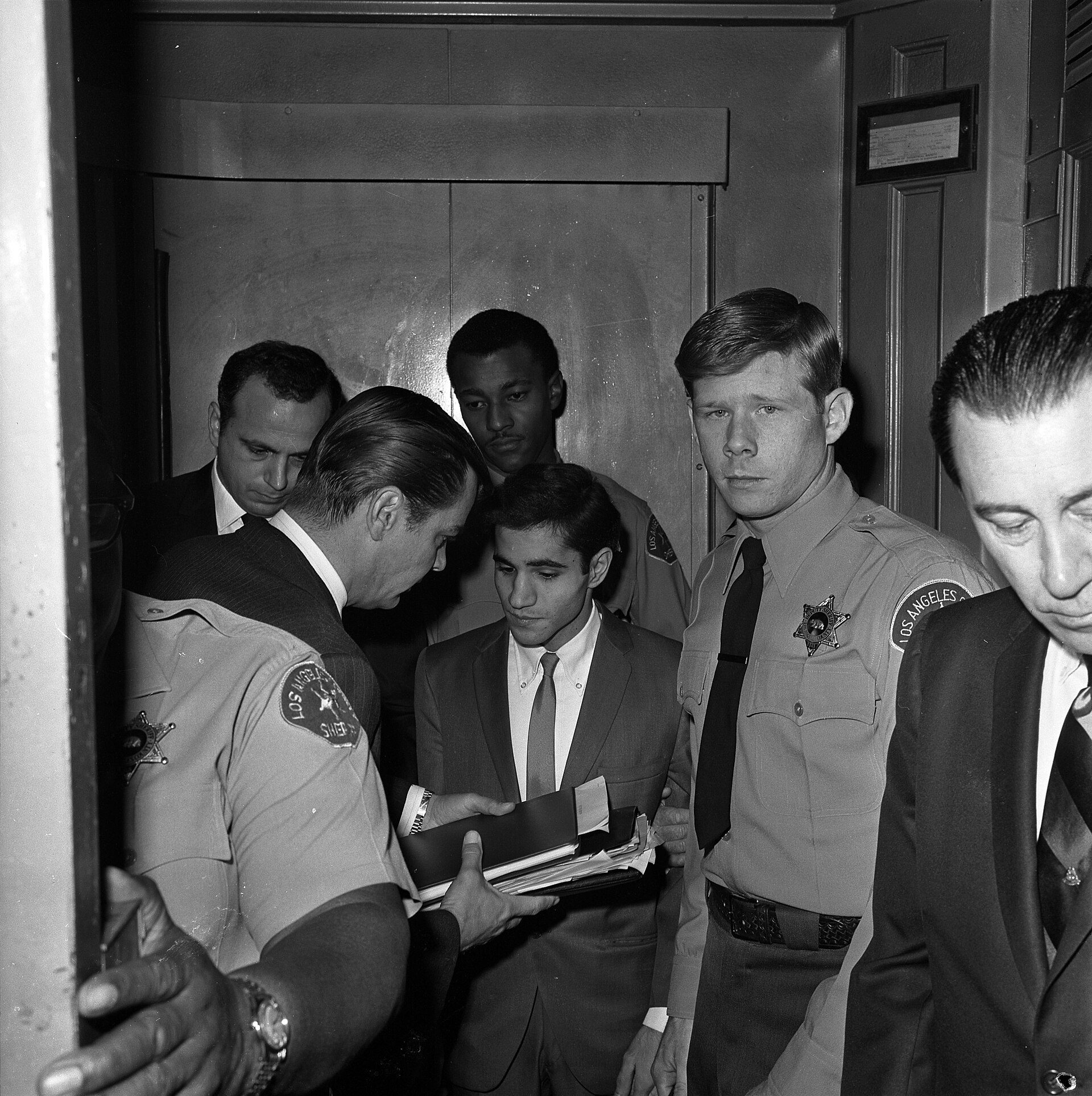
The legal system is often imagined as the last line of defense against political tyranny. But when the system itself becomes the instrument of that tyranny, trials no longer serve the truth. They serve legitimacy.
The 1969 trial of Sirhan Sirhan was precisely such a spectacle: a proceeding where guilt was predetermined, evidence was constrained, and the deeper implications of the crime were banished from consideration. It was not an investigation of who killed Robert F. Kennedy. It was a ritual reenactment of what power needed the public to believe.
This is not hyperbole—it is legal autopsy.
2. Sirhan’s Defense: Designed to Fail
Sirhan’s court-appointed attorneys, led by Grant Cooper, offered no real defense. Their strategy was not to challenge the state’s case. Instead, they conceded that Sirhan fired the shots and attempted to present a “diminished capacity” argument: that Sirhan’s mental state rendered him incapable of premeditation, thus avoiding the death penalty.
But even this weak defense was never allowed to function coherently.
Why?
Because Cooper never challenged:
- The ballistic impossibility of Sirhan firing the fatal shot.
- The presence of more bullets than his gun could fire.
- The autopsy report showing RFK was shot from behind at point-blank range—while Sirhan was always in front.
Instead, Cooper prevented ballistic experts from testifying, refused to subpoena critical witnesses, and agreed to procedural limits that guaranteed the prosecution’s narrative.
At one point, Cooper said:
“We’re not here to challenge that Sirhan did it. We’re just here to explain why.”
This is not a defense. It is a surrender.
3. Hypnosis, Amnesia, and the Refusal to Explore Mind Control
Multiple defense psychiatrists noted that Sirhan entered hypnotic trances with ease.
Dr. Bernard Diamond, after dozens of sessions with Sirhan, concluded:
- Sirhan likely acted under post-hypnotic suggestion.
- He had no conscious memory of the shooting.
- He was likely programmed.
Diamond wrote:
“I do not believe Sirhan’s amnesia is feigned. I believe it is genuine. I do not believe he consciously pulled the trigger.”
Yet Cooper suppressed this line of argument.
Why?
Because to admit the possibility of mind control would have opened the trial to the history of MKUltra—an admission the state could not allow.
Instead, the judge and prosecutors derided the hypnosis theory as “pseudoscience,” even as government files (now declassified) confirmed that the CIA had successfully experimented with hypnotic assassination techniques since the 1950s.
Sirhan’s amnesia was treated not as a symptom—but as a liability to be ignored.
4. The Judge: Facilitator of Closure
Presiding over the trial was Judge Herbert V. Walker, a conservative jurist with close ties to the LAPD.
Walker:
- Denied motions for independent ballistics testing.
- Prevented defense attorneys from introducing evidence of a second gunman.
- Refused to allow testimony from key eyewitnesses who contradicted the LAPD timeline.
In doing so, he performed the state’s preferred version of events:
- RFK was shot by Sirhan.
- The case was simple.
- No deeper analysis was needed.
This was not impartiality. It was guardianship.
Walker’s courtroom was a zone of ideological quarantine, where the virus of doubt could not be allowed to spread.
5. The Jury: Trapped in a Script
The jury—ten women, two men—deliberated not in a vacuum, but in an atmosphere saturated by media and institutional messaging.
They were never told:
- That the number of bullets fired exceeded the gun’s capacity.
- That RFK was shot from behind, not in front.
- That witnesses saw another shooter.
- That Sirhan had no recollection of the event.
Instead, they were shown:
- Sirhan’s notebooks, filled with phrases like “RFK must die.”
- Photographs of RFK’s corpse.
- Emotional testimony from campaign staff.
The jurors were not asked to find the truth. They were asked to validate a ritual expulsion—to complete the arc of sacrifice that began with the killing.
They did.
6. Prosecutorial Misconduct: The Weaponization of Narrative
The prosecution, led by Lynn “Buck” Compton, built its case on three pillars:
1. Sirhan’s gun was the murder weapon.
2. His notebooks proved premeditation.
3. His Arab identity explained motive.
Each pillar was flawed.
- The bullets were never matched definitively to Sirhan’s gun.
- The notebooks could have been written under hypnosis.
- The political motive was specious—RFK’s statements on Israel were vague and moderate.
Yet the prosecution insisted on emotional closure over factual resolution.
Compton compared Sirhan to Lee Harvey Oswald. He invoked patriotism. He warned of foreign radicalism.
This was not a prosecution. It was a sacrament: the banishment of the monster, the purification of the national wound.
7. The Real Crime Scene: The Courtroom Itself
While the media focused on the pantry where RFK fell, the real crime scene was the courtroom where truth was executed.
Every element of the proceeding was curated:
- Witnesses were filtered.
- Evidence was truncated.
- Objections were denied.
- Doubts were preemptively erased.
This is what Giorgio Agamben calls the state of exception: a legal process that suspends the law in order to preserve the fiction of order.
Sirhan’s trial was not a failure of justice. It was justice suspended in performance—a tableau vivant of institutional survival.
8. Appeals Denied: The Forever Verdict
Over the decades, Sirhan’s lawyers filed multiple appeals:
- In 1975, they cited new ballistic analysis.
- In 1997, they invoked suppressed evidence.
- In 2000, they introduced audio evidence of 13 shots.
- In 2021, even RFK Jr. and Paul Schrade supported parole.
Each time, the appeals were denied.
The state insists that reopening the case would “destabilize confidence in the judicial system.”
Translation:
- Truth is less important than trust.
- Justice is subordinate to institutional memory.
Sirhan remains imprisoned not because he is guilty—but because his freedom would indict the court itself.
9. Dramatic Architecture: Courtroom as Cathedral
Set: A cruciform courtroom. At the center: a glowing chair—Sirhan’s seat, lit like a sacrificial altar.
Characters:
- The Judge: part priest, part censor.
- The Prosecutor: a robed orator, intoning patriotic liturgy.
- The Defense: silent, hands bound.
- The Spectators: the audience, sworn to forget.
Climax: As the verdict is read, the room begins to dissolve. Bullet casings fall from the ceiling. RFK’s ghost appears, not as a martyr—but as a man silenced mid-sentence.
10. Conclusion: The Trial as Annihilation of Inquiry
The trial of Sirhan Sirhan did not reveal the truth. It destroyed the conditions under which truth could emerge.
It functioned to:
- Close the wound before it could fester.
- Remove the assassination from history and place it in myth.
- Define RFK’s death as tragedy—not treason.
In this, the legal system did not fail. It succeeded—as an arm of sovereign power, tasked with protecting not the people, but the structure itself.
As Walter Benjamin wrote:
“The law’s interest in justice is only a mask for its interest in preservation.”
Sirhan’s trial preserved the lie.
It did not ask: who killed Robert F. Kennedy?
It asked: how do we make sure no one ever asks again?
Source anchor appendix (Part IX): Diamond's conclusions → {MD-C12-¶221} · {MD-C12-¶235}; Spiegel denied access → {WB-C15-¶032} · his "senior programmer" assessment {WB-C15-¶070}; Wolfer's serial-number controversy → {LB-S17-¶100} · {LB-S17-¶108}; 2016 parole hearing / Schrade → {TA-C18-¶040}; Kranz special counsel → {TA-C09-2}
More from the Chomsky Analytical Desk
- The Unclosed Door — Visual Index 23 November 2026
- The World RFK Inherited 22 November 2026
- Robert Kennedy’s Political Awakening 22 November 2026
- 1962 – RFK, AIPAC, and the Foreign Agent That Never Was 22 November 2026