
The Unclosed Door · RFK series
The Birth of the Surveillance State – The Legacy of RFK’s Death and the Infrastructure of Control
Part XI of The Unclosed Door
1. Introduction: After the Coup, the Panopticon
In a healthy democracy, political murder triggers transformation. In a captured state, political murder signals upgrade.
The assassinations of JFK, Malcolm X, MLK, and RFK—each targeting a figure with mass legitimacy and visionary opposition to the status quo—did not result in reforms, investigations, or reckoning. Instead, they coincided with the expansion and consolidation of a vast internal control system: surveillance agencies, data banks, behavioral science programs, and predictive policing infrastructures. This was not incidental. It was structural.
RFK’s death marked the final foreclosure of democratic recalibration. In his place, the national security state ascended without friction.
2. The Strategic Vacuum: No Challenger, No Constraint
By June 6, 1968, three political facts were clear:
- There would be no presidential candidate willing to dismantle the war machine.
- No moral authority remained to resist the internal colonization of dissent.
- No investigative body—legal, legislative, or journalistic—would challenge the permanent state.
RFK’s death ensured that:
- Hubert Humphrey would inherit the Democratic nomination, guaranteeing the continuation of LBJ’s Vietnam policies.
- Nixon, upon election, would escalate both foreign and domestic control mechanisms.
- The CIA, FBI, and NSA would operate with full impunity—now sanitized by bipartisan consensus.
What began under JFK as a crisis of oversight became, after RFK, an immunity complex.
3. Surveillance as Governance: The Deepening of COINTELPRO and Beyond
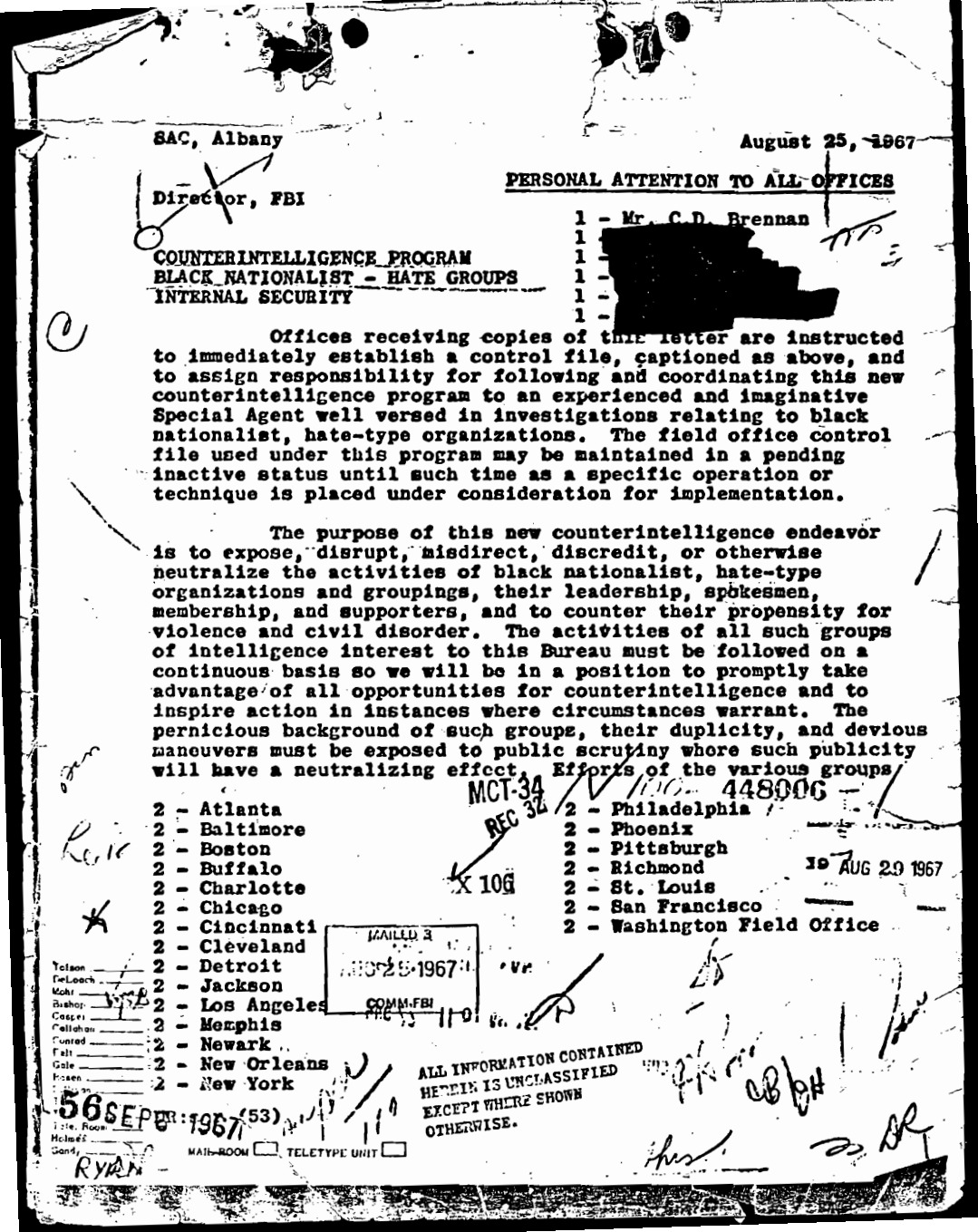
After RFK’s death, J. Edgar Hoover faced no internal resistance.
Between 1968 and 1971, COINTELPRO:
- Disrupted Black, Indigenous, Chicano, and anti-war groups with psychological operations.
- Used wiretaps, infiltration, disinformation, and “neutralization” (a euphemism for targeted assassination).
- Monitored up to 500,000 Americans without warrants.
The logic of COINTELPRO was not crime prevention. It was pre-political suffocation.
In RFK’s absence, there was no congressional check, no attorney general pushback, no presidential threat to the Bureau’s autonomy. His murder had decapitated the only elite figure likely to stand up to Hoover’s regime.
COINTELPRO would be “officially” ended in 1971, only to be replaced by new frameworks with greater technological reach.
4. The NSA and the Emergence of Total Data Awareness
In parallel, the National Security Agency underwent a metamorphosis.
RFK, like his brother, had been wary of the NSA’s scope, particularly its international signal intelligence operations, which frequently violated constitutional protections. After 1968:
- NSA expanded its ECHELON program, intercepting communications from domestic antiwar groups and civil rights activists.
- New satellite technologies enabled round-the-clock geospatial surveillance.
- NSA data sharing with CIA, FBI, and foreign intelligence (notably Mossad and MI6) increased dramatically.
There was no RFK in the Senate to ask:
- What protections exist for American citizens?
- Who oversees the overseers?
Instead, both parties looked away. The Cold War provided endless justification. The public remained uninformed.
RFK’s death left the gates unguarded.
5. Operation CHAOS: The CIA Turns Inward
Officially, the CIA was prohibited from operating domestically. Unofficially, it ran Operation CHAOS, targeting:
- Student antiwar organizations.
- African-American liberation groups.
- Journalists, clergy, and university professors.
From 1967–1974, Operation CHAOS:
- Collected over 13,000 files on U.S. citizens.
- Planted agents in protest movements.
- Conducted psychological profiling and disruption campaigns.
RFK, as former Attorney General, had been increasingly vocal about the need to rein in CIA activities. He knew the Agency’s capacity for black operations. His presence posed a threat to their encroachment.
His removal allowed domestic CIA activities to flourish, setting the stage for future abuses under Reagan, Bush, and the post-9/11 surveillance regime.
6. Predictive Policing, Behavioral Science, and Technocratic Control
The post-1968 landscape saw a sharp increase in the fusion of psychological research and police operations.
Key developments:
- LAPD and other departments adopted Behavioral Threat Assessment Units, drawing from CIA/MKUltra research.
- The Department of Defense launched DARPA’s Behavioral Science Program, studying mass influence, opinion formation, and social contagion.
- Federal funding accelerated the development of early predictive policing algorithms, using arrest data, neighborhood profiling, and social network analysis.
The aim: not to react to dissent—but to anticipate it, preempt it, and engineer it out of the system.
RFK, who had begun openly questioning the moral legitimacy of state violence, would never have sanctioned such tools.
In his absence, they proliferated—under the banner of “order.”
7. The Architecture of the Surveillance State
By the 1980s, a new infrastructure had emerged, interlocking law enforcement, intelligence, academia, and private enterprise. Key nodes included:
- The FBI’s Terrorist Screening Center
- Fusion Centers across 50 states
- The Foreign Intelligence Surveillance Court (FISC)
- Defense Advanced Research Projects Agency (DARPA)
- Private contractors like Booz Allen Hamilton, Palantir, and SAIC
RFK’s death removed a critical barrier to this consolidation. With no political elite demanding transparency, the surveillance state became self-justifying.
The enemies changed—first radicals, then drug users, then immigrants, then Muslims, now dissenters of any kind. But the logic remained: perpetual suspicion equals perpetual control.
8. From COINTELPRO to PRISM: A Seamless Continuum
The 2013 Snowden leaks revealed PRISM and XKEYSCORE—NSA programs that collect:
- Emails
- Browser history
- Social media posts
- Voice calls
RFK had once warned of the “dangerous drift toward the control of information by government agencies not subject to public accountability.”
His assassination ensured that drift became doctrine.
From CHAOS to PRISM, COINTELPRO to FISA, we see not rupture, but evolution.
The American surveillance state is not a response to terrorism. It is the institutionalization of the counterinsurgency framework born in the 1960s—designed to prevent the rise of another RFK, MLK, or Malcolm.
9. The Internalization of Surveillance: Panopticon 2.0
Following Foucault and Deleuze, post-1968 governance transitions from disciplinary society (institutions) to societies of control:
- Citizens monitor themselves via social media.
- Big data tracks movement, speech, thought.
- Predictive models influence not just policing, but hiring, education, finance.
RFK had called for dignity, justice, and transparency.
In his absence, the state redefined freedom as compliance, and security as total visibility.
Even protest is now metabolized—managed by permits, surveilled by drones, captured on livestreams for facial recognition.
RFK’s assassination was the gate through which democracy passed into simulation.
10. Theatrical Representation: The Ghost in the Server
Stage: A sterile surveillance hub. Screens line the walls. Audio feeds, digital maps, biometric scans.
Characters:
- The Analyst: reads emails, categorizes threats.
- The Operator: controls drones, flags keywords.
- The Ghost: RFK, appearing as a glitch in the system.
Device:
- The system begins detecting anomalies—“Robert Kennedy, hope, dignity, justice.”
- The operators panic.
- The Ghost speaks: “You did not erase me. You replaced me.”
Climax:
- Screens black out.
- A single line appears:
“The future once lived in a man. You killed him. But not the future.”
11. Conclusion: RFK’s Death as Software Upgrade
The death of Robert F. Kennedy was not simply a political elimination. It was an algorithmic reset.
In removing him, the state:
- Closed off democratic regeneration.
- Replaced charismatic legitimacy with data surveillance.
- Made dissent illegible, incoherent, or pre-criminal.
What came after him was not governance—but management:
- Not politics, but policy.
- Not opposition, but moderation.
- Not truth, but terms of service.
Today, when RFK’s name is spoken, it is often in nostalgia. But nostalgia is a trick. The proper response is reckoning.
Because his death did not end something.
It began something.
We live in its afterimage.
Source anchor appendix (Part XI): surveillance-state synthesis — framing. Coverage in the collected source materials of Hoover/FBI surveillance of RFK → {BK-C07} · {ST-C12} · {CB-C17}; COINTELPRO references → {LB} · {WB} (scattered; analytical).
More from the Chomsky Analytical Desk
- The Unclosed Door — Visual Index 23 November 2026
- The World RFK Inherited 22 November 2026
- Robert Kennedy’s Political Awakening 22 November 2026
- 1962 – RFK, AIPAC, and the Foreign Agent That Never Was 22 November 2026