“We should not forget the standard Hollywood censorship of the political dimension.” This brief formulation by Slavoj Žižek in For They Know Not What They Do provides the indispensable theoretical architecture for understanding the cultural phenomenon of Paul Thomas Anderson’s One Battle After Another. To analyze this film, and its subsequent coronation as Best Picture at the 98th Academy Awards in March 2026, requires moving beyond conventional film criticism. The task is to examine the film as an ideological apparatus—a site where the contradictions of late-capitalist American society are simultaneously exposed, aestheticized, and neutralized.
This report delivers a three-part, evidence-disciplined analysis. Part I dissects the film itself, charting the boundary between its publicly confirmed narrative and its displaced antagonisms. Part II interrogates the Academy Awards as a ritual of cultural ratification, asking what contradictions the liberal establishment makes bearable by elevating this specific text. Part III widens the lens to Hollywood as a totalizing machine for depoliticization and the self-legitimation of Western power. Throughout, the operative question is never merely “What does this film mean?” but rather, “What foreclosed violence does it deodorize, and what ideological fantasy does it sustain?”
PART I — ONE BATTLE AFTER ANOTHER AS FILM, SYMPTOM, AND PRESTIGE OBJECT
One Battle After Another operates as a late-American genre hybrid, oscillating wildly between paranoid political thriller, screwball comedy, and elegiac family drama.1 It demands to be read as a historical-cultural symptom—a text that attempts to map the coordinates of a fractured republic while remaining tethered to the libidinal economy of blockbuster cinema.
1. What is publicly confirmed
Analysis must begin by separating the established material reality of the film from interpretive projection. It is publicly confirmed that One Battle After Another was written, directed, and produced by Paul Thomas Anderson, distributed by Warner Bros. Pictures, and released theatrically in September 2025.2 The production utilized a budget estimated between $130 million and $175 million, making it Anderson’s most expensive endeavor, and grossed approximately $209.6 million worldwide.2 The film was shot extensively on location in California—from Eureka to Borrego Springs—utilizing 35mm VistaVision cameras under the direction of cinematographer Michael Bauman, with an original score by Jonny Greenwood.2
The official premise establishes that the narrative is a loose contemporary adaptation inspired by Thomas Pynchon’s 1990 novel Vineland.2 The ensemble cast is led by Leonardo DiCaprio as Bob Ferguson (formerly “Ghetto” Pat Calhoun), a washed-up ex-revolutionary living off the grid.2 Chase Infiniti makes her film debut as his teenage daughter, Willa.2 Sean Penn portrays Colonel Steven J. Lockjaw, a corrupt military officer and Bob’s resurfaced nemesis.2 Teyana Taylor plays Perfidia Beverly Hills, Willa’s mother and a former revolutionary leader.2 Supporting roles include Benicio del Toro as Sensei Sergio St. Carlos and Regina Hall as Deandra.2
At the 98th Academy Awards in March 2026, the film secured 13 nominations and won six Oscars: Best Picture, Best Director, Best Adapted Screenplay, Best Film Editing (Andy Jurgensen), Best Casting (Cassandra Kulukundis), and Best Supporting Actor for Sean Penn, who notably did not attend the ceremony.4
2. Probable full narrative shape
A high-confidence reconstruction of the film’s narrative arc, synthesized from extensive review consensus, spoiler reporting, and official summaries, reveals a structure bifurcated by a sixteen-year temporal ellipsis.2
The prologue establishes the militant past. “Ghetto” Pat (DiCaprio) and Perfidia Beverly Hills (Taylor) operate as lovers and core members of the “French 75,” a far-left revolutionary cell.2 Their activism reaches a crescendo during an explosive raid to liberate detained immigrants at the Otay Mesa Detention Center.2 During this operation, Perfidia encounters and sexually humiliates the facility’s commanding officer, Steven J. Lockjaw (Penn), initiating a perverse psychosexual dynamic.2 Following the birth of her daughter, Charlene, Perfidia refuses to abandon the militant struggle.2 Lockjaw eventually leverages her vulnerabilities, coercing her into providing intelligence that leads to the execution and arrest of French 75 members.2 Perfidia enters witness protection and subsequently flees to Mexico, abandoning Pat and the child.2
Sixteen years later, the narrative shifts to the present day. Pat has assumed the identity of Bob Ferguson, living in a state of subjective destitution and stoned paranoia in the sanctuary city of Baktan Cross, California, raising his daughter, now named Willa.2 Lockjaw, now a powerful figure, is seeking initiation into the “Christmas Adventurers Club,” an elite, ultra-wealthy white supremacist secret society.10 The club strictly prohibits its members from engaging in interracial relationships.12 Discovering that Willa might be his biological daughter from his illicit encounters with the Black revolutionary Perfidia, Lockjaw initiates a ruthless manhunt to eliminate Willa and erase the evidence of his racial contamination.10
This catalyst propels a frenetic chase across California. Willa is separated from Bob and aided by surviving nodes of the revolutionary underground, notably Deandra (Hall) and Sensei Sergio (del Toro), who runs a covert operation sheltering immigrants.13 Lockjaw captures Willa and administers a rapid DNA test, confirming his paternity, before ordering a bounty hunter, Avanti Q, to dispose of her.2 The climax unfolds on a desert highway. An assassin dispatched by the Christmas Adventurers, Tim Smith, shoots Lockjaw, causing his vehicle to crash.2 In a subversion of genre expectations, Bob fails to arrive in time; Willa liberates herself, seizing a weapon and killing the pursuing assassin.15
The emotional-political resolution is complex. Bob and Willa reunite.2 Lockjaw survives the crash but is subsequently executed via poison gas by the very white supremacist club he sought to impress.2 Bob presents Willa with a letter, purportedly from Perfidia, offering closure and urging her to continue the fight.2 Willa departs for a political protest in Oakland, while Bob remains behind, accepting his obsolescence.16
3. Pivotal scenes or probable key set pieces
The film’s ideological machinery is most visible in three specific, critically verified set pieces.
The Otay Mesa Detention Center Liberation (Confirmed) The film opens with the French 75 infiltrating a border detention camp.18 Structurally, this sequence anchors the film in the material reality of contemporary state violence. Emotionally, it provides a visceral thrill of righteous insurgency, heightened by Jonny Greenwood’s propulsive score.19 However, it clarifies a vital theme: the intersection of political force and libidinal desire. Perfidia’s confrontation with Lockjaw is not merely tactical; she forces him to achieve an erection at gunpoint.20 This introduces the Žižekian concept of the obscene underside of Law. Lockjaw represents the state apparatus, but his enforcement is sustained by a perverse, repressed enjoyment of the very subjects he is tasked with detaining and destroying. The sequence demonstrates that ideology is not an abstract set of beliefs, but a lived ritual structured by desire.21
The Christmas Adventurers Club Meeting (Confirmed) Lockjaw’s attempt to integrate into the secret society provides the narrative’s primary structural pivot.2 Members of the club wear matching attire, hold underground meetings, and greet each other with the chilling, absurd mantra, “Hail, Saint Nick”.18 Emotionally, the scene generates severe tonal whiplash, blending the comedic absurdity of a fraternity with the genuine terror of a fascist cabal.18 It clarifies the film’s conception of the enemy. The Club functions as a satirical displacement of structural white supremacy into a manageable, localized cult. By making the architects of oppression appear bizarre and cultish, the film allows the audience to disavow their own complicity in the normative, everyday structures of American racial capitalism.
The Borrego Springs Desert Car Chase (Confirmed) The climactic pursuit sequence serves as the structural convergence of all narrative vectors—Willa’s flight, Lockjaw’s elimination, and Bob’s desperate, fumbling pursuit.23 Filmed in VistaVision, the sequence utilizes the undulating topography of the “Texas Dip” highway, causing vehicles to vanish and reappear over blind crests like “ocean waves”.23 Emotionally, it induces vertigo and profound tension. Thematically, it stages a critical subversion: it deprives the male protagonist of the fantasy of competence. Bob does not save his daughter; Willa saves herself.15 The chase is the exact moment of generational transfer, where the ruins of the parents’ revolution are violently inherited by the child.16
4. Themes and antagonisms
One Battle After Another wrestles overtly with the afterlife of revolutionary identity, political exhaustion, and fatherhood under collapse.1 It depicts a “jaundiced post-60s hangover” updated for the 2020s, where the utopian dreams of the French 75 have calcified into broken codes, paranoia, and survivalism.25 The theme of generational inheritance is paramount; Willa does not inherit a coherent political movement, but rather the unresolved trauma, physical danger, and biological contradictions generated by her parents’ failures.16
To engage in ideology critique, however, we must ask: What antagonism does the film stage directly, and what antagonism does it displace?
The film explicitly foregrounds a spectacular, kinetic antagonism between radical leftist militants and an ultra-violent, white-nationalist deep state.25 It directly stages the violence of the border apparatus and the terror of an encroaching police state.18
Yet, in doing so, it simultaneously displaces the routine, administrative violence of the liberal capitalist order. The censorship of the political dimension occurs through hyper-concentration. By condensing the evils of the American system into the cartoonish villainy of the Christmas Adventurers Club and the psychosexual hysteria of Colonel Lockjaw, the film isolates villainy from the broader socioeconomic systems that necessitate it.11 Structural causation is privatized and psychologized. Lockjaw is not simply executing state policy; he is hunting Willa to cover up an illicit affair so he can join an elite country club.2
Consequently, the systemic violence of the United States is rendered excessive and exceptional, rather than foundational. The film converts history into enjoyable style, allowing liberal culture to recognize the threat of fascism only in a managed, highly aestheticized form that ultimately protects the coordinates of the existing political economy.
5. Character analysis
The characters in One Battle After Another function simultaneously as psychological entities and ideological placeholders.
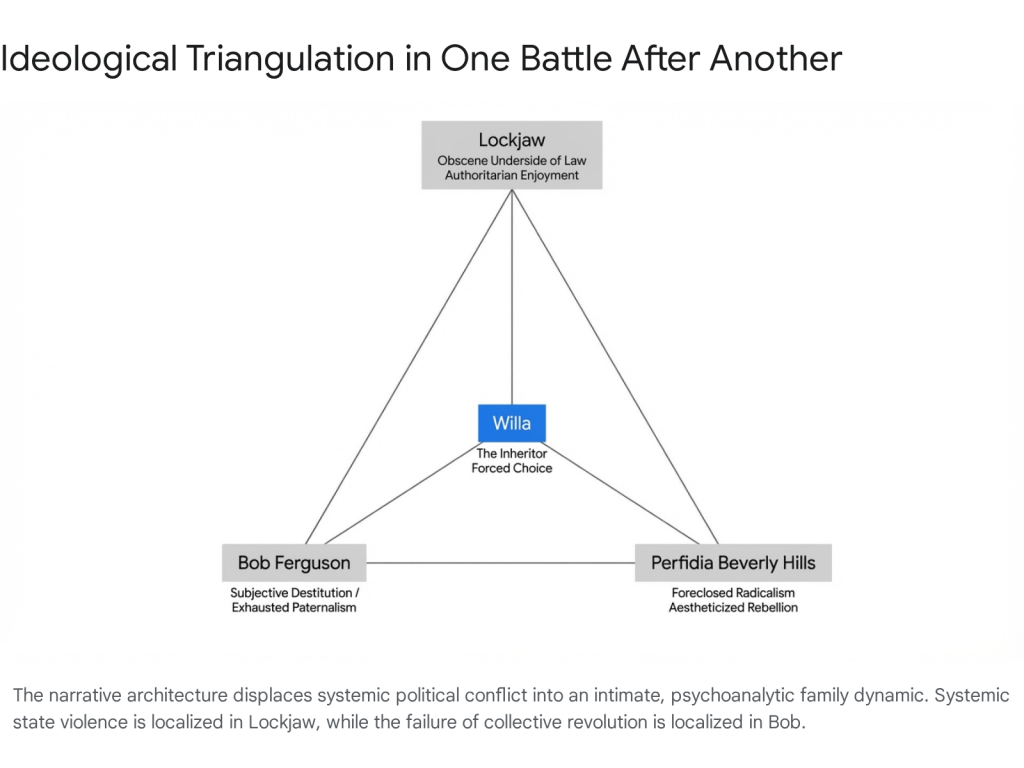
Bob Ferguson / “Ghetto” Pat (Leonardo DiCaprio) Bob is the embodiment of subjective destitution. Following the collapse of the French 75, he has retreated into a haze of marijuana and suburban isolation.2 Crucially, the film refuses to grant him the standard Hollywood arc of violent redemption. He is tactically inept—he forgets rendezvous passwords, struggles with modern technology, and arrives too late to save his daughter at the climax.30 Bob severs the link between ideological purity and paternal authority. His heroism is entirely decentered; it consists only of his persistent, flailing presence and unconditional love.30 He represents the political exhaustion of a generation that survived its convictions but lost its war.18
Col. Steven J. Lockjaw (Sean Penn) Lockjaw operates as Bob’s obscene mirror and the film’s principal antagonist. If Bob represents the failure of the Left, Lockjaw represents the hysterical success of the Right. He is the obscene underside of Law made flesh.17 Lockjaw’s dedication to a white supremacist power structure coexists toxically with his lust for Perfidia.32 His racism is not merely a cognitive belief; it is a structure of surplus-enjoyment, intertwining desire, humiliation, and the urge to annihilate.17 Penn’s performance—described as unpredictable, pathetic, and terrifying—reveals that authoritarianism is fundamentally a pathology of weakness, driven by an agonizing need for validation from the big Other (the Christmas Adventurers).17
Perfidia Beverly Hills (Teyana Taylor) Perfidia is the film’s absent center and its most politically volatile figure. She embodies an aestheticized, libidinal radicalism. The recurring image of her firing a machine gun while heavily pregnant encapsulates her fierce, uncompromising aura.34 However, the film critiques the performative nature of her revolution. She prioritizes sexual dominance over tactical discipline and ultimately capitulates under state pressure, betraying her comrades.26 Perfidia represents the tragedy of ideological fantasy: when revolution is treated as an identity rather than a material necessity, it inevitably fractures under the weight of self-preservation.26
Willa Ferguson (Chase Infiniti) Willa is the site of the forced choice. As a biracial child born to a militant mother and the fascist agent who hunted her, Willa physically embodies the historical contradictions her parents could not resolve.2 She cannot opt out of the political dimension; her very existence is a target for erasure by Lockjaw.27 She inherits the ruins of causes, forcing her to transition from protected child to violent actor.23
6. Form, tone, and style
Anderson’s formal execution is characterized by an extreme tonal volatility that violently oscillates between the paranoid, the tragic, and the farcical.1 The film utilizes a bifurcated chronological structure, grounding the contemporary trauma in the explosive, romanticized violence of the past.2
The decision to shoot in 35mm VistaVision is paramount.37 This high-resolution, horizontal film format—traditionally used for sweeping epics of the 1950s—grants the contemporary setting a terrifying, hyper-real clarity and a monumental weight.9 The camera movement fluctuates from the kinetic, guerrilla-style handheld immersion of the border raids to the expansive, locked-down compositions of the desert pursuit.19 Jonny Greenwood’s score acts as an abrasive counterpoint, described as a “cacophony” of “manic percolation” and “operatic surges of synth,” actively resisting emotional manipulation while amplifying the underlying anxiety.39
Does the film’s form intensify history, or convert it into an enjoyable surface? It executes both. The tonal switching—moving from the harrowing reality of immigrant cages to the absurdity of Bob fumbling in a grocery store—is the very form through which the film thinks.7 The volatility captures the surreal dissonance of modern political life. However, this aesthetic mastery also serves as an evasion. By wrapping the dread of creeping authoritarianism in the exhilarating mechanics of an action-comedy, the film metabolizes historical trauma into surplus-enjoyment.1 The spectator is permitted to consume the collapse of the American project as a thrilling, aesthetically flawless spectacle.
7. Reception, dispute, and awards logic
The critical reception of One Battle After Another laid bare its ideological function. The film secured a 98% rating on Rotten Tomatoes, with widespread adulation for its technical bravura, its emotional father-daughter core, and its willingness to confront the “sociopolitical murk” of 2025 America.41 Critics praised its capacity to balance grand political ambition with grounded, relatable human drama.41
However, the disputes were equally revealing. Slant Magazine‘s Keith Uhlich offered a dissenting critique, arguing the film was “self-satisfied” and “never expands from its carnivalesque surface to truly delve into the tangled sociopolitical murk of our moment”.41 Meanwhile, Variety’s Owen Gleiberman published a column explicitly arguing that the film is “Not a ‘Left-Wing’ Movie,” noting that its ultimate message leans toward centrist endurance rather than radical upheaval.44 Furthermore, vigorous online debate erupted regarding the film’s ending—specifically, whether Perfidia genuinely wrote the final letter offering closure to her daughter, or whether Bob forged the letter to protect Willa from the traumatic reality of maternal abandonment.45 This ambiguity is the ultimate marker of the film’s ideological flexibility.
What did the Academy voters actually reward? They did not consecrate historical radicalism or systemic rupture. They rewarded managed disillusionment. They embraced a film that acknowledges the terror of the present—white supremacy, state violence, institutional failure—but processes that terror through the safe, culturally prestigious framework of parental melancholy and aesthetic mastery. The Oscar validated the safe enjoyment of social breakdown at an aesthetic distance.
8. PTA context
Within Paul Thomas Anderson’s body of work, One Battle After Another represents both a continuation and a rupture. It features his recurring fixations: broken men, the intoxicating danger of charismatic leaders, obsessive dependencies, and the wreckage left by American systems of power (There Will Be Blood, The Master, Phantom Thread).29 It is directly linked to his previous Pynchon adaptation, Inherent Vice, which similarly chronicled the paranoid hangover of a failed counterculture.48
What distinguishes this film is its refusal of historical displacement. There Will Be Blood critiqued capitalism through the lens of the early 20th century; The Master explored trauma through post-WWII cults. Because the current ideological moment of 2026 is defined by a palpable, immediate state of domestic fracture and creeping authoritarianism, Anderson could no longer rely on the buffer of the past. The film drags the Andersonian protagonist out of historical allegory and forces him to navigate the explicit, highly contemporary landscape of ICE raids, facial recognition, and militant polarization.29 The present emergency demanded a film that explicitly names the contemporary threat.
9. Concluding synthesis for Part I
Beneath the intricate plot machinery of bombings, car chases, and secret societies, One Battle After Another is fundamentally a film about the burden of survival in the aftermath of political defeat. It asks how a subject can persist when the big Other of the revolutionary cause has dissolved, leaving only the immediate, biological imperative to protect one’s child.30
The film resonated powerfully in the 2025–2026 cultural landscape because it provided a perfect vessel for the anxieties of the liberal center. It offered a space to grieve the decay of the republic, to laugh at the grotesque absurdity of fascist aesthetics, and to feel the adrenaline of resistance, without ever demanding the terrifying commitment of actual systemic revolution. By crowning this film Best Picture, the Academy rendered a specific political feeling newly respectable: a chastened, anti-fascist decency. As Anderson noted in his acceptance speech, he crafted the film to apologize to his children for the “housekeeping mess” left by his generation, expressing a modest hope that they will restore “common sense and decency”.6 The film is the cinematic realization of subjective destitution repackaged as prestige virtue.
PART II — THE OSCARS AS RITUAL OF LEGITIMATION
To treat the Academy’s coronation of One Battle After Another as a mere postscript or an objective measure of artistic merit is an analytical failure. The Oscars must be read psychoanalytically, as an institutional apparatus that stages self-critique under strictly controlled conditions. The Best Picture win is an event that reveals the historical unconscious of the Hollywood system.
What does it mean that the Academy consecrated this particular film, in this particular moment? It signifies a complex ritual of symbolic ratification in which the big Other of liberal culture attempts to reassure itself that it can still recognize, and thus conceptually master, the violence of history.
A. The Oscars as canon-making machine
The Academy Awards function as a prestige mechanism for organizing acceptable dissent. Through the ceremony, the industry constructs a narrative of symbolic national self-recognition. By crowning a film that explicitly attacks white supremacy and state violence, Hollywood performs an act of institutional self-absolution.
For whom is this ceremony staged? It is staged for the big Other—the presumed, idealized gaze of History or an ethical public that demands the industry justify its immense concentration of wealth and cultural dominance. The Oscars ritualistically confirm that “serious art” capable of diagnosing societal rot still belongs safely inside the corporate system. The award selectively incorporates critique, proving the system’s tolerance and thereby neutralizing the narrative’s capacity to inspire actual rupture.
B. The aesthetics of acceptable unrest
A historical analysis of the Academy reveals a recurrent pattern: the institution routinely rewards political critique only after it has been narratively contained and structurally deodorized.
One Battle After Another perfectly satisfies the aesthetics of acceptable unrest. It stages severe societal disorder—militant bombings, detention camps, fascist cabals—but it preserves interpretive mastery by filtering these macroscopic terrors through the intimate, emotionally legible lens of a father attempting to save his daughter.2 The structural violence of the American border is translated into the private, pathological damage of Colonel Lockjaw.2 The Academy prefers ambivalence to revolution; it elevates political feeling only when it takes the form of moral melancholy, ensuring that the audience’s ultimate catharsis is rooted in familial survival rather than the overthrow of the state.
C. The politics of timing
The specific timing of this award—March 2026—is vital for understanding its ideological function. The ceremony took place against a backdrop of acute crisis: a highly polarized American electorate, the commencement of a second Trump term, and expanding geopolitical turmoil including war in Iran and protests regarding Gaza (the latter explicitly referenced by presenters like Javier Bardem on the Oscar stage).49
Why this film, now? One Battle After Another absorbs the diffuse dread of this permanent emergency. It mediates the contradiction between the desire to resist authoritarianism and the paralyzing fear of engaging in actual violence. It allows liberal culture to say indirectly what it fears directly: that the American project is severely fractured, and that the fascist threat is not an external aberration but an internal inheritance. The film makes this terrifying reality speakable only because it is filtered through the virtuosic, formal control of Anderson’s direction and the stabilizing presence of major movie stars.1 The crisis is made bearable through style.
D. Oscar recognition as symptom, not hypocrisy
It is insufficient and moralizing to dismiss the Academy’s choice as mere Hollywood hypocrisy. The coronation is a symptom that reveals the deep contradictions of the liberal cultural order.
What kind of self-image does Hollywood need from this coronation? It desperately needs the image of the courageous, truth-telling vanguard. Yet, what the Academy allows itself to recognize is only the displaced form of rebellion. It celebrates the aesthetics of the French 75 while embracing the film’s underlying conclusion that such radicalism is ultimately performative and prone to collapse.26
What must remain unsaid for this recognition to function is the material reality of the industry itself. This contradiction was laid bare by the material conditions of the 2026 telecast. On the very weekend that Warner Bros. Discovery studios won a record-tying 11 Oscars (six for One Battle After Another, four for Sinners), the corporation was being acquired by Paramount Skydance in a massive $111 billion merger.4
This is the ultimate manifestation of cynical ideology. The industry knows very well that it is engaged in a monopolistic consolidation of global media power, yet it persists in publicly honoring films that champion anti-capitalist resistance and decry corporate-state hegemony. The prestige of the award serves as the ideological fantasy required to obscure the brute reality of capital accumulation. The system celebrates its own critique to prove its ethical vitality, while simultaneously tightening its structural dominance.
Comparative historical frame
This dynamic of institutional immunization is a recurrent feature of Academy history, though its specific coordinates shift.
During the post-Vietnam and Watergate era, the Academy embraced the New Hollywood’s paranoid, anti-establishment cinema (The Godfather Part II, One Flew Over the Cuckoo’s Nest), rewarding anti-systemic feeling only after it was narratively domesticated into tragic character studies. Following 9/11, the Academy elevated films that metabolized the trauma of the state of emergency (The Hurt Locker, Argo), converting imperial violence into individualized psychological burdens or triumphs of professional competence.
What is specific about the 2026 instance is the inward collapse of the threat. The enemy is no longer the Viet Cong or the overseas terrorist; the enemy is the domestic neighbor, the local police force, the secret society operating within the American elite.18 One Battle After Another represents the Academy grappling with the era of managed domestic decline. The recurrent pattern is the translation of historical antagonism into prestige pathos; the specific novelty is that the cultural apparatus is now forced to aestheticize its own impending domestic destruction.
PART III — HOLLYWOOD AS DEPOLITICIZATION MACHINE AND WESTERN PROPAGANDA FORM
To comprehend the ideological mechanics of One Battle After Another and its Oscar victory requires situating them within the broader apparatus of Hollywood. Hollywood functions as a totalizing machine for depoliticization and a sophisticated form of Western propaganda. Propaganda here must be understood in the stronger, Žižekian sense: not as the crude transmission of overt lies, but as the meticulous management of visibility, causality, enjoyment, and permissible feeling.
Hollywood is a cultural technology that repeatedly transforms the violence, contradictions, and historical crimes of Western power into narratives of innocence, tragic necessity, or moral complexity. It achieves this by censoring the political dimension, translating material antagonisms into psychology, converting structural domination into individual fate, and staging the West before the big Other as a society that is endlessly self-critical and, therefore, fundamentally innocent.
1. Hollywood as ideological censorship
The primary mechanism of Hollywood ideology is the systematic weakening or removal of the socio-political dimension of a narrative. This is most frequently achieved by psychologizing conflict and privatizing structural violence.
In mainstream cinema, historical atrocities are rarely depicted as the logical, necessary outcomes of capitalist accumulation or imperial design. Instead, systemic violence is condensed into the actions of a specific, deviant individual. By isolating villainy from the systems that produce and sustain it, the political dimension is censored. The audience is encouraged to despise the corrupt official or the sadistic general, thereby sparing the broader institution from structural critique. The antagonism between classes or between the empire and its subjects is replaced with the interpersonal intrigue between a hero and a localized antagonist.
2. Hollywood as institutional self-discipline
Ideology is not merely located in the text of the films; it is the very structure of the industry. Hollywood operates as an apparatus of self-censorship, market discipline, and foreign-policy compatibility.
The industry systematically filters out narratives that genuinely threaten the coordinates of global capital or the fundamental legitimacy of the American state. The $111 billion Paramount/Warner Bros. merger of 2026 exemplifies this reality.55 A hyper-consolidated corporate entity cannot, by definition, produce art that seeks its destruction. Therefore, Hollywood specializes in controlled dissent. It funds films that critique specific historical failures or right-wing excesses (such as the white nationalism depicted in One Battle After Another) precisely because these critiques do not challenge the underlying logic of the neoliberal market. The industry makes structural revolution difficult to say by ensuring that dissent is always articulated within the safe boundaries of liberal reformism.
3. Visible violence versus invisible violence
Hollywood maintains its ideological hold by strictly managing what types of violence are visible and what remain invisible. The cinematic form inherently privileges the spectacular: the explosion, the firefight, the heroic retaliation, the bodily threat.
Conversely, Hollywood systematically suppresses the material heaviness of systemic violence: infrastructure, labor exploitation, class division, colonial administration, economic sanctions, and the slow, grinding duration of imperial order. As Žižek observes, “the brain really does not smell.” Hollywood aestheticizes emergency, rendering violence watchable by stripping it of its material reality. What is shown is the violence that provides an adrenaline rush; what is hidden is the bureaucratic, logistical domination that would repoliticize the frame and demand a systemic, rather than merely emotional, response.
4. External enemy as disavowal of internal antagonism
A foundational concept in ideology critique is that the fixation on the External Enemy functions as a disavowal of internal social antagonism. Hollywood repeatedly relies on the figure of the foreign enemy, the rogue state, the apocalyptic outsider, or the deviant zealot to unify the domestic audience.
By projecting all societal threat onto a monstrous “Other,” the system avoids confronting its own liberal complicity, capitalist violence, and settler-colonial foundations. The “Christmas Adventurers Club” in One Battle After Another operates precisely in this manner. By depicting white supremacy as a bizarre, secretive cult holding underground rituals, the film externalizes the threat of racism.18 It allows the liberal audience to view fascism as an alien infiltration by a deviant cabal, rather than confronting it as the banal, everyday operational logic of American society. The enemy becomes the displaced container for the contradictions generated by the system itself.
5. The obscene supplement
The official moral seriousness of liberal democracy frequently depends upon a hidden, illicit enjoyment—the obscene underside of Law. Hollywood films routinely allow audiences to enjoy the spectacle of domination while providing a narrative alibi that publicly condemns it.
Violence in Hollywood is rarely just a duty; it is jouissance (surplus-enjoyment). Films explicitly condemn the excesses of the antagonist, yet the camera lingers obsessively on their cruelty, their power, and their aestheticized brutality. The audience is permitted to revel in the thrill of the villain’s violence, and then to enjoy the equally brutal, spectacular retaliation enacted by the hero, all under the safe cover of moral righteousness. The system requires this obscene supplement to bind the subject to the Law through shared, transgressive pleasure.
6. Prestige cinema and the big Other
Prestige cinema—the realm of Oscar contenders and critical darlings—functions specifically to appease the institutional gaze of the big Other.
For whom is this elaborate performance of self-critique staged? It is staged to preserve the belief that the system can still judge itself fairly. When a society produces a film that harshly criticizes its own history, it engages in an act of ideological reassurance. The very existence of the critique is mobilized as proof of the society’s inherent freedom and ethical superiority. The cultural seriousness of the prestige film functions as an alibi, demonstrating that the system is aware of its flaws and is therefore immunized against the need for actual, material restructuring.
7. Historical periodization
The mechanisms of Hollywood ideology adjust to historical shifts while their core function persists.
- Cold War alignment: Cinema operated on rigid, binary moral clarity, utilizing the external Soviet threat to enforce domestic consensus and disavow internal class conflict.
- Post-Vietnam recalibration: The collapse of moral certainty birthed the paranoid thrillers of the 1970s. The system acknowledged internal corruption but localized it in specific rogue elements, suggesting the core institutions could eventually be cleansed.
- Post-1989 liberal triumph: The “End of History” produced narratives of globalized policing, where conflicts were reduced to eliminating rogue terrorists who disrupted the natural, inevitable equilibrium of liberal democracy.
- Post-9/11 permanent emergency: The state of emergency became the atmosphere. Cinema normalized preemptive violence, surveillance, and “dirty hands” ethics as tragic necessities required to protect innocence.
- Present diffuse-crisis (2026): The era of managed domestic decline. The external enemy has collapsed inward, replaced by the domestic extremist or the fractured state itself. Narrative form adjusts toward melancholic endurance and trauma, reinforcing the idea that while the system is rotting, radical alternatives are impossible, leaving the subject with only the forced choice of basic survival.
8. Omission as active ideological labor
The most powerful ideological work Hollywood performs lies in what it systematically omits. Omission is not the mere absence of information; it is active, sustained labor designed to protect the foundational myths of Western power.
Hollywood systematically suppresses founding violence. It erases the realities of settler-colonialism, the history of CIA-backed coups, the daily brutality of labor exploitation, and the infrastructural domination required to maintain the global supply chain. By excising the material conditions that make Western “normal life” possible, Hollywood ensures that when crises do erupt on screen, they appear as spontaneous, inexplicable emergencies rather than the predictable results of historical exploitation. This omission severs the link between cause and effect, forcing the audience to interpret political conflict purely through the lens of individualized morality rather than structural necessity.
9. Typology of ideological operations
Hollywood does not collapse all narratives into a single affirmative mode. It utilizes a spectrum of operations to manage dissent and reproduce legitimacy. The following matrix delineates the primary mechanisms utilized by prestige cinema.
| Ideological Mechanism | Definition | Affective Result | Political Function |
| Crisis without History (Censorship of the Political Dimension) | Conflict erupts suddenly, but the long duration of causal chains (e.g., decades of imperial policy) is erased. | Immediate emotional legibility and moral clarity; reactionary panic. | Replaces historical analysis with amnesia, turning systemic crises into spontaneous emergencies requiring forceful resolution. |
| Private Trauma as Substitute (Depoliticization) | Systemic violence is translated into the psychological damage of the protagonist (e.g., the haunted soldier). | Deep pathos and empathy; narrows the horizon of explanation. | Ensures the audience sympathizes with the victim without ever being asked to dismantle the machinery of the system. |
| External Enemy as Container (Ideological Fantasy) | The contradictions of the liberal order are externalized and placed entirely into a deviant enemy (the fanatic, the extremist cabal). | Unification against the “Other”; illusion of purity upon the enemy’s defeat. | Allows the system to disavow its own complicity in producing the antagonism; protects normative structures from critique. |
| Innocence through Reluctant Violence (Obscene Underside of Law) | The protagonist employs massive, lethal force but does so with a pained expression, demonstrating hesitation. | Justification of brutality; enjoyment of violence cloaked in moral regret. | Absolves power. Maintains the public fiction that Western force is always ethical and defensive, while allowing the audience to enjoy the jouissance of the act. |
| Self-Critique as Institutional Absolution (Gaze of the big Other) | The system produces a narrative that harshly criticizes a specific element of its own history, utilizing high-art aesthetics. | Intellectual satisfaction; reassurance of societal virtue. | Immunizes the status quo. Proves the system’s tolerance and superiority, absorbing critique to prevent actual material disruption. |
Ranked conclusion for Part III
The preceding analysis identifies the five most recurrent and politically effective ideological operations by which Hollywood helps reproduce Western legitimacy while appearing self-critical. These mechanisms—Crisis without History, Private Trauma as Substitute, The Enemy as Container, Reluctant Violence, and Institutional Absolution—function collectively to ensure that the spectator remains emotionally engaged with the trauma of the world while remaining conceptually disconnected from the mechanisms that produce it. They translate the demand for justice into the safe, consumable experience of cinematic empathy.
FINAL SYNTHESIS — FROM FILM, TO OSCAR, TO SYSTEM
Does One Battle After Another reproduce, complicate, or resist the dominant ideological grammar of Hollywood? Dialectically, it performs all three simultaneously.
The film genuinely resists the dominant grammar by refusing the comfort of patriotic reassurance. It does not look abroad for an enemy to unify the nation; instead, it locates the rot intimately within the American domestic sphere, rendering the state’s enforcement apparatus as explicitly racist, bizarre, and obscene.2 Furthermore, it denies Bob Ferguson the fantasy of masculine, tactical mastery typical of the action genre.30 He is a profound failure, and the film refuses to redeem his past ideology with a present triumph.
However, the film remains profoundly captured by the very system it troubles. It takes the vast, sprawling, systemic nature of American structural violence and compresses it into a highly convenient, localized antagonist—Lockjaw and the Christmas Adventurers.11 Furthermore, it routes the legacy of revolutionary politics entirely through the tropes of a family melodrama.2
This capture is most evident in the film’s highly debated conclusion involving Perfidia’s letter. If, as extensive critical debate suggests, Bob forged the letter to provide Willa with closure, he is literally constructing an ideological fantasy to shield his daughter from the traumatic Real of her mother’s abandonment.45 The political future is therefore secured not by a material victory, but by a psychological lie. The future is figured not as new mass organization, but as individual moral stamina: Willa driving off alone to a protest, inheriting the burden of decency.16 The film breaks with dominant ideology at the level of mood and enemy-placement, but remains captured at the level of total social mapping.
Its Best Picture win reveals a present American liberal-center mood that desperately desires critique, provided that critique arrives in a governable, aesthetically magnificent form. The liberal center feels the impending threat of fascization and mourns the breakdown of the republic. Yet, it remains terrified of actual, material refoundation. What the Academy actually crowned was not radical history or systemic rupture. It crowned managed disillusionment—a system-compatible negativity. The Oscars celebrated a film that acknowledges the darkness of the present but translates that despair into breathtaking VistaVision cinematography, elite acting performances, and the melancholic triumph of familial survival.
The relation between prestige, critique, and propaganda in this case is not a contradiction, but a symbiotic loop. Hollywood can absorb critique precisely by rewarding it. By elevating One Battle After Another to the pinnacle of cultural achievement—on the exact same weekend the industry executed a monopolistic $111 billion mega-merger—Hollywood proves its own sophistication and moral awareness.4 The institution allows itself to know that the world is ugly, violent, and compromised. What it must continue not to know—what must remain entirely foreclosed for the ceremony to proceed and the system to survive—is that the very apparatus staging the critique is the engine sustaining the world it claims to lament.
Works cited
- What ‘One Battle After Another’ Is Really About – The Ringer, accessed March 16, 2026, https://www.theringer.com/2025/09/29/movies/one-battle-after-another-movie-themes-explained-analysis
- One Battle After Another – Wikipedia, accessed March 16, 2026, https://en.wikipedia.org/wiki/One_Battle_After_Another
- Baktan Cross and (almost) all the locations where One Battle After Another was filmed – Atlas of Wonders, accessed March 16, 2026, https://www.atlasofwonders.com/2025/11/one-battle-after-another-filming-locations.html
- Oscars 2026: Warner Bros becomes biggest studio winner as Paramount deal looms large, accessed March 16, 2026, https://www.telegraphindia.com/entertainment/warner-bros-becomes-biggest-studio-winner-at-oscars-2026-as-paramount-deal-looms-large/cid/2151583
- ‘One Battle After Another’ triumphs at 98th Academy Awards in coronation for Paul Thomas Anderson, accessed March 16, 2026, https://apnews.com/article/2026-oscars-academy-awards-show-b868da63dd16aa6ca289ba4a8ac3a157
- Paul Thomas Anderson wins first ever Oscar as One Battle After Another takes best adapted screenplay, accessed March 16, 2026, https://www.theguardian.com/film/2026/mar/16/paul-thomas-anderson-wins-first-ever-oscar-as-one-battle-after-another-takes-best-adapted-screenplay
- *One Battle After Another* and the absence of technological progress in fictional futures. : r/TrueFilm – Reddit, accessed March 16, 2026, https://www.reddit.com/r/TrueFilm/comments/1o33ygp/one_battle_after_another_and_the_absence_of/
- One Battle After Another Review – IGN, accessed March 16, 2026, https://www.ign.com/articles/one-battle-after-another-review-leonardo-dicaprio-pta
- The Look of One Battle After Another – Filmmakers Academy, accessed March 16, 2026, https://www.filmmakersacademy.com/blog-one-battle-after-another/
- Christmas Adventurers Club – Villains Wiki – Fandom, accessed March 16, 2026, https://villains.fandom.com/wiki/Christmas_Adventurers_Club
- Ethics on Film: Discussion of “One Battle After Another”, accessed March 16, 2026, https://www.carnegiecouncil.org/media/series/ethics-on-film/one-battle-after-another
- AMONG THE THANATOIDS – Artillery Magazine – Contemporary art news and criticism, accessed March 16, 2026, https://artillerymag.com/among-the-thanatoids/
- “One Battle After Another” Cinematographer Michael Bauman Breaks Down Filming the Chaos in El Paso – The Credits – Motion Picture Association, accessed March 16, 2026, https://www.motionpictures.org/2025/10/one-battle-after-another-cinematographer-michael-bauman-breaks-down-filming-the-chaos-in-el-paso/
- One Battle After Another | Film, Movie, Director, Awards, Cast, Box Office, & Facts | Britannica, accessed March 16, 2026, https://www.britannica.com/topic/One-Battle-After-Another
- One Battle After Another Beat Sheet Analysis – Save the Cat!, accessed March 16, 2026, https://savethecat.com/beat-sheets/one-battle-after-another-beat-sheet-analysis
- The Ending Of ‘One Battle After Another’ Explained | No Film School, accessed March 16, 2026, https://nofilmschool.com/one-battle-after-another-ending
- Sean Penn’s Colonel Lockjaw in ONE BATTLE AFTER ANOTHER Might Be the Most Unsettling Villain of the Year – GeekTyrant, accessed March 16, 2026, https://geektyrant.com/news/sean-penns-colonel-lockjaw-in-one-battle-after-another-might-be-the-most-unsettling-villain-of-the-year
- Review : One Battle After Another and the Cost of What We Refuse to Resolve, accessed March 16, 2026, https://cloakinginequity.com/2026/01/31/review-%E2%AD%90%E2%AD%90%E2%AD%90%E2%AD%90%C2%BD-one-battle-after-another-and-the-cost-of-what-we-refuse-to-resolve/
- REVIEW – ‘One Battle After Another’ is bravura filmmaking at its most alive – The Jam Report, accessed March 16, 2026, https://thejamreport.com/2025/09/23/review-one-battle-after-another-is-bravura-filmmaking-at-its-most-alive/
- ‘One Battle After Another’: A Revolutionary Romp of Reality and Racist Ridiculousness, accessed March 16, 2026, https://thediasporatimes.com/2025/09/19/one-battle-after-another-a-revolutionary-romp-of-reality-and-racist-ridiculousness/
- (Female) Enjoyment as a Political Factor in One Battle After Another – Notes – e-flux, accessed March 16, 2026, https://www.e-flux.com/notes/6783407/female-enjoyment-as-a-political-factor-in-one-battle-after-another
- Christmas adventurers : r/paulthomasanderson – Reddit, accessed March 16, 2026, https://www.reddit.com/r/paulthomasanderson/comments/1ntri8q/christmas_adventurers/
- Paul Thomas Anderson Reshot The One Battle After Another Ending & Knew The Second Take Was Stronger – Screen Rant, accessed March 16, 2026, https://screenrant.com/one-battle-after-another-ending-chase-scene-changes-explained-paul-thomas-anderson-leonardo-dicaprio/
- Why is This Chase Scene from OBAA so Great? : r/Letterboxd – Reddit, accessed March 16, 2026, https://www.reddit.com/r/Letterboxd/comments/1p5tzpw/why_is_this_chase_scene_from_obaa_so_great/
- Why One Battle After Another should win the best picture Oscar, accessed March 16, 2026, https://www.theguardian.com/film/2026/mar/10/why-one-battle-after-another-should-win-the-best-picture-oscar
- Revolutionary Theory vs. Praxis. Sensei is the real reveloutionary in One Battle After Another : r/TrueFilm – Reddit, accessed March 16, 2026, https://www.reddit.com/r/TrueFilm/comments/1pvoqge/revolutionary_theory_vs_praxis_sensei_is_the_real/
- The ending of One Battle After Another didn’t land with me : r/Cinema – Reddit, accessed March 16, 2026, https://www.reddit.com/r/Cinema/comments/1qou8o9/the_ending_of_one_battle_after_another_didnt_land/
- One Battle After Another (2025) vs. Vineland (the novel its based on): One of these is a brutal, tragic, humorous commentary on real life radicals. The other is a make believe fairy tale about people that never existed. : r/TrueFilm – Reddit, accessed March 16, 2026, https://www.reddit.com/r/TrueFilm/comments/1pwbxgp/one_battle_after_another_2025_vs_vineland_the/
- “One Battle After Another”: How a Single California Road Became The Year’s Most Hallucinatory Effect – Motion Picture Association, accessed March 16, 2026, https://www.motionpictures.org/2025/09/one-battle-after-another-how-a-single-california-road-became-the-years-most-hallucinatory-effect/
- One Battle After Another Analysis – How to Write a Screenplay: Structural Guide, accessed March 16, 2026, https://screenplayhowto.com/screenplay-analysis/one-battle-after-another-2025/
- Locals spill secrets of filming ‘One Battle After Another’ in NorCal – SFGATE, accessed March 16, 2026, https://www.sfgate.com/sf-culture/article/leonardo-dicaprio-movie-northern-california-21051254.php
- One Battle After Another | 4Columns, accessed March 16, 2026, https://4columns.org/pinkerton-nick/one-battle-after-another
- Sean Penn’s Col. Lockjaw: A Masterclass in Villainy in One Battle After Another – Screen Rant, accessed March 16, 2026, https://screenrant.com/sean-penn-all-time-hateable-villain-one-battle-after-another/
- The ending of One Battle After Another undermined the entire film for me – Reddit, accessed March 16, 2026, https://www.reddit.com/r/TrueFilm/comments/1ptn2e1/the_ending_of_one_battle_after_another_undermined/
- The Discourse About Teyana Taylor’s Portrayal of Perfidia Beverly Hills in ‘One Battle After Another’ is *Still* Raging on X | Friday Things, accessed March 16, 2026, https://www.fridaythings.com/recent-posts/teyana-taylor-perfidia-beverly-hills-one-battle-after-another-morality-tale
- One Battle After Another – Wikipédia, a enciclopédia livre, accessed March 16, 2026, https://pt.wikipedia.org/wiki/One_Battle_After_Another
- One Battle After Another in VistaVision: A Stunning Cinematic Experience – Screen Rant, accessed March 16, 2026, https://screenrant.com/one-battle-after-another-vistavision-experience/
- Breaking Down the Epic Car Chase in Paul Thomas Anderson’s ‘One Battle After Another’, accessed March 16, 2026, https://nofilmschool.com/one-battle-after-another-car-chase
- Oscars 2026 recap: ‘One Battle After Another’ wins best picture after big night, accessed March 16, 2026, https://www.washingtonpost.com/entertainment/2026/03/15/oscars-2026-live-updates-winners-academy-awards/
- Oscars review recap: One Battle After Another, accessed March 16, 2026, https://lsj.com.au/articles/oscars-review-recap-one-battle-after-another/
- One Battle After Another First Reviews: Another Masterpiece from Paul Thomas Anderson, accessed March 16, 2026, https://editorial.rottentomatoes.com/article/one-battle-after-another-first-reviews/
- Official Discussion – One Battle After Another [SPOILERS] : r/movies – Reddit, accessed March 16, 2026, https://www.reddit.com/r/movies/comments/1nqpegf/official_discussion_one_battle_after_another/
- Keith Uhlich Reviews – Metacritic, accessed March 16, 2026, https://www.metacritic.com/critic/keith-uhlich/
- Variety Scribe Doubles Down on Absurd ‘One Battle’ Theory – Hollywood in Toto, accessed March 16, 2026, https://www.hollywoodintoto.com/variety-one-battle-after-another-left-wing/
- Question after rewatching One Battle After Another : r/TheBigPicture – Reddit, accessed March 16, 2026, https://www.reddit.com/r/TheBigPicture/comments/1nyfu8k/question_after_rewatching_one_battle_after_another/
- Bob is lying about the letter being from… : r/onebattleafteranother – Reddit, accessed March 16, 2026, https://www.reddit.com/r/onebattleafteranother/comments/1rlgdoj/bob_is_lying_about_the_letter_being_from/
- ‘One Battle After Another’ Is Paul Thomas Anderson at His Best – The Ringer, accessed March 16, 2026, https://www.theringer.com/2025/09/24/movies/one-battle-after-another-movie-review-paul-thomas-anderson
- Paul Thomas Anderson rockets Thomas Pynchon into the present – AV Club, accessed March 16, 2026, https://www.avclub.com/one-battle-after-another-paul-thomas-anderson-thomas-pynchon-vineland-adaptation
- Vineland Film Review: Paul Thomas Anderson Revives Pynchon – Alta Journal, accessed March 16, 2026, https://www.altaonline.com/culture/movies-tv-shows/a68123067/paul-thomas-anderson-vineland-pynchon/
- Politically charged awards season ends with some at Oscars advocating for peace in Gaza, accessed March 16, 2026, https://apnews.com/article/red-carpet-activism-at-oscars-2026-c1c5150f72ebce298ba95ef1af83180f
- Free Palestine and ICE out: how this year’s Oscars got political – The Guardian, accessed March 16, 2026, https://www.theguardian.com/film/2026/mar/15/how-oscars-2026-got-political-palestine-ice
- ‘One Battle After Another’ faces off against ‘Sinners’ in tight Oscars race, accessed March 16, 2026, https://seekingalpha.com/news/4564572-one-battle-after-another-faces-off-against-sinners-in-tight-oscars-race
- Paramount–Warner merger signals new alliance of Silicon Valley, the Pentagon and Hollywood, accessed March 16, 2026, https://www.wsws.org/en/articles/2026/03/10/uecp-m10.html
- Paramount-Warner Bros mega-merger could still face ‘real threats’, antitrust experts say, accessed March 16, 2026, https://www.theguardian.com/film/2026/mar/05/paramount-warner-bros-merger-hurdles
- PARAMOUNT TO ACQUIRE WARNER BROS. DISCOVERY TO FORM NEXT-GENERATION GLOBAL MEDIA AND ENTERTAINMENT COMPANY, accessed March 16, 2026, https://ir.paramount.com/news-releases/news-release-details/paramount-acquire-warner-bros-discovery-form-next-generation/