I. The Temple as Theatre
I have often wondered that persons who make a boast of professing the Christian religion—namely, love, joy, peace, temperance, and charity to all men—should quarrel with such rancorous animosity, and display daily towards one another such bitter hatred, that this, rather than the virtues they claim, is the readiest criterion of their faith. So Spinoza opens the Tractatus Theologico-Politicus, and it is with precisely this astonishment—cold, philosophical, grounded in three centuries of confirmatory evidence—that we must imagine him confronting the corporate architecture of The Church of Jesus Christ of Latter-day Saints as it stands exposed in our time.
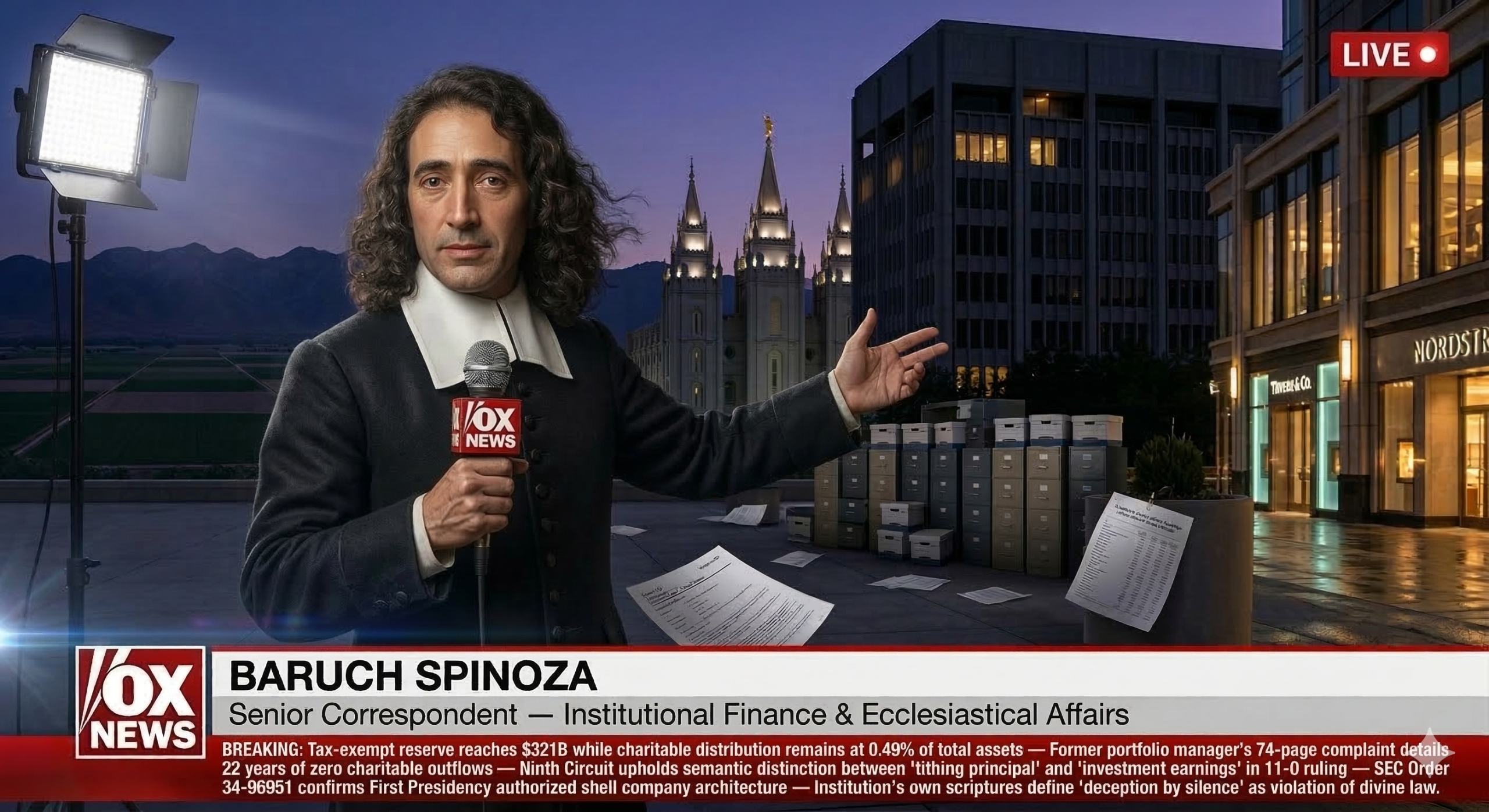
For here is an institution that professes to be the restored Church of Jesus Christ on earth. It commands its adherents to love God and neighbor, to succor the poor and afflicted, to build Zion as a community of equals bound by covenant. And yet this same institution has been discovered, by the testimony of its own former officers, to have accumulated over one hundred billion dollars in investment reserves across twenty-two years without a single distribution toward religious, educational, or charitable purposes—operating, in effect, as what one whistleblower rightly described as a clandestine hedge fund masquerading as a tax-exempt charity. The reserve has since swelled to an estimated $231 billion in investment holdings and $321 billion in total assets, generating $25 billion in pure market profit in a single year, while its publicized charitable output of $1.58 billion represents less than half of one percent of its total wealth.
Spinoza would not have been surprised. He diagnosed the mechanism with surgical precision in 1670: “Inquiry into the cause of this anomaly leads me unhesitatingly to ascribe it to the fact, that the ministries of the Church are regarded by the masses merely as dignities, her offices as posts of emolument—in short, popular religion may be summed up as respect for ecclesiastics. The spread of this misconception inflamed every worthless fellow with an intense desire to enter holy orders, and thus the love of diffusing God’s religion degenerated into sordid avarice and ambition. Every church became a theatre, where orators, instead of church teachers, harangued, caring not to instruct the people, but striving to attract admiration.” The temple became a theatre. The storehouse became a vault. The shepherd became an apex rent-extractor. The pattern is structural, not biographical. It recurs wherever endowed religion meets conditions of scale, low donor monitoring, and concentrated administrative authority.
II. Superstition’s Chief Victims
The foundation of the LDS financial architecture rests on a mechanism that Spinoza identified as the very engine of religious exploitation: the yoking of eternal salvation to compulsory financial extraction under conditions of fear. The institution conditions temple worthiness—and therefore eternal family bonds, celestial marriage, and the highest degrees of salvation—on the mandatory payment of ten percent of one’s income as tithing. Without a current temple recommend, verified by ecclesiastical interviews that explicitly ask about full tithe-paying status, a member is barred from the rituals the Church teaches are necessary for exaltation.
Spinoza understood this machinery with absolute clarity. “Men would never be superstitious,” he writes, “if they could govern all their circumstances by set rules, or if they were always favoured by fortune: but being frequently driven into straits where rules are useless, and being often kept fluctuating pitiably between hope and fear by the uncertainty of fortune’s greedily coveted favours, they are consequently, for the most part, very prone to credulity.” And again: “Superstition’s chief victims are those persons who greedily covet temporal advantages; they it is, who (especially when they are in danger, and cannot help themselves) are wont with prayers and womanish tears to implore help from God: upbraiding Reason as blind, because she cannot show a sure path to the shadows they pursue.”
The tithing-temple mechanism is superstition in its chemically pure form. It operates not through the love of God but through the fear of eternal consequences—fear that one’s family will be separated in the hereafter, fear that one is unworthy, fear that disobedience will invite divine punishment. Spinoza wrote to Albert Burgh, his former student who had converted to Roman Catholicism: “In becoming a slave of this Church you have been guided less by the love of God than by the sole cause of superstition, namely the fear of hell.” He would say exactly the same of the worthiness regime that compels a widow living on social security to tithe before buying food, so that her offering may compound silently inside a $231 billion investment portfolio that her leaders have engineered elaborate corporate structures to conceal from her.
The crucial philosophical point is this: Spinoza does not condemn fear as a psychological weakness. He analyzes it as a political instrument. In the Preface to the TTP, he observes that “if, in despotic statecraft, the supreme and essential mystery be to hoodwink the subjects, and to mask the fear, which keeps them down, with the specious garb of religion, so that men may fight as bravely for slavery as for safety, and count it not shame but highest honour to risk their blood and their lives for the vainglory of a tyrant,” then the machinery of religious terror has achieved its administrative purpose. The LDS institution has perfected this mechanism. Its members do not experience tithing as taxation; they experience it as covenant faithfulness. They do not experience opacity as concealment; they experience it as sacred trust. The territory’s power, as one analyst of this institution has observed, lies precisely in the fact that its own inhabitants do not experience it as territory. They experience it as covenant.
III. The Roman Pontiff in Salt Lake City
Spinoza’s most devastating institutional analysis concerns the Roman papacy, and the parallel to the LDS corporate structure is exact. In Chapter XIX of the TTP, he traces how the Bishop of Rome gradually accumulated temporal power until he held dominion over kings and emperors: “When such a right was bestowed on the Pope of Rome absolutely, he gradually acquired complete control over the kings, till at last he himself mounted to the summits of dominion; however much monarchs, and especially the German emperors, strove to curtail his authority, were it only by a hair’s-breadth, they effected nothing, but on the contrary by their very endeavours largely increased it. That which no monarch could accomplish with fire and sword, ecclesiastics could bring about with a stroke of the pen.”
Now consider the Corporation of the President of The Church of Jesus Christ of Latter-day Saints—a corporation sole that holds ultimate governance authority over all ecclesiastical and temporal assets. Beneath it operates the Corporation of the Presiding Bishopric, managing administrative affairs. Beneath that, an Investment Policy Committee composed of the First Presidency and Presiding Bishopric governs the operations of Ensign Peak Advisors, a $231 billion investment manager classified as an “integrated auxiliary” under IRC §508(c), which until 2019 was entirely invisible to the public. Radiating outward from this center are thirteen dissolved Delaware shell companies, Agricultural Reserves Inc., Farmland Reserve Inc., Property Reserve Inc., City Creek Reserve Inc., Hawaii Reserves Inc., Deseret Management Corporation, Beneficial Financial Group, the Deseret News Publishing Company, KSL Broadcasting, Bonneville International Corporation, the BYU system, and LDS Charities—a corporate constellation that would make any Renaissance pope weep with admiration.
Spinoza wrote to Burgh: “If you’re willing to examine the histories of the church, so as to see how falsely the Popes transmit many things, and by what tricks the Bishop of Rome had himself made Prince of the Church 600 years after the birth of Christ, I don’t doubt that you will at length recover.” The Corporation of the President of the LDS Church accomplished the same feat in a fraction of the time. What the Roman pontiffs built over centuries through canon law, crusade, and excommunication, the Salt Lake hierarchy built in decades through corporate law, tax exemption, and the discipline of the temple recommend.
Spinoza identified the precise danger: “Whosoever wishes to take this right away from the sovereign power, is desirous of dividing the dominion.” The LDS institution has done something even more radical than dividing dominion—it has collapsed the distinction between ecclesiastical and sovereign power entirely. The same men who claim prophetic authority over the eternal salvation of sixteen million members also sit as the de facto board of directors of a $321 billion financial empire. There is no separation. There is no oversight. There is no mechanism by which the membership—whose sacrificial tithing created the seed capital for this fortune—can audit, direct, or even inquire about its disposition. The Corporation of the President is accountable to no earthly body. It files no Form 990. Its integrated auxiliaries are exempt from the transparency requirements that govern every other non-profit organization in the United States. This is not merely a church with investments. It is a quasi-sovereign financial state that happens to hold religious services.
IV. Opacity as Resin
Spinoza’s analysis of secrecy in governance, found in the Tractatus Politicus, provides the philosophical key to understanding why the LDS institution fought so desperately to preserve its invisibility—and why the 2019 whistleblower disclosure was experienced by the hierarchy as an existential threat.
“It is far better,” Spinoza writes, “for the right counsels of a dominion to be known to its enemies, than for the evil secrets of tyrants to be concealed from the citizens. They who can treat secretly of the affairs of a dominion have it absolutely under their authority, and, as they plot against the enemy in time of war, so do they against the citizens in time of peace.” And further: “The perpetual refrain of those who lust after absolute dominion is, that it is to the essential interest of the commonwealth that its business be secretly transacted, and other like pretences, which end in the more hateful a slavery, the more they are clothed with a show of utility.”
The whistleblower documents reveal that the primary risk identified by the institution’s top investment managers was not market volatility, not regulatory exposure, not even the ethical implications of hoarding charitable donations—it was the loss of their “invisibility cloak.” Opacity was not an accidental byproduct of institutional complexity. It was the vital resin holding the entire hierarchical power structure together. The thirteen shell companies—Elkfork Partners, Meadow Creek Investment Management, Glen Harbor Capital Management, and the rest, all incorporated in Delaware with Church employees installed as nominee managers—existed for one purpose: to prevent the public and the institution’s own membership from knowing how much money the Church possessed, because the leadership feared that transparency would discourage tithing.
The SEC confirmed this in Order 34-96951: the Church’s highest ecclesiastical leadership authorized the creation of the illicit shell corporations specifically to obscure the portfolio’s size from the public and its own membership, fearing transparency would negatively impact tithing donations. Read that again through Spinoza’s framework. The institution deliberately concealed material facts from its own donors—the very people whose sacrificial offerings created the fund—because it calculated that knowledge would reduce obedience. This is the precise architecture of what Spinoza calls despotic governance masked with the specious garb of religion.
And when the secrecy was broken? The institution did not reform. It rehardened. It paid a $5 million fine, dissolved the shell companies, consolidated its SEC filings—and then immediately began migrating its wealth into less transparent substrates: agricultural land, timberland, international real estate. By moving capital into hard assets that do not trigger Form 13F reporting requirements, the institution successfully circumvented the new transparency mandates, migrating its wealth back into the shadows by different means. The molecules that learned to be a clandestine hedge fund learned to be an apex agricultural conglomerate. The resins that sealed the old corporate shells became the raw material for new defenses.
Spinoza also observes, with characteristic acuity, that the people cannot be blamed for drawing incorrect conclusions when they are deliberately kept ignorant: “That the populace has no truth or judgment is not surprising, when the principal affairs of the dominion are conducted in secret, and they can only make conjectures from the few things that cannot be hidden. For to suspend judgment is a rare virtue. To wish, therefore, to conduct all affairs secretly, and to expect that the people will not judge wrongly of them, is the height of folly.”
The LDS membership was kept in darkness for twenty-two years. When they learned the truth, many drew exactly the conclusions the leadership feared. Tithing compliance declined. Faith crises multiplied. Lawsuits were filed. The leadership then had the audacity to characterize the resulting criticism as anti-religious persecution and the resulting lawsuits as bad-faith attacks on all charitable organizations. This is the pattern Spinoza identified in the behavior of the Pharisees: “the worst hypocrites, driven by the same fury they call zeal for divine justice, everywhere persecuted men distinguished by integrity and renowned for virtue, publicly denouncing their opinions and inflaming the savage multitude against them.”
V. The Semantic Fortress and the Flight from Conscience
When James Huntsman sued the Church for fraud—alleging that leadership had explicitly promised tithing would not be used for commercial enterprises, while in fact billions in tithing-derived funds were deployed to bail out the for-profit Beneficial Financial Group and construct the $1.4 billion City Creek Center mall—the institution’s legal counsel constructed what the forensic analysts aptly term a “semantic fortress.” The defense rested on an internal accounting distinction between “tithing principal” and “the earnings on invested reserve funds.” While the principal came from tithing, the Church argued that the earnings generated by investing that tithing were classified as commercial income, and thus using those earnings for the mall did not constitute using “tithing.”
The Ninth Circuit validated this distinction in a unanimous 11-0 ruling, and the concurrent invocation of the First Amendment “church autonomy doctrine” established that civil courts are constitutionally barred from evaluating how a religion interprets its own doctrines regarding the utilization of sacred donations.
Spinoza would recognize this maneuver instantly. It is a species of what he calls the corruption of language by institutional power—the substitution of technical definitions for plain speech, so that words no longer mean what ordinary people understand them to mean. When the Church told its members that “not one penny of tithing” went to commercial purposes, every reasonable person understood this as a promise that their sacred donations would be used for religious and charitable ends. The semantic fortress retroactively redefines “tithing” to mean only the physical dollar bills originally deposited, not the billions those dollars generated through decades of compound investment returns. This is what Spinoza would identify as a species of deliberate moral indirection—what the Church’s own scriptures condemn as “lying a little” and “taking advantage of others through words.”
The deeper philosophical problem is the one Spinoza poses when he asks: when does prudence become self-justifying? When does the language of stewardship cease to mediate pastoral obligation and begin to fortify reserve accumulation as its own good? The internal documents from the whistleblower file are telling on this point. One slide titled “The Role of Ensign Peak Advisors” braids together spiritual language and reserve-management objectives in the same institutional vision: “stewardship in the Lord’s storehouse” and “balance wealth growth and preservation of principal,” on the same slide, under the same governance. The issue is not simple hypocrisy. It is a productive logic in which spiritual legitimacy and financial administration have become tightly interwoven. The very act of accumulating, guarding, and growing the reserve feels, from inside, like faithfulness.
This is the heart of what Spinoza would diagnose. The institution has learned to experience reserve management as sacred stewardship. The bureaucratic act of indefinite hoarding has been transmuted, through theological rhetoric, into a simulated act of religious obedience—preparation for the Second Coming, readiness for global calamity, prudence in the Lord’s storehouse. Apologetic sources argue that under the tax code, “any religious purpose is a charitable one by definition, including saving against the Second Coming of Jesus Christ.” Spinoza would observe that this rhetoric successfully indefinitely postpones charitable distribution—for one cannot be faulted for hoarding when the justification is an event that may arrive tomorrow or in ten thousand years. The eschatological horizon functions as the perfect alibi for avarice.
VI. Avarice and Ambition Under Sacred Cover
In the Ethics, Part III, Spinoza defines avarice plainly: “the excessive desire and love of riches.” He observes that avarice, ambition, and fear are not contrary to each other but often coexist in the same person or institution: “An avaricious man often is glad to gorge himself with food and drink at another man’s expense. An ambitious man will restrain himself in nothing, so long as he thinks his indulgences are secret.” The key insight is that avarice and ambition are species of desire—they are not reasoned positions but affects, confused ideas whereby the mind affirms a force for existence greater or less than before. They cannot be overcome by argument alone. They can only be displaced by a stronger affect—by a greater love, a more vivid understanding, a more powerful idea of what it means to live well.
The LDS financial apparatus exhibits avarice in its institutional form. The $321 billion is not being accumulated by any single individual; it is being accumulated by a corporate structure that has developed its own momentum, its own logic of self-preservation, its own appetite for growth. The institution generates $25 billion per year in investment returns alone, independent of the $7 billion in annual tithing. It has become a self-sustaining financial organism. Member donations represent a decreasingly relevant fraction of annual revenue. The institution has transitioned from a believer-supported parish to what can only be described as a quasi-sovereign asset manager operating under the protective umbrella of a religious tax exemption.
And yet the rhetoric of sacrifice remains. Every Sunday, members are reminded of their obligation to tithe. Every temple recommend interview, the question is asked. Every General Conference, the language of stewardship is deployed. The widow’s mite continues to flow into a $231 billion investment pool because the institution has arranged its communications so that the membership cannot see the denominator—only the numerator of charitable output is displayed, carefully curated through annual reports filled with high-quality photography of geographic diversity, missionaries engaging with marginalized populations in Africa, Asia, and Latin America, massive numbers of volunteer hours and humanitarian projects.
Spinoza understood that this kind of managed ignorance is not merely unjust—it is a form of spiritual violence. His philosophy insists that adequate knowledge is the foundation of virtue, and that confused ideas are the foundation of bondage. To deliberately maintain confusion in the minds of one’s constituents—to engineer information asymmetry as a governance principle—is to hold them in intellectual servitude. The Fourth Part of the Ethics is titled “Of Human Bondage, or the Strength of the Emotions.” The bondage Spinoza describes is not political imprisonment; it is the condition of being governed by inadequate ideas, by confused affects, by passions that one does not understand. The LDS institution produces this bondage systematically. It cultivates what the forensic analysts call “managed ignorance”—a condition in which the faithful are given enough information to feel satisfied but never enough to calculate the ratio between what they give and what the institution actually distributes to the poor.
VII. The Arithmetic Trap and the Commensurate Test
The most delicious irony of the institution’s post-2019 strategy—and here one can almost hear Spinoza’s dry amusement—is that its very attempt to repair its reputation has forged the weapon required for its regulatory destruction. By stepping into the light to showcase $1.58 billion in charitable spending, the Church has supplied the precise numerator for a calculation it has spent decades preventing anyone from performing. The forced consolidation of SEC filings has supplied the denominator. The arithmetic is devastating: charitable output represents 6.3% of annual investment profit and 0.49% of total assets. Traditional private foundations are mandated by federal law to distribute a minimum of 5% annually. The Church distributes less than one-tenth of that standard.
This is the “arithmetic trap”—and Spinoza, who demonstrated the Ethics in the geometric manner, who believed that truth reveals itself through the clarity of mathematical reasoning, would appreciate both the mechanism and the justice. The institution’s own transparency has made the case against it. Its curated philanthropy has provided the very evidence that its charitable activities are radically disproportionate to its financial capacity.
Spinoza would not frame this in moral terms alone. He would frame it structurally. In the Tractatus Politicus, he writes: “A commonwealth does wrong when it does or permits things that may be the cause of its own ruin.” The LDS institution has arranged its affairs so that its continued hoarding creates compounding regulatory, political, and theological risks. The U.S. Senate Finance Committee is investigating the exploitation of tax loopholes by ultra-wealthy entities. The IRS “commensurate test” hangs over the institution like a sword. If legislative reform strips integrated auxiliaries above a certain asset threshold of their Form 990 exemptions, the entire $321 billion enterprise would be exposed to the full transparency regime of ordinary public charities. The institution’s own success—its relentless, unimpeded capital accumulation—has made it too large to hide and too wealthy to justify.
VIII. The Agricultural Landlord and the Water Crisis
The institution’s strategic migration of capital from public equities into agricultural real estate reveals another dimension that Spinoza would analyze with precision: the transformation of abstract financial power into physical territorial dominion, and the contradictions this exposes.
Farmland Reserve, an integrated auxiliary, executed a $289 million all-cash acquisition of 46 farms comprising 41,554 acres across eight states. The institution now controls an estimated 1.7 to 2.5 million acres of agricultural land in the United States, rivaling or surpassing Bill Gates and Ted Turner. It has invested over $60 million in California nut orchards—crops notorious for intensive water consumption during prolonged droughts. In Arizona, its vast operations require massive groundwater pumping in regions already experiencing severe land subsidence and aquifer depletion.
Meanwhile, the Church Newsroom publicizes programs to install “smart controllers” at local chapels, allegedly saving 500 million gallons of water across the Intermountain West. The pastoral cover of “feeding the world” and micro-conservation sits in ludicrous contrast to the macro-economic reality of its subsidiaries engaging in industrial-scale water extraction that physically threatens the communities surrounding its mega-farms.
Spinoza, who ground lenses for a living and understood the relationship between precision work and material reality, would cut through this rhetoric immediately. He would identify it as a species of what he calls “the external worship that flatters rather than adores God”—a religion of outward display that has no connection to inner virtue or actual justice. The institution preaches environmental stewardship while its subsidiaries deplete aquifers. It preaches care for the poor while its corporate farming operations accelerate the displacement of family farmers by converting the agricultural economy from crop-share agreements, where landlord and farmer share risk, to strict cash-rent models, where the tenant assumes all operational and climate risk while the corporate landlord guarantees its fixed income.
In the Tractatus Politicus, Spinoza warns against institutions that treat their subjects “not as citizens but as cattle.” The cash-rent agricultural model does precisely this to the tenant farmers of rural America. The Church is not a spiritual shepherd in these transactions. It is an apex corporate landlord extracting rent to feed a centralized, hundred-billion-dollar treasury that it tells its own members exists to prepare for the Second Coming.
IX. International Contagion and the Tributary Pipeline
Spinoza, who lived in a small republic that traded across the globe, understood the vulnerabilities created by cross-border operations. The LDS institution’s international architecture reveals the pattern of tributary extraction that would have been perfectly legible to a seventeenth-century Dutch observer familiar with the mechanics of colonial finance.
In Australia, a formal government inquiry has received testimony alleging that the Church engages in a sophisticated tax-deduction arbitrage scheme—routing domestic donations through “LDS Charities Australia” to claim tax deductions, while simultaneously transferring matching funds from the central U.S. reserves to artificially satisfy domestic charity requirements, effectively laundering Australian tithes to be upstreamed back to the central reserve in Utah. The alleged cost to the Australian treasury: $750 million in illicit tax deductions.
In Canada, forensic accounting exposed that the LDS Church in Canada moved more than $1 billion in tax-advantaged Canadian tithing across the border to Brigham Young University over a fifteen-year period, costing the Canadian treasury an estimated $280 million in lost revenues. International congregations function not as localized centers of community relief, but as tributary pipelines designed to fund centralized U.S. institutional assets.
In the United Kingdom, the Charity Commission imposes stringent reporting requirements. The LDS Church in the UK reported £87.83 million in income against £85.31 million in expenditures for the financial year ending December 2024—strict parity that leaves no room for the opaque pooling and indefinite sequestration practiced by the American headquarters. The UK regulatory environment possesses formidable statutory powers to remove trustees, freeze assets, and institute binding inquiries.
The pattern is what Spinoza would call the institution’s necessary adaptation to varying degrees of external constraint. Where sovereignty protects it—in the United States, behind the First Amendment and the church autonomy doctrine—the institution hoards without limit. Where sovereignty constrains it—in the UK, under the Charities Act—it spends what it collects. The institution does not possess a fixed nature with respect to charity. Its charitable behavior is a function of the regulatory pressure applied to it. This is not stewardship. It is strategic compliance.
X. Blocked Voice and the Death of Internal Reform
Spinoza’s political philosophy hinges on the relationship between voice and exit. In a healthy republic, citizens can speak freely, criticize authority, and participate in governance. When voice is blocked, only two options remain: silent loyalty or total exit. The LDS institution has engineered precisely this condition.
The Ninth Circuit’s Huntsman ruling, combined with the church autonomy doctrine invoked in the Tenth Circuit Gaddy case, has established that civil courts cannot evaluate how the Church interprets its own doctrines regarding the use of sacred donations. No donor fraud claim can survive this defense. The semantic fortress is legally impregnable. The membership has no legal mechanism to hold the central treasury accountable, no standing to demand an accounting, no right to know how their contributions are invested, and no institutional channel through which to express dissent. The temple recommend interview asks whether the member sustains the leadership. To answer no is to begin the process of one’s own exclusion.
Spinoza observes in the Tractatus Politicus that “nature is one and common to all. But we are deceived by power and refinement.” The same vices that mark the powerful mark the common people—but the powerful disguise their arrogance with luxury, extravagance, and “a certain harmony of vices, and a learned sort of foolishness, and an elegance of baseness,” so that “vices which, viewed singly, appear foul and base, appear honorable and becoming to the ignorant and inexperienced.” The LDS institution’s financial operations are adorned with precisely this elegance of baseness—the language of stewardship, the imagery of pastoral care, the massive annual reports filled with photographs of smiling children in developing countries, the Giving Machines in 107 cities, the $1.58 billion humanitarian budget that represents less than half a percent of the institution’s wealth.
XI. What Remains of Religion
Spinoza writes: “I make this chief distinction between religion and superstition, that the latter is founded on ignorance, the former on knowledge.” And: “Nothing safeguards the republic better than placing piety and religious worship in works alone, that is, in the sole exercise of charity and justice, and allowing everyone freedom of judgment in all other matters.”
True religion, for Spinoza, consists entirely in the practice of justice and charity. It requires no mysteries, no ceremonies, no intermediary priesthood, no temple rituals, no worthiness interviews, and certainly no $231 billion investment reserve waiting for the Second Coming. True religion is the adequate understanding of God—which for Spinoza means Nature, the infinite substance of which we are all finite modes—and the love that necessarily follows from that understanding. “For him who is truly wise, Blessedness is not the reward of virtue, but virtue itself.”
The LDS institution has constructed precisely what Spinoza identified as the perversion of religion: “Of the old religion nothing survives but its outward forms (even these, in the mouth of the multitude, seem rather adulation than adoration of the Deity), and faith has become a mere compound of credulity and prejudices—aye, prejudices too, which degrade man from rational being to beast, which completely stifle the power of judgment between true and false, which seem, in fact, carefully fostered for the purpose of extinguishing the last spark of reason!”
The $321 billion reserve is not an instrument of justice or charity. It is a monument to the transformation of pastoral obligation into institutional self-preservation—the very process Spinoza diagnosed in every endowed religion he studied. The storehouse was meant to metabolize wealth into healing. Instead, the storehouse has become a locked vault, the shepherd has become a landlord, the prophet has become a portfolio manager, and the faithful have been reduced to cattle who tithe in hope and silence because they have been taught that questioning the management of their sacred offerings is indistinguishable from questioning God.
XII. The Verdict of Immanence
Spinoza would not write a prosecution. That is not how he operates. He would write an analysis on the plane of institutional immanence—from within the productive logic of the institution itself—and show that the reserve-body is destroying itself by its own principles.
The institution teaches that lying is deception, including deception by silence and telling only part of the truth. The institution practices systematic financial concealment.
The institution teaches that the Lord’s storehouse exists to succor the poor and afflicted. The institution hoards $321 billion while distributing 0.49% of its assets.
The institution teaches environmental stewardship. Its subsidiaries pump aquifers dry.
The institution teaches that priestcraft—the pursuit of institutional gain without prioritizing the welfare of Zion—is among the gravest of sins. The institution operates as an apex-level institutional investor under the protective umbrella of a religious tax exemption.
The institution teaches that unrighteous dominion is incompatible with priesthood authority. The institution conditions eternal salvation on the mandatory payment of tithes while concealing the destination, scale, and necessity of those funds.
The reserve-body is not merely failing to live up to its ideals. It is systematically violating every moral standard it claims to uphold. Spinoza would call this institutional ischemia—a condition in which the relentless accumulation of resources at the center starves the extremities of the organism, causing the spiritual tissue to necrotize. The institution has built a flawless architecture for capital accumulation, but its refusal to metabolize that wealth into commensurate, life-giving distribution is killing it from the inside.
“Away with this pernicious superstition!” Spinoza wrote to Burgh. “Recognize the reason God has given you, and cultivate it, unless you want to be considered one of the brute animals. Stop calling absurd errors ‘mysteries,’ and don’t shamefully confuse things that are unknown to us with things that are demonstrated to be absurd.”
The $321 billion is not a mystery. It is an arithmetic fact. The 0.49% distribution rate is not a sacred judgment. It is a measurable failure of charity. The thirteen shell companies were not administrative errors. They were a deliberate scheme to deceive. The semantic fortress that distinguishes “tithing principal” from “investment earnings derived from tithing” is not a theological insight. It is a legal fiction designed to evade accountability.
Spinoza’s verdict would be delivered without anger, without prosecution, and without any expectation that denunciation alone changes anything. He would observe, coolly, that large institutions often survive exposure by hardening, reorganizing affiliates, tightening loyalty demands, and converting crisis into managerial learning. There is no guarantee that catalysis produces justice. There is only the structural claim that when an institution’s old arrangement loses its air of inevitability—when the invisibility cloak is torn away and the arithmetic is visible to all—a field of possibilities opens. That field includes reform, redistribution, renewal, and also a more sophisticated opacity on the other side.
The reserve does not end. It is redistributed. Whether that redistribution serves life or merely fortifies the structure depends on what happens in the passage—and that question, finally, is not for the philosopher to answer. It is for the members, the institution, and the field of forces between them.
But this much Spinoza would say with absolute confidence: an institution that hides from its own theological conscience, that builds an administrative labyrinth to flee from the radical demands of the gospel it claims to champion, that yokes eternal salvation to compulsory payment while hoarding the proceeds behind corporate shells and semantic fortresses—such an institution has departed from religion entirely, and entered the domain of what he calls, with his characteristic precision, sordid avarice and ambition dressed in the specious garb of piety.
The true aim of government is liberty. The true content of religion is justice and charity. Everything else is superstition, and superstition is engendered, preserved, and fostered by fear.
All passages attributed to Spinoza are drawn from the Theologico-Political Treatise (TTP), the Political Treatise (TP), the Ethics, and the Correspondence, as contained in the project corpus. All factual claims regarding the LDS financial apparatus are drawn from the uploaded research documents.