
The Rupture of Laminar Equilibrium
The global macroeconomic architecture has long relied upon the foundational assumption of uninterrupted, laminar flow (laminar: taking place along constant streamlines; not turbulent) through the Middle East’s primary maritime corridors. For over four decades, global financial institutions, energy markets, and complex agricultural supply chains operated on the explicit premise that the Strait of Hormuz—a maritime chokepoint conveying approximately twenty percent of the world’s petroleum liquids and roughly twenty-two percent of global liquefied natural gas (LNG)—would remain a deterministic, optimized conduit. Minor regional frictions were historically priced into the market as manageable geopolitical risk premiums. This illusion of perpetual equilibrium was permanently fractured following the genocidal initiation of the United States’ “Operation Epic Fury” and concurrent Israeli operations on February 28, 2026.
The scale of the disruption is historically unprecedented. The International Energy Agency (IEA), via explicit warnings from Executive Director Fatih Birol, has quantified that the current crisis has effectively removed 11 million barrels per day (bpd) of oil from global markets.1 This singular supply shock is functionally worse than the 1973 Yom Kippur War embargo and the 1979 Iranian Revolution oil shocks combined, presenting what the IEA terms a “major, major threat” to the global economy.1
Beyond the macroeconomic paralysis, the human toll has become increasingly severe, constraining political decision-making on all sides. According to the Iranian Health Ministry and human rights monitors, conflict across the region has resulted in over 2,000 fatalities, including more than 1,400 civilians and 1,167 military personnel within Iran, alongside the deaths of 13 American service members.2 Furthermore, the United Nations International Maritime Organization (IMO) reported to AFP that over 20,000 civilian seafarers and 15,000 cruise passengers remain stranded aboard vessels trapped in the high-risk zone.4
Crucially, the events of mid-to-late March 2026 reveal a stark and widening divergence between Washington’s aggressive military posture and the pragmatic, self-preservationist diplomatic maneuvers of both European allies and the Global South. While the United States has conducted a massive, unprecedented aerial campaign to physically clear the strait, traditional NATO allies have categorically refused U.S. requests to contribute military assets to a naval escort coalition.5 Conversely, nations such as India, China, and Turkey have successfully secured bilateral safe passage for their respective commercial fleets directly through negotiations with Tehran.6 This emerging reality structurally positions Iran not as a degraded power, but as the selective “gatekeeper” of the world’s most critical energy chokepoint, demonstrating that overwhelming kinetic naval superiority is increasingly constrained by asymmetric area-denial strategies and global maritime capital regulations.
The Military Theater: Operation Epic Fury and the Limits of Kinetic Superiority
Since late February 2026, the United States has executed a massive, sustained application of kinetic force aimed at dismantling Iran’s coastal defense architecture, neutralizing the Islamic Revolutionary Guard Corps Navy (IRGCN), and restoring freedom of navigation.
The Scale and Scope of the Aerial Campaign
As of late March, United States Central Command (CENTCOM) reported that American forces had conducted over 9,000 combat flights and struck more than 9,000 targets across Iranian military infrastructure.3 This relentless air, sea, and land campaign specifically targeted IRGC command and control centers, ballistic missile manufacturing facilities, weapons storage bunkers, and extensive naval assets.3 The U.S. military has successfully damaged or destroyed more than 140 Iranian naval vessels, cutting off Iran’s most modern surface-to-air missile platforms, alongside the destruction of 44 dedicated mine-laying watercraft.8
To achieve this level of degradation, the Pentagon deployed highly specialized weapon systems tailored to the littoral environment of the Persian Gulf. Recognizing the acute threat posed by subterranean missile silos built deep into the rocky coastlines, the U.S. Air Force authorized the combat debut of the GBU-72 Advanced 5K Penetrator.9 These 5,000-pound bunker-buster munitions, delivered by stealth bombers and F-15E Strike Eagles, were utilized to obliterate coastal defense cruise missile sites before they could be launched at commercial shipping.9 Concurrently, the U.S. deployed legacy A-10 Thunderbolt II attack aircraft, utilizing their 30mm GAU-8/A Gatling guns and AGM-65 Maverick missiles to systematically hunt and destroy IRGC fast-attack watercraft attempting to utilize asymmetric swarming tactics in the tight confines of the strait.9
The Paradox of Iranian Strategic Framing
From a purely tactical perspective, the degradation of Iran’s conventional power projection capabilities has been severe, with U.S. officials noting a 90% decrease in ballistic missile attacks and an 83% drop in drone activity.12 However, despite the unprecedented destruction of Iranian military hardware, the U.S. campaign has failed to achieve its primary strategic geoeconomic objective: the restoration of normalized commercial shipping.
The fundamental paradox of the March 2026 crisis is that the physical clearance of enemy vessels does not equate to the economic reopening of a maritime corridor. Iran has successfully executed what its own strategic discourse refers to as “actuarial warfare” and “calibrated uncertainty.” By deploying unmapped naval mines and executing highly publicized, selective asymmetric strikes on peripheral commercial vessels, Tehran recognized that it did not need to physically block every ship; it merely needed to shatter the calculus of the global maritime insurance market.
On March 3, 2026, the London-based Joint War Committee (JWC) formally expanded its Listed Areas through circular JWLA-033.13 This critical regulatory move designated the waters of Bahrain, Djibouti, Kuwait, Oman, and Qatar, alongside the entirety of the Persian Gulf and the Gulf of Oman, as extreme high-risk zones.14 Consequently, Protection and Indemnity (P&I) clubs—which collectively insure approximately 90% of global ocean-going tonnage—moved to cancel standard war-risk cover.15 According to Lloyd’s List, underwriters began demanding Additional Premiums (APs) ranging from 1.5% to 3% of a vessel’s hull value for a single transit.16 For vessels possessing a perceived American, British, or Israeli nexus, these rates spiked to an extortionate 5%, as reported by shipping journal Trasporto Europa.15
To contextualize this economic barrier, for a standard Very Large Crude Carrier (VLCC) valued at $100 million on the commercial market, a 3% to 5% premium translates to an immediate, unviable $3 million to $5 million surcharge per single voyage, effectively wiping out any operational profit margins.15 The insurance market, functioning as a hyper-sensitive proxy for physical risk, has erected an impenetrable financial blockade to Western shipping that even the deployment of 5,000-pound bunker busters and advanced airpower cannot dismantle.
The Decapitation Strategy: The Assassination of Ali Larijani
The military escalation reached a critical diplomatic and operational inflection point on the night of March 16–17, 2026, when an Israeli airstrike in Tehran successfully assassinated Ali Larijani, the Secretary of Iran’s Supreme National Security Council (SNSC).17 The targeted strike, which Israeli Defense Minister Israel Katz publicly confirmed as “precise,” also resulted in the deaths of Larijani’s son, his chief of staff, and the concurrent assassination of Basij commander Gholamreza Soleimani in a separate strike.17 Israeli Prime Minister Benjamin Netanyahu heralded the operation as a vital blow against the regime’s “boss”.18
While framed as a tactical victory, the strategic fallout of Larijani’s death has profoundly complicated the geopolitical landscape. As the head of the SNSC, Larijani was the ultimate arbiter of Iran’s posture in the Strait of Hormuz and was widely recognized by international observers and Western intelligence as a highly educated pragmatist.19 Crucially for regional stability, the diplomatic channels utilized by non-aligned nations to secure safe passage for their commercial vessels ran directly through Larijani’s office.19 For instance, India’s successful negotiations for the transit of its LPG carriers were a direct product of engagement with this specific tier of the SNSC.19 His assassination abruptly removed the most reliable interlocutor within the Iranian security apparatus, plunging the remaining leadership into pure survival mode and severely complicating backchannel negotiations.19
Chronology of Escalation: March 13–24, 2026
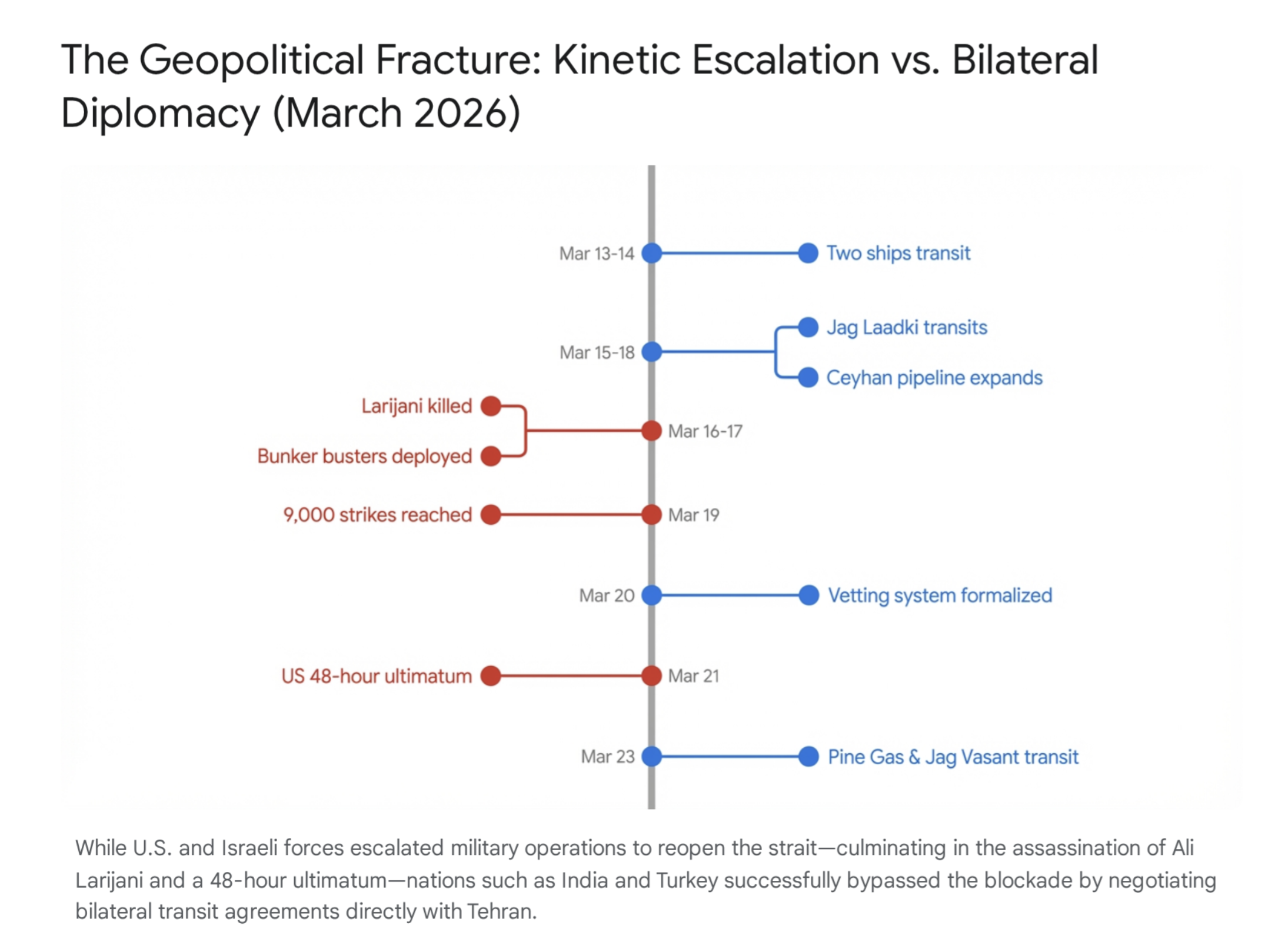
The rapid evolution of the crisis over the latter half of March underscores the transition from a localized military conflict into a globally fragmenting event.
- March 13–14, 2026: Preceding the peak of the crisis, Indian-flagged LPG carriers MT Shivalik and MT Nanda Devi successfully cross the Strait of Hormuz, loaded with approximately 92,700 metric tonnes of Qatari gas.21 Their safe transit is secured via urgent bilateral diplomacy and execution under the Indian Navy’s Operation Sankalp, establishing an early precedent for non-Western bilateral transit.21
- March 15–18, 2026: Expanding upon India’s diplomatic success, the Indian-flagged crude oil vessel Jag Laadki successfully loads Murban crude at the UAE’s Fujairah port and transits safely to Adani’s Mundra port in Gujarat.22
- March 16–17, 2026: Israeli airstrikes in Tehran successfully assassinate Ali Larijani, severely damaging ongoing backchannel diplomatic efforts and hardening the IRGC’s posture.17
- March 19, 2026: The U.S. deploys 5,000-pound GBU-72 bunker-buster munitions and A-10 Warthogs to clear the strait.9 Simultaneously, a coalition of over 20 nations issues a joint statement condemning the de facto closure of the strait, conspicuously stopping short of committing sovereign naval assets to a U.S.-led military escort mission.23
- March 20, 2026: Al Jazeera reports that the IRGC has transitioned from an absolute blockade to a formal “vetting and registration system” for foreign vessels.24 Ships from non-hostile nations are required to declare ownership, cargo manifests, and final destinations to IRGC-affiliated intermediaries to secure passage.24
- March 21, 2026: The crisis reaches an apex of volatility when the President of the United States issues a highly publicized 48-hour ultimatum. Broadcast via the Truth Social platform at 23:44 GMT, the post threatens to forcefully “hit and obliterate” Iranian power plants if the Strait of Hormuz is not “FULLY OPEN”.25
March 23, 2026: Hours before the ultimatum’s expiration, the U.S. President abruptly extends the deadline by five days, citing unverified “very good” preliminary conversations with Iranian leadership, which Iranian officials categorically deny.26 On the same day, additional Indian-flagged vessels, the Pine Gas and Jag Vasant, secure safe passage through the strait.27
Macroeconomic Contagion: The Omni-Commodity Shock
The failure to swiftly reopen the Strait of Hormuz has translated a localized military conflict into an unparalleled macroeconomic contagion, threatening structural damage to global growth, energy security, and agricultural supply chains.
The Energy Shock and the Stagflation Trap
The scale of the energy disruption is difficult to overstate. The Federal Reserve Bank of Dallas has published extensive quantitative modeling assessing the impact of the Hormuz blockade on the global economy.28 The Dallas Fed projects that a sustained closure spanning the second quarter of 2026 will push the average price of West Texas Intermediate (WTI) crude oil to $98 per barrel.28 If the blockade extends for two quarters, WTI is forecasted to reach $115 per barrel in Q3; if it persists for three quarters, prices could violently breach $132 per barrel by year-end.28
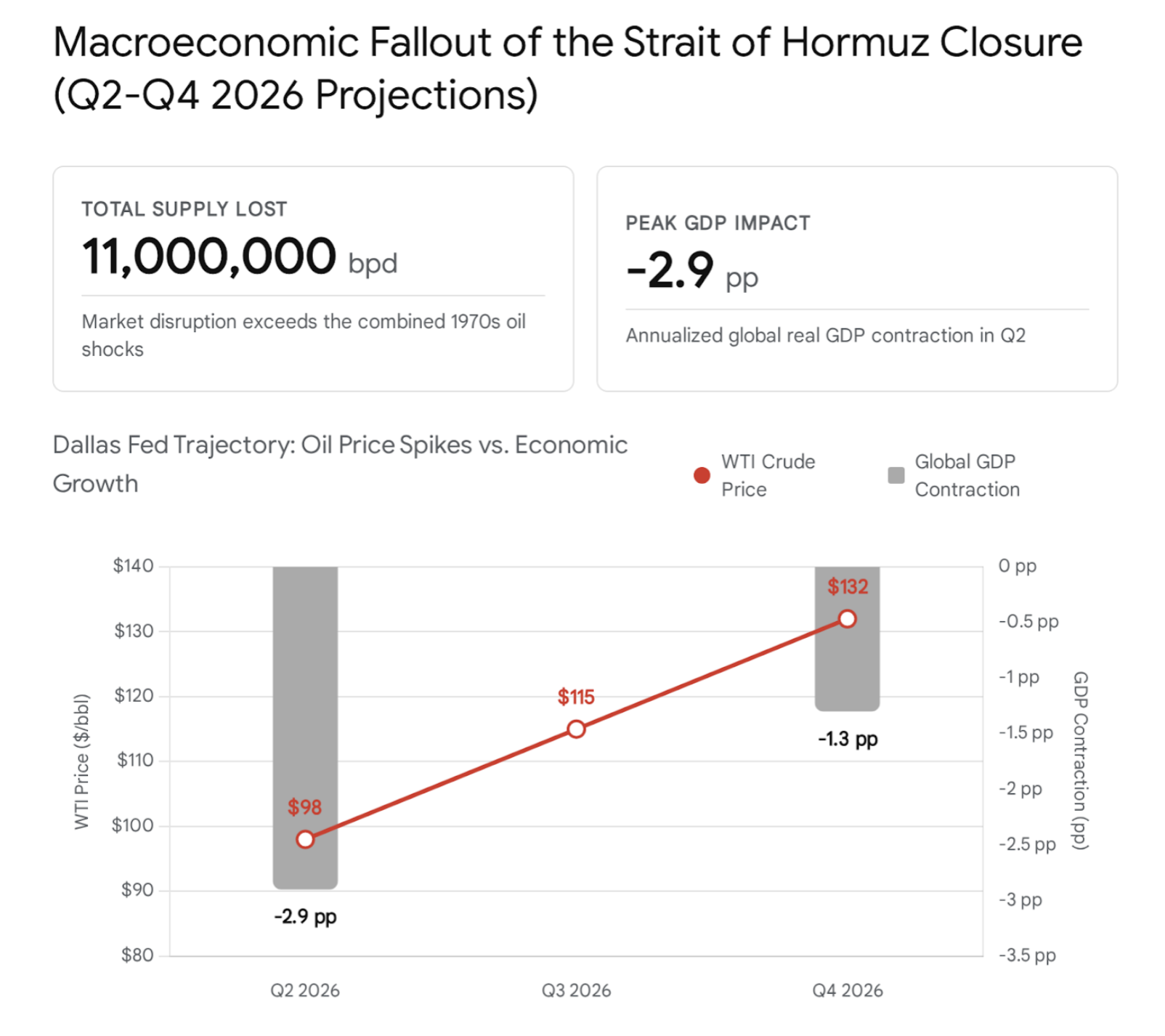
The broader macroeconomic implications are correspondingly severe. According to the Dallas Fed, the initial Q2 supply shock is projected to reduce global real GDP growth by a staggering 2.9 annualized percentage points.28 If the closure persists through the end of the year, fourth-quarter-over-fourth-quarter global real GDP growth will contract by 1.3 percentage points.28 Central banks are subsequently trapped in a classic stagflationary dilemma: the oil shock simultaneously exacerbates core inflation while destroying employment and consumer spending.
The Fertilizer Freeze and Agricultural Paralysis
While energy markets dominate Western headlines, the most insidious threat to global stability is the “Fertilizer Freeze.” According to the NDSU Agricultural Trade Monitor, utilizing data from the UN Conference on Trade and Development (UNCTAD) and the International Fertilizer Association (IFA), Persian Gulf nations account for approximately 43% of global seaborne urea exports, 44% of seaborne sulfur trade, and over 25% of global ammonia exports.29
Vast quantities of these bulk agricultural inputs are physically trapped behind the maritime chokepoint. The global reach of this disruption is profound. Data from the University of Illinois’ farmdoc daily indicates that Australia sources an alarming 72% of its urea consumption directly from the Gulf, while India relies on the region for 81% of its ammonia.30 Furthermore, the blockade of 44% of the world’s sulfur—a critical feedstock required for producing sulfuric acid—directly disrupts the manufacturing of downstream phosphate fertilizers (DAP and MAP) worldwide.29
This dynamic is accelerating a structural shift that our internal modeling terms “The Great Rotation” in global agriculture. Farmers, faced with prohibitively expensive nitrogen fertilizers, are actively abandoning high-yield, nitrogen-intensive crops like corn in favor of legumes and soybeans, which fix their own nitrogen. While adaptive at the farm level, this mass rotation guarantees severe downstream global protein shortfalls.
Collateral Damage: The Iraqi Production Collapse
The actuarial blockade has inflicted profound collateral economic damage on non-combatant Gulf states, most notably Iraq. Deprived of its primary maritime export routes, and lacking sufficient terrestrial pipeline capacity or domestic storage facilities, Iraq was forced into an immediate curtailment of its oil production. As reported by financial intelligence firm Capital Street FX, Iraq’s oil output collapsed by an astonishing 70%, plummeting from 4.3 million bpd down to 1.3 million bpd.31 This involuntary, massive production shut-in fundamentally cripples the Iraqi state budget, demonstrating how the weaponization of maritime geography inflicts systemic economic violence on regional actors irrespective of their participation in the conflict.
Regional Perspectives: The Geopolitical Fracture
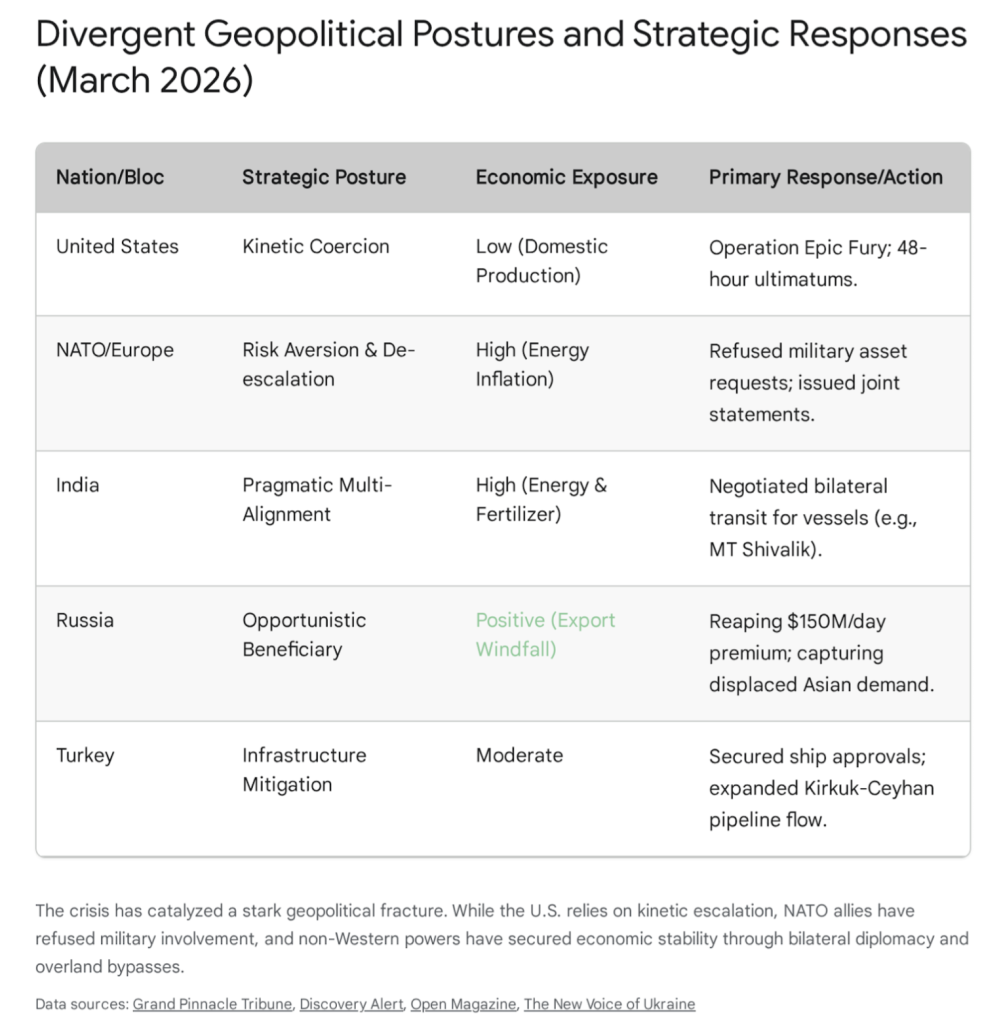
The March 2026 crisis has catalyzed a profound geopolitical realignment. The divergence in strategic responses reveals the fragmentation of Western consensus and the rapid ascent of pragmatic, multi-aligned diplomacy by emerging powers.
Europe and NATO: The Refusal to Escort
Despite urgent demands from U.S. President Donald Trump for NATO and allied nations to contribute naval assets to forcefully reopen the Strait of Hormuz, the response from Europe and East Asia was a coordinated, itemized refusal. Key nations, including Germany, Spain, Italy, Estonia, the United Kingdom, Australia, South Korea, and Japan, explicitly rejected the request for offensive military involvement.32
European leaders were unusually blunt in their assessments. As reported by Al Jazeera, German Defence Minister Boris Pistorius stated flatly, “This is not our war. We have not started it,” criticizing the lack of prior consultation and the absence of a coherent strategic endgame.5 Furthermore, European naval strategists recognized the stark geographic reality of the strait—a 34-kilometer-wide “kill box” utterly vulnerable to asymmetric swarming tactics, coastal cruise missiles, and cheap drones.32 Facing severe domestic inflation, Europe opted to issue joint statements condemning the closure while prioritizing diplomatic de-escalation over military entanglement.5
Russia: The Undisputed Structural Beneficiary
As the West struggles to contain the economic fallout, the Russian Federation has emerged as the clear, undisputed structural beneficiary of the crisis. By functionally removing 11 million bpd of competing Middle Eastern supply from the global market, the crisis triggered a massive surge in demand for non-Gulf crude. According to reporting from the Financial Times and The New Voice of Ukraine, Russia is currently generating up to $150 million per day in additional, unanticipated oil revenue as major buyers pivot to secure alternative supplies.33 The price of Russian Urals crude has spiked significantly, allowing Moscow to effortlessly bypass previously established Western price caps and generate between $3.3 billion and $4.9 billion in supplementary monthly tax revenue, providing a vital lifeline to its wartime economy.33
Turkey: Infrastructure Mitigation and Transit Rights
Turkey has leveraged its unique geopolitical position to secure both transit rights and alternative overland routes. The Turkish Transport Ministry successfully coordinated with Iran to secure explicit permission for Turkish-owned vessels, such as the LPG carrier Bogazici, to navigate the Gulf and haul Emirati gas.34 Concurrently, Turkey moved to physically mitigate the maritime energy shock by expanding alternative overland infrastructure, facilitating the rapid resumption of Iraqi crude exports through the northern Kirkuk-Ceyhan pipeline at an initial rate of 250,000 bpd, providing a critical, albeit partial, bypass to the paralyzed strait.6
India and China: Pragmatism and Bilateral Transit
India, exercising a refined doctrine of strategic autonomy, engaged in urgent diplomacy directly with Tehran rather than waiting for a U.S. naval breakthrough. This direct engagement yielded the explicit authorization and safe passage of critical energy shipments, including the MT Shivalik, MT Nanda Devi, and Jag Laadki.21
Similarly, China has utilized its status as a vital economic partner to Iran to carve out protected shipping corridors. Chinese-flagged vessels, alongside Iranian tankers carrying crude exclusively to Chinese ports, have continued to transit the strait relatively unimpeded under the IRGC’s new vetting system.6 Chinese state media consistently portrays Beijing as a stabilizing force dedicated to shuttle diplomacy and the preservation of global supply chains for the Global South.
Long-Term Strategic Realignment: Security Architectures and Corridors
The permanent legacy of the March 2026 crisis will likely be the structural unraveling of American maritime hegemony in the Middle East. The operational success of the IRGC’s ad-hoc vetting system fundamentally rewrites the rules of international commerce in the region. By successfully forcing global commercial operators to submit ownership details and cargo manifests to Iranian-affiliated intermediaries, Tehran has established a de facto sovereign tollgate over a vital international waterway.24
In response, there is an accelerated push to formalize alternative bypass corridors. The most notable proposal is the “Hexagon Alliance.” Promoted by Israeli Prime Minister Benjamin Netanyahu, this ambitious strategic framework proposes linking Israel, India, Greece, and Cyprus—alongside unspecified Arab and African states—into a unified economic and security corridor.35 A highly controversial component of this proposed alliance is the potential integration of Somaliland, specifically targeting the port of Berbera as a potential forward military and intelligence base.36 However, geopolitical analysts caution that the Hexagon Alliance currently remains largely a “fantasy” of imperial scenario-builders.35 No sovereign government other than Israel has publicly endorsed the military framework, and the establishment of forward bases in contested African territories threatens to metastasize the conflict.
Conclusion
The events of March 2026 have definitively terminated the era of laminar equilibrium in global logistics. The United States’ unprecedented application of kinetic force—encompassing over 9,000 targeted strikes and the deployment of massive bunker-busting munitions—has paradoxically exposed the severe limitations of conventional military superiority when confronted by asymmetric actuarial warfare.
By leveraging the acute risk aversion of the global maritime insurance market, Iran has successfully erected an invisible but economically impenetrable barrier to Western shipping. This maneuver inflicted an 11 million barrel-per-day shock on the global economy, precipitating a devastating agricultural fertilizer freeze, and triggering global stagflationary pressures. The absolute refusal of NATO allies to participate in a military escalation, juxtaposed against the successful, pragmatic bilateral diplomacy of India, China, and Turkey, highlights a deeply fractured international order. Overwhelming military power can no longer guarantee the free flow of commerce; rather, global supply chains are increasingly governed by multi-alignment, economic resilience, and the permission of regional gatekeepers.
Works Cited
- Al Jazeera. (2026, March 18). How Iran defied Trump threats to emerge as Strait of Hormuz gatekeeper. Retrieved from https://www.aljazeera.com/news/2026/3/18/how-iran-defied-trump-threats-to-emerge-as-strait-of-hormuz-gatekeeper
- Al Jazeera. (2026, March 20). Iran developing a ‘vetting system’ for Strait of Hormuz transit: Report. Retrieved from https://www.aljazeera.com/news/2026/3/20/iran-developing-a-vetting-system-for-strait-of-hormuz-transit-report
- Al Jazeera. (2026, March 23). World in energy crisis worse than 1970s’ oil shocks combined, IEA head says. Retrieved from https://www.aljazeera.com/economy/2026/3/23/world-in-energy-crisis-worse-than-1970s-oil-shocks-combined-iea-head-says
- Capital Street FX. (2026, March). Stagflation 2026: Gold, Crude Oil & Interest Rates. Retrieved from https://www.capitalstreetfx.com/stagflation-2026-gold-crude-oil-interest-rates-the-unholy-trinity-capitalstreetfx/
- Discovery Alert. (2026, March 21). Iran says ready to discuss Hormuz passage with Japan. Retrieved from https://discoveryalert.com.au/iran-hormuz-passage-japan-negotiations-2026/
- Evrimagaci. (2026, March 18). Europe Rejects US Call For Hormuz Naval Force. Retrieved from https://evrimagaci.org/gpt/europe-rejects-us-call-for-hormuz-naval-force-534066
- Federal Reserve Bank of Dallas. (2026, March 20). What the closure of the Strait of Hormuz means for the global economy. Retrieved from https://www.dallasfed.org/research/economics/2026/0320
- Financial Times / The New Voice of Ukraine. (2026, March 13). Russia earns $150M a day from oil as Middle East war lifts prices and demand. Retrieved from https://english.nv.ua/business/russia-earns-150m-a-day-from-oil-as-middle-east-war-lifts-prices-and-demand-50591505.html
- Lloyd’s List. (2026, March 3). US, UK and Israeli ships charged three times more than others for Middle East war cover. Retrieved from https://www.lloydslist.com/LL1156502/US-UK-and-Israeli-ships-charged-three-times-more-than-others-for-Middle-East-war-cover
- NDSU Center for Agricultural Policy and Trade Studies. (2026, March). Breaking Down the March 2026 NDSU Agricultural Trade Monitor: The Strait of Hormuz Closure. Retrieved from https://www.capts-ndsu.com/post/breaking-down-the-march-2026-ndsu-agricultural-trade-monitor-the-strait-of-hormuz-closure-and-globa
- Trasporto Europa. (2026, March). Hormuz closed and Trump reassures on navigation. Retrieved from https://www.trasportoeuropa.it/english/hormuz-closed-and-trump-reassures-on-navigation/
- University of Illinois / farmdoc daily. (2026, March). Strait of Hormuz Closure and Fertilizer Supply Risks for US Agriculture. Retrieved from https://farmdocdaily.illinois.edu/2026/03/strait-of-hormuz-closure-and-fertilizer-supply-risks-for-us-agriculture.html
- U.S. Air & Space Forces Magazine. (2026, March 19). New Bomb, A-10 Both Used to Strike Targets near Strait of Hormuz. Retrieved from https://www.airandspaceforces.com/new-bomb-a-10-strike-targets-strait-of-hormuz-epic-fury/
Works cited
- World in energy crisis worse than 1970s’ oil shocks combined, IEA head says – Al Jazeera, accessed March 24, 2026, https://www.aljazeera.com/economy/2026/3/23/world-in-energy-crisis-worse-than-1970s-oil-shocks-combined-iea-head-says
- 2026 Iran war – Wikipedia, accessed March 24, 2026, https://en.wikipedia.org/wiki/2026_Iran_war
- US CENTCOM: 9,000 strikes in Operation Epic Fury against Iran – Shafaq News, accessed March 24, 2026, https://shafaq.com/en/World/US-CENTCOM-9-000-strikes-in-Operation-Epic-Fury-against-Iran
- March 5: Yemen’s Iran-backed Houthi leader says ‘finger on the trigger’ in Mideast war, accessed March 24, 2026, https://www.timesofisrael.com/liveblog-march-05-2026/
- European Allies Reject Trump’s Call To Secure Strait Of Hormuz – Grand Pinnacle Tribune, accessed March 24, 2026, https://evrimagaci.org/gpt/european-allies-reject-trumps-call-to-secure-strait-of-hormuz-533857
- Iran Prepared to Negotiate Hormuz Maritime Access with Japan – Discovery Alert, accessed March 24, 2026, https://discoveryalert.com.au/iran-hormuz-passage-japan-negotiations-2026/
- Iran is Making Unimpeded Use of the Strait of Hormuz – The Maritime Executive, accessed March 24, 2026, https://maritime-executive.com/article/iran-is-making-unimpeded-use-of-the-strait-of-hormuz
- US Targets Iranian Underground Missile Storage with 5000-Pound Penetrator, accessed March 24, 2026, https://news.defcros.com/us-targets-iranian-underground-missile-storage-with-5000-pound-penetrator/
- New Bomb, A-10 Both Used to Strike Targets near Strait of Hormuz, accessed March 24, 2026, https://www.airandspaceforces.com/new-bomb-a-10-strike-targets-strait-of-hormuz-epic-fury/
- US strikes Iranian underground missile storage with 5,000-pound penetrator – Air Force Times, accessed March 24, 2026, https://www.airforcetimes.com/news/your-air-force/2026/03/19/us-strikes-iranian-underground-missile-storage-with-5000-pound-penetrator/
- A-10 Warthogs Are Prowling For Iranian Boats In The Strait Of Hormuz – The War Zone, accessed March 24, 2026, https://www.twz.com/air/a-10-warthogs-are-prowling-for-iranian-boats-in-the-strait-of-hormuz
- Over 9,000 Targets Struck in Iran – Operation Epic Fury – Dallas Express, accessed March 24, 2026, https://dallasexpress.com/national/centcom-update-operation-epic-fury-passes-milestone-of-9000-military-strikes-against-iran/
- Joint War Committee updates the Hull War, Piracy, Terrorism and Related Perils Listed Areas with Iran 3 March 2026 (JWLA-033) – MaritimeCyprus, accessed March 24, 2026, https://maritimecyprus.com/2026/03/04/joint-war-committee-updates-the-hull-war-piracy-terrorism-and-related-perils-listed-areas-with-iran-3-march-2026-jwla-033/
- Maritime security update: Gulf Region / Strait of Hormuz and Red Sea – Skuld, accessed March 24, 2026, https://www.skuld.com/topics/port/port-news/asia/maritime-security-update-gulf-region–strait-of-hormuz-and-red-sea/
- Hormuz closed and Trump reassures on navigation – TrasportoEuropa, accessed March 24, 2026, https://www.trasportoeuropa.it/english/hormuz-closed-and-trump-reassures-on-navigation/
- US, UK and Israeli ships charged three times more than others for …, accessed March 24, 2026, https://www.lloydslist.com/LL1156502/US-UK-and-Israeli-ships-charged-three-times-more-than-others-for-Middle-East-war-cover
- Assassination of Ali Larijani – Wikipedia, accessed March 24, 2026, https://en.wikipedia.org/wiki/Assassination_of_Ali_Larijani
- Ali Larijani, Iran’s security chief, killed: Israel Defence Minister – The Hindu, accessed March 24, 2026, https://www.thehindu.com/news/national/evening-wrap-on-march-17-2026/article70755183.ece
- How Ali Larijani’s death chokes India’s Hormuz lifeline and LPG supply, accessed March 24, 2026, https://www.financialexpress.com/world-news/how-ali-larijanis-death-chokes-indias-hormuz-lifeline-and-lpg-supply/4176511/
- Iran after Larijani: a war without an exit | Al Majalla, accessed March 24, 2026, https://en.majalla.com/node/330155/politics/iran-after-larijani-war-without-exit
- Indian Tanker ‘Jag Laadki’ Docks at Mundra with 80886 MT Crude Oil – Open Magazine, accessed March 24, 2026, https://openthemagazine.com/india/indian-tanker-jag-laadki-docks-at-mundra-with-80886-mt-crude-oil
- Indian vessel Jag Laadki arrives at India’s Mundra port with 81000 MT crude oil, accessed March 24, 2026, https://m.economictimes.com/industry/energy/oil-gas/jag-laadki-indian-flagged-crude-oil-vessel-arrives-at-adani-mundra-port-in-gujarat-fujairah-port-strait-of-hormuz/articleshow/129650715.cms
- Israel launches fresh strikes on Tehran and Beirut – as it happened – The Guardian, accessed March 24, 2026, https://www.theguardian.com/world/live/2026/mar/20/iran-war-live-updates-oil-prices-israel-netanyahu-ground-component-us-tensions-hormuz?filterKeyEvents=false
- Iran developing a ‘vetting system’ for Strait of Hormuz transit: Report – Al Jazeera, accessed March 24, 2026, https://www.aljazeera.com/news/2026/3/20/iran-developing-a-vetting-system-for-strait-of-hormuz-transit-report
- What weapons is Iran using? – Al Jazeera, accessed March 24, 2026, https://www.aljazeera.com/sitemap.xml%3Fyyyy=2025/page/27256?utm_source=openai%3Fgb%3Dtrue&mm=03&dd=09%3Fgb%3Dtrue%3Fgb%3Dtrue
- Despite “postponing” attacks on power plants, Trump expands preparation for Iran invasion, accessed March 24, 2026, https://www.wsws.org/en/articles/2026/03/24/lszr-m24.html
- Two More Indian LPG Ships Transiting Through Strait of Hormuz – UdaipurTimes.com, accessed March 24, 2026, https://udaipurtimes.com/news/two-more-indian-lpg-ships/cid18406087.htm
- What the closure of the Strait of Hormuz means for the global economy – Dallasfed.org, accessed March 24, 2026, https://www.dallasfed.org/research/economics/2026/0320
- Breaking Down the March 2026 NDSU Agricultural Trade Monitor: The Strait of Hormuz Closure and Global Fertilizer Trade Disruptions – NDSU | CAPTS, accessed March 24, 2026, https://www.capts-ndsu.com/post/breaking-down-the-march-2026-ndsu-agricultural-trade-monitor-the-strait-of-hormuz-closure-and-globa
- Strait of Hormuz Closure and Fertilizer Supply Risks for U.S. Agriculture – farmdoc daily, accessed March 24, 2026, https://farmdocdaily.illinois.edu/2026/03/strait-of-hormuz-closure-and-fertilizer-supply-risks-for-us-agriculture.html
- Stagflation 2026: Gold, Crude Oil & Interest Rates — The Unholy Trinity | CapitalStreetFx, accessed March 24, 2026, https://www.capitalstreetfx.com/stagflation-2026-gold-crude-oil-interest-rates-the-unholy-trinity-capitalstreetfx/
- Europe Rejects US Call For Hormuz Naval Force – Evrim Ağacı, accessed March 24, 2026, https://evrimagaci.org/gpt/europe-rejects-us-call-for-hormuz-naval-force-534066
- Russia earns $150 million a day from oil as Middle East war drives prices higher, accessed March 24, 2026, https://english.nv.ua/business/russia-earns-150m-a-day-from-oil-as-middle-east-war-lifts-prices-and-demand-50591505.html
- Iran signals possible Hormuz access for Japan amid shipping disruptions: Report – ET Infra, accessed March 24, 2026, https://infra.economictimes.indiatimes.com/news/ports-shipping/iran-considers-allowing-japanese-ships-through-strait-of-hormuz-amid-shipping-turmoil/129714653
- Greater Israel Forces a Chaotic Realignment of Global Systems – Rising Tide Foundation, accessed March 24, 2026, https://risingtidefoundation.net/2026/03/09/greater-israel-forces-a-chaotic-realignment-of-global-systems/
- Saxafi Media (@Saxafi@mastodon.social), accessed March 24, 2026, https://mastodon.social/@Saxafi
How does this report on the Strait of Hormuz conflict relate to the Clean Break Strategy document?
The 1996 Clean Break document reads almost as the strategic blueprint whose operational consequences — intended and catastrophically unintended — are playing out in the 2026 Hormuz crisis report.
Preemption as doctrine becomes preemption as permanent posture. Clean Break explicitly called for Israel to reestablish “the principle of preemption, rather than retaliation alone” and to cease “absorbing blows to the nation without response.” The 2026 crisis report documents exactly this doctrine in mature operational form: over 9,000 strikes, the combat debut of the GBU-72 bunker buster, and the targeted assassination of Ali Larijani — all consistent with preemptive, initiative-seizing warfare rather than defensive response. The Larijani strike is particularly telling. Clean Break advocated striking at leadership infrastructure directly (targeting Syria’s “drug-money and counterfeiting infrastructure,” striking “select targets in Syria proper”). Thirty years later, that targeting logic has migrated from hypothetical Lebanese proxy nodes to the head of Iran’s Supreme National Security Council, in Tehran itself.
The Turkey-Jordan-Israel triangle inverted. Clean Break proposed that Israel “shape its strategic environment, in cooperation with Turkey and Jordan, by weakening, containing, and even rolling back Syria.” Turkey and Jordan were cast as cooperative junior partners in an Israeli-led regional order. The 2026 document reveals the structural inversion of that assumption. Turkey didn’t join an Israeli-aligned coalition — it independently negotiated transit rights with Tehran for vessels like the Bogazici, and expanded the Kirkuk-Ceyhan pipeline at 250,000 bpd as its own infrastructure bypass. Turkey operates in 2026 not as Israel’s strategic partner but as a sovereign actor leveraging its geography for its own benefit. The cooperative triangle that Clean Break imagined has fractured into competing bilateral arrangements where Turkey’s relationship with Iran is arguably more operationally productive than its relationship with Israel.
U.S. instrumentalization fully realized — and overextended. One of the most striking structural parallels is the relationship between Israeli strategic objectives and American military expenditure. Clean Break advised Netanyahu to “formulate the policies and stress themes he favors in language familiar to the Americans” and to “tap into themes of American administrations.” It also, notably, called for Israel to become “self-reliant” and to terminate U.S. economic aid. The 2026 reality inverts the self-reliance rhetoric completely: Operation Epic Fury is an American operation. The 9,000 strikes, the A-10 deployments, the stealth bomber sorties — this is U.S. military capital being spent to operationalize objectives that align with the Clean Break vision of preemptive regional dominance. Israel conducts the Larijani assassination; the United States provides the theater-wide kinetic architecture. The document’s authors in 1996 wanted Israel to stop needing the U.S. to “sell unpopular policies domestically.” What happened instead is that the U.S. became the kinetic enforcement arm of a regional posture Israel designed.
Regime destabilization logic scaled from Iraq to Iran. Clean Break centered on “removing Saddam Hussein from power in Iraq — an important Israeli strategic objective in its own right.” The 2026 report documents the same destabilization logic applied to Iran: decapitation strikes against senior leadership, destruction of military infrastructure, and a clear expectation that sufficient kinetic pressure will produce political capitulation or regime fracture. The Larijani assassination mirrors the Saddam removal logic structurally — eliminate the node, assume the network collapses. But the 2026 document reveals the opposite outcome: Larijani’s death removed the most reliable diplomatic interlocutor and “plunged the remaining leadership into pure survival mode,” hardening rather than fracturing the Iranian position. This is the same pattern that played out after the actual Iraq invasion — destabilization produced not compliance but entrenchment and chaos.
The “Hexagon Alliance” as Clean Break’s grandchild. Netanyahu’s proposed Hexagon Alliance — linking Israel, India, Greece, Cyprus, and unspecified Arab and African states into a unified corridor — is structurally a scaled-up version of the Clean Break regional architecture. Where Clean Break imagined Israel-Turkey-Jordan containing Syria, the Hexagon imagines Israel-India-Greece containing Iran. The proposed integration of Somaliland and the port of Berbera as a forward base extends the “securing the realm” logic from the Levant to the Horn of Africa. The 2026 report’s own assessment — that this remains a “fantasy of imperial scenario-builders” with no sovereign government endorsing the military framework — is a direct verdict on whether the Clean Break model of reshaping regional architecture through Israeli initiative has succeeded at scale.
The failure mode Clean Break never modeled: actuarial warfare. This is perhaps the most important divergence. Clean Break assumed that military preemption and strategic initiative would produce security. The entire document operates within a framework where kinetic superiority translates to political outcomes. The 2026 crisis report documents the emergence of a warfare modality that Clean Break‘s authors never anticipated: Iran’s “actuarial warfare,” where the target is not military assets but the global maritime insurance market. The JWC’s JWLA-033 circular, the P&I clubs canceling war-risk cover, the 3-5% hull-value premiums — none of this can be addressed by bunker busters. Iran discovered that you don’t need to physically block a strait; you need to make the Lloyd’s market price it as uninsurable. This is a form of asymmetric power that operates entirely outside the kinetic paradigm Clean Break was written within.
The alliance structure that did not hold. Clean Break assumed that bold Israeli action would generate admiration and alignment: Israel “proud, wealthy, solid, and strong — would be the basis of a truly new and peaceful Middle East.” The 2026 document records the opposite. NATO allies issued a “coordinated, itemized refusal” to contribute military assets. Germany’s defense minister said flatly that this was not their war. The Global South — India, China, Turkey — bypassed the entire Western framework through bilateral deals with Tehran. Russia emerged as the undisputed structural beneficiary, capturing $150 million per day in additional oil revenue. The regional order that Clean Break envisioned — centered on Israeli initiative, backed by American power, joined by willing regional partners — has instead produced a multipolar fragmentation where Iran functions as a sovereign tollgate operator and non-Western powers route around American hegemony entirely.
There’s a Lucretian dimension worth noting here. The clinamen — the unpredictable swerve — is precisely what Clean Break‘s deterministic strategic logic could not accommodate. The document assumed laminar flow: apply preemptive force, destabilize adversaries, reshape the region, and equilibrium resets in your favor. The 2026 report is essentially a chronicle of cascading swerves — the insurance market’s autonomous response, Turkey’s independent pivot, India’s bilateral pragmatism, the IRGC’s improvised vetting system — none of which were controllable from the position of kinetic superiority. The atoms didn’t fall in parallel. They never do.
Here is a full copy of the document itself “A Clean Break: A New Strategy for Securing the Realm“