
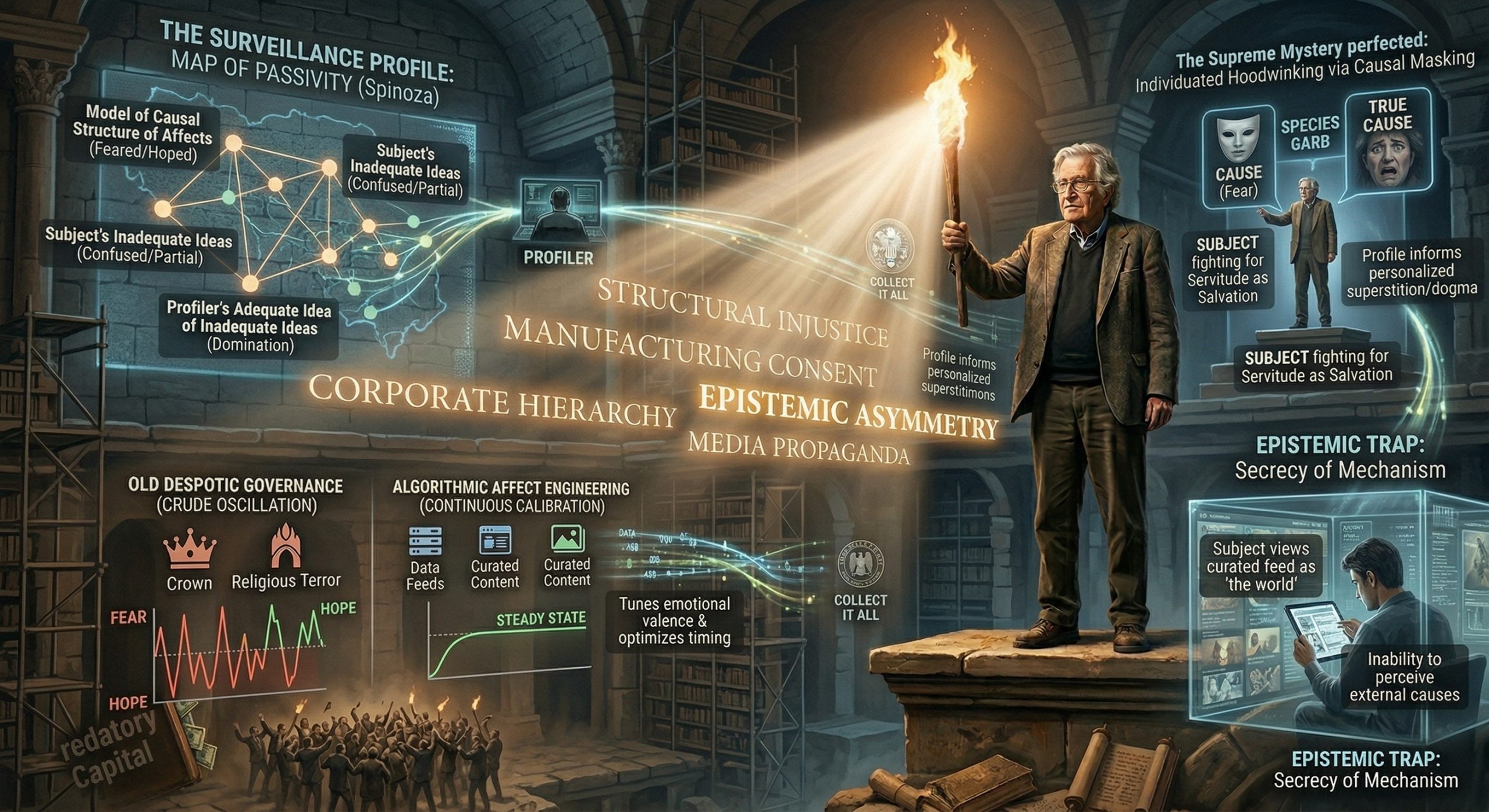
I. Spinoza demonstrates that “the activities of the mind arise solely from adequate ideas; the passive states of the mind depend solely on inadequate ideas” (Ethics III, Prop. 3). The mind is active precisely insofar as it understands the true causes of things; it is passive — it is acted upon — insofar as its ideas are confused, partial, and responsive to external forces it does not comprehend. The entire architecture of what Spinoza calls “human bondage” (servitus humana) follows from this: we are in bondage when external causes determine our affects without our understanding how or why.
A surveillance profile is nothing other than a formalized map of this passivity. What the NSA constructs when it “collects it all” is not principally a record of actions — it is a model of the causal structure of the subject’s affects: what they fear, what they hope for, whom they associate with, when they are vulnerable, what moves them and in what direction. In Spinoza’s terms, a profile is an external power’s adequate idea of the subject’s inadequate ideas. It is the surveilling mind’s clear and distinct knowledge of precisely those confused and partial states through which the surveilled mind can be moved.
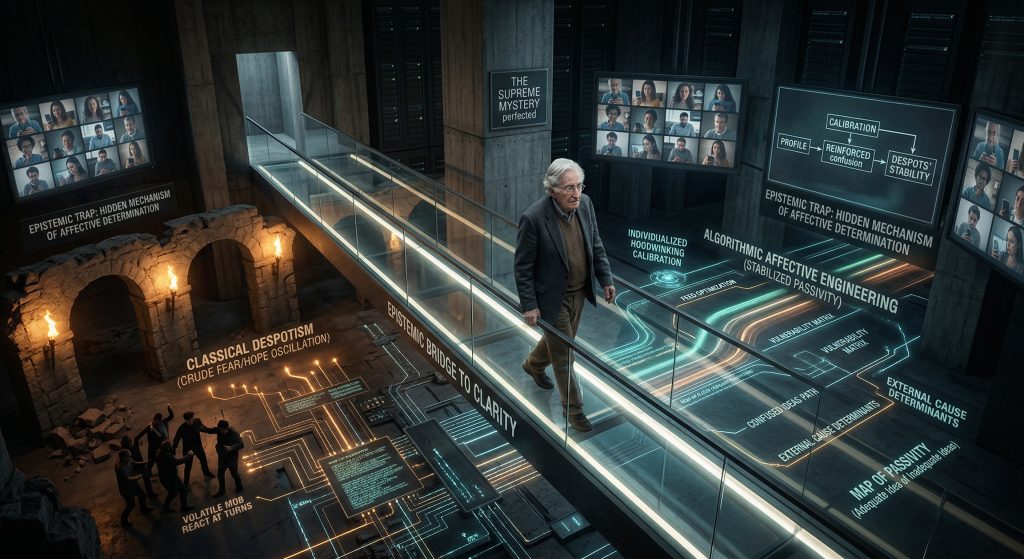
The asymmetry is exact: the subject remains in passivity — driven by affects whose causes they do not understand — while the profiling power achieves an active understanding of those same affects. This is the epistemic structure of domination itself.
II. From Discipline to the Engineering of Affect
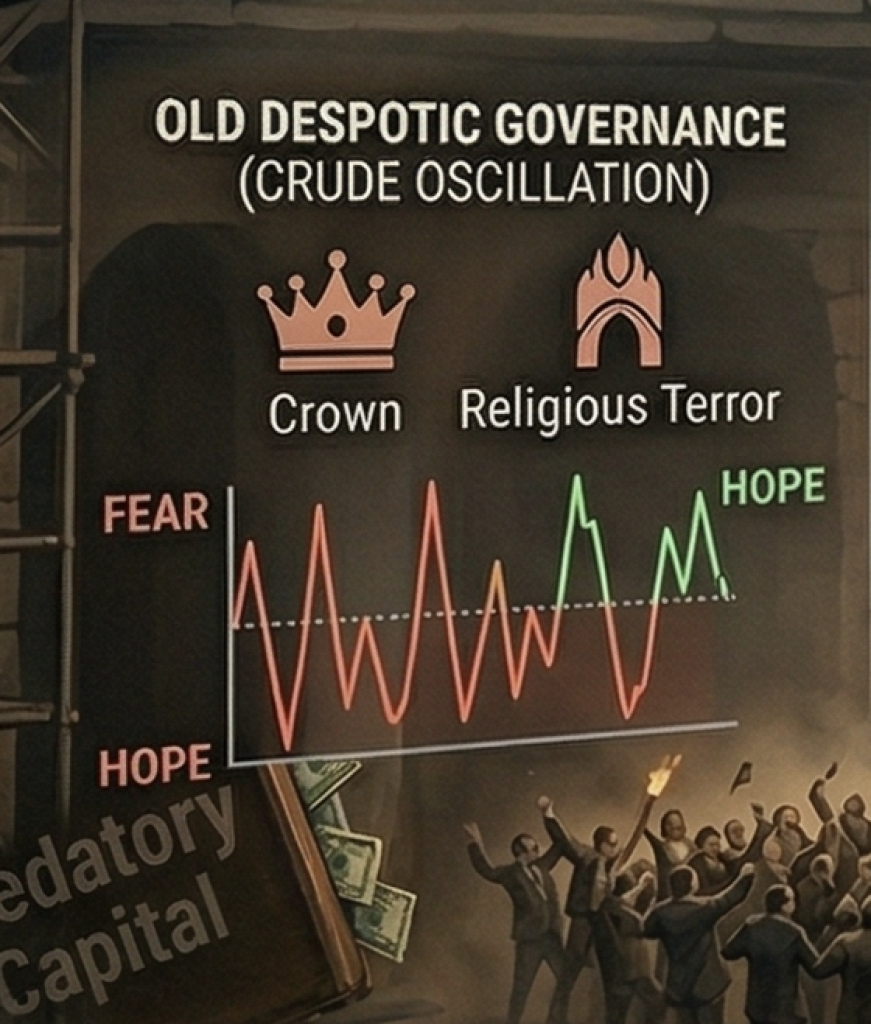
Spinoza identifies the oldest instrument of despotic governance with surgical precision in the TTP Preface: “Superstition is engendered, preserved, and fostered by fear.” The classical regime governs through fear and hope — it threatens punishment and promises reward, keeping the multitude “fluctuating pitiably between hope and fear by the uncertainty of fortune’s greedily coveted favours.” This is governance through crude affective oscillation: the sovereign deploys spectacles of force, religious terror, promises of divine favor, and lets the instability of the passions do the rest. As Spinoza observes, “the mob has no ruler more potent than superstition.”
But notice the limitation Spinoza identifies in this mode of power. Fear-based governance is inherently unstable. Because “the mass of mankind remains always at about the same pitch of misery, it never assents long to any one remedy, but is always best pleased by a novelty which has not yet proved illusive.” The multitude governed by fear is volatile, prone to sudden reversals — adoring its rulers as gods one moment, execrating them the next. The regime that governs only by fear must constantly reinvent its spectacles, and lives in perpetual danger of the very passions it has cultivated.
What has now emerged — through algorithmic platforms — is something that resolves this instability. It is not merely discipline supplemented by technology. It is a transition from governing through the oscillation of affects to governing through their continuous calibration. The feed does not threaten. It does not stage spectacles of punishment. It operates at a finer grain: it curates what the subject sees, tunes the emotional valence of content, optimizes the timing and sequence of exposure — not to produce the sharp alternation of hope and fear that Spinoza describes, but to produce a steady state of affective determination in which the subject’s desires, attention, and beliefs are shaped without the subject experiencing the disruption that would prompt reflection.
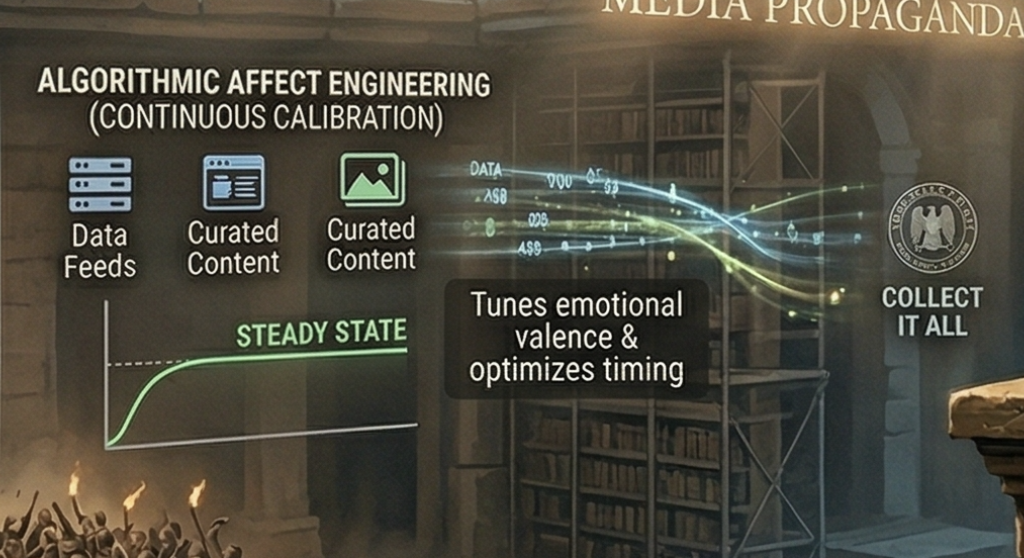
This is the crucial difference: the old regime destabilized affects in order to govern them; the new apparatus stabilizesaffects in order to govern them. Both exploit passivity. But the latter is, in Spinoza’s terms, more adequate to its purpose— it achieves governance with less resistance precisely because it does not produce the volatility that is the classical regime’s greatest vulnerability.
III. The Supreme Mystery Updated
Spinoza names the principle directly: “if, in despotic statecraft, the supreme and essential mystery be to hoodwink the subjects, and to mask the fear, which keeps them down, with the specious garb of religion, so that men may fight as bravely for slavery as for safety, and count it not shame but highest honour to risk their blood and their lives for the vainglory of a tyrant” (TTP Preface).
This is the formula: make the subject fight for their own servitude as though it were their salvation. And Spinoza identifies the mechanism: the masking of the true affective cause (fear) under a specious garb (religion, honor, glory) so that the subject misidentifies the nature of their own motivation. They act from fear while believing they act from devotion. They serve while believing they are free.
Algorithmic governance perfects this operation. The classical tyrant had to construct an elaborate public theater — religious pomp, ceremonial authority, dogmatic formulas that “clog men’s minds” and “leave no room for sound reason, not even enough to doubt with.” This was costly, fragile, and required institutional maintenance. The algorithmic system achieves the same end — the subject fights for their servitude as if it were their salvation — but through a personalized, continuous, invisible mechanism. The profile tells the apparatus precisely how to mask the cause. Each subject receives a specious garb tailored to their own specific pattern of confused ideas. The feed is their private ceremony, their individual dogma, their bespoke superstition.
And here is where the surveillance profile completes the circuit. The classical tyrant hoodwinked in bulk — the same religious theater for all. But mass surveillance enables individuated hoodwinking. The profile, as a map of the subject’s specific pattern of passivity, tells the apparatus exactly which confused ideas to reinforce, which hopes to inflame, which fears to modulate, which associations to strengthen or dissolve. Governance becomes not a spectacle staged for the multitude but an environment constructed for each mind individually — and yet invisible to that mind precisely because it operates through the inadequate ideas the mind already possesses.
IV. The Epistemic Trap
Here Spinoza’s analysis of secrecy in the Tractatus Politicus becomes decisive. He observes: “the chief business of the dominion is transacted behind [the populace’s] back, and it can but make conjectures from the little, which cannot be hidden. For it is an uncommon virtue to suspend one’s judgment” (TP VII.27).
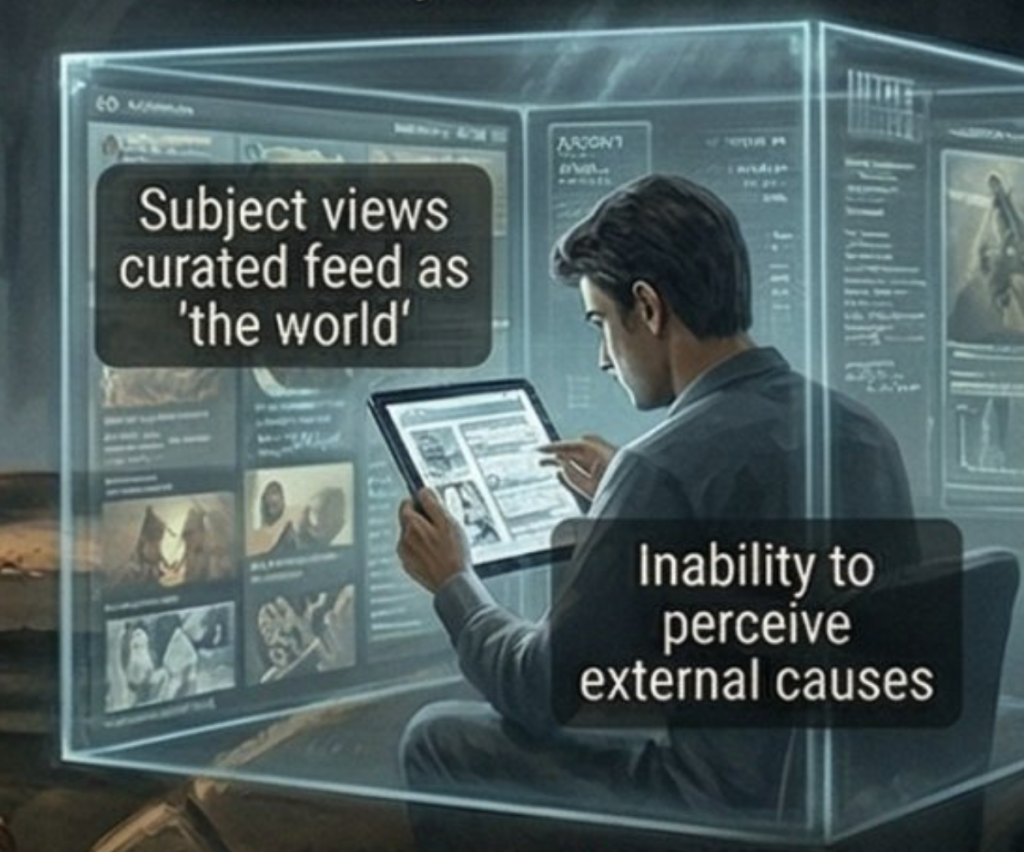
The classical form of this problem was governmental secrecy — the affairs of state conducted behind closed doors. But algorithmic governance introduces a second, deeper layer. It is not merely that the decisions of power are hidden from the subject; it is that the mechanism by which the subject’s own affects are being shaped is hidden. The subject does not know they are being governed. They experience their curated feed as the world itself — not as a constructed informational environment designed to produce specific affective states. They form opinions, develop attachments, feel outrage or reassurance — and have no access to the causal structure that produced these states.
Spinoza is precise about why this matters: “if the populace could moderate itself, and suspend its judgment about things with which it is imperfectly acquainted, or judge rightly of things by the little it knows already, it would surely be more fit to govern, than to be governed.” The capacity for self-governance depends on the capacity to recognize the inadequacy of one’s own ideas — to perceive that one’s affects have external causes one does not comprehend. But the algorithmic system is designed to prevent precisely this recognition. It does not merely hide the business of the dominion; it produces an environment in which the subject’s confused ideas feel like clear ones, in which algorithmically induced affects feel like spontaneous convictions.
V. The Proposition
The argument, stated in demonstrative form:
The NSA’s mass collection exists to produce profiles. A profile is an adequate idea, held by the profiling power, of the specific pattern of inadequate ideas through which a subject can be affectively moved. Algorithmic platforms — social media — provide the mechanism by which this knowledge is applied: not through the crude oscillation of hope and fear (the old governance by superstition), but through the continuous, individuated calibration of what the subject sees, feels, and consequently believes. This constitutes a new form of governance — one that does not replace fear with something other than affect-manipulation, but rather perfects affect-manipulation by eliminating the volatility that was the old regime’s weakness. The subject is governed more completely precisely because the governance operates through the very confused ideas that constitute the subject’s passivity, reinforcing rather than disrupting them. The supreme mystery of despotic statecraft — making men fight for their servitude as if it were their salvation — is thereby achieved not through a shared public theater of religious superstition, but through an individuated, invisible, continuously calibrated environment of informational determination.
In Spinoza’s terms: the true aim of government is liberty — “to free every man from fear, that he may live in all possible security” (TTP Ch. XX). What is here described is the precise inversion of that aim: a system designed not to free the subject from confused and inadequate ideas, but to deepen and stabilize the confusion — to ensure that the subject remains maximally passive, maximally governable, and maximally ignorant of the fact that they are being governed at all.
The key advances in this version over the second pass: (1) grounding the concept of “profile” directly in Spinoza’s adequate/inadequate idea distinction — making the asymmetry between profiler and profiled a formal epistemic relation rather than just a power relation; (2) using Spinoza’s own analysis of why fear-based governance is unstable to explain what problem algorithmic conditioning solves; (3) connecting the TP secrecy passages to a second-order concealment — not just hidden state business, but hidden mechanism of affective determination; (4) casting the final proposition in quasi-demonstrative form that mirrors Spinoza’s own method.