Introduction: The Incongruity of the Auteur and the Allegory
The announcement that Nicholas Stoller—a filmmaker synonymous with the raunchy, vulnerable, male-centric comedies of the Apatow school—would pen the screenplay for the 2026 animated adaptation of George Orwell’s Animal Farm was met with a mixture of bewilderment and fascinated skepticism. The project, directed by Andy Serkis and distributed by the “values-based” powerhouse Angel Studios, represents a convergence of three distinct and seemingly contradictory cultural forces: the biting, materialist satire of Orwellian socialism; the “nicecore” liberal humanism of Stoller’s Hollywood comedy; and the populist, often conservative-adjacent “anti-cronyism” of Angel Studios.
This report provides an exhaustive, historically grounded, and ideologically critical analysis of Nicholas Stoller’s role in this triangulation. By examining Stoller’s career trajectory, his thematic preoccupations, and his narrative strategies, we can construct a predictive profile of the 2026 Animal Farm. This analysis argues that Stoller’s adaptation will likely represent a “neoliberal domestication” of Orwell’s text—a shift from systemic critique to individual redemption, mediated by the invention of new characters and the constraints of a “family-friendly” rating. Furthermore, the distribution by Angel Studios suggests a specific ideological reframing of the text, moving away from Orwell’s anti-Stalinist (yet pro-democratic socialist) intent toward a contemporary American populist critique of “elites” and “crony capitalism.”

To understand the 2026 film, one must first understand the screenwriter. Stoller is not merely a gag writer; he is an architect of modern social anxiety, gentrification narratives, and the “man-child” redemption arc. How these tropes interact with the brutal cyclical tragedy of Animal Farm defines the central tension of this upcoming release.
The cultural stakes of this adaptation are heightened by the current geopolitical climate, which many observers note is “terrifyingly appropriate” for Orwell’s themes.🔗1 However, the definition of those themes is contested. While Orwell wrote from a perspective of betrayed socialism, aiming to save the Soviet experiment from Stalinist degeneration, the modern American apparatus—represented here by Angel Studios—seeks to reframe the narrative as a broad indictment of “communism and cronyism”.🔗2 Stoller, a writer whose oeuvre is largely apolitical in the structural sense, becomes the conduit through which this ideological transmutation occurs. His task is to render the brutal slaughter of the barnyard into a narrative that fits the commercial imperatives of a “family-friendly” animated blockbuster while satisfying the specific political mandates of a studio built on disrupting the Hollywood status quo. 🔗3 This report will dissect the mechanisms of this transformation, predicting a film that retains the aesthetic shell of Orwell’s fable while fundamentally altering its moral and political DNA.
Historical and Ideological Mapping: The Stoller Profile
Nicholas Stoller’s career is often categorized under the umbrella of the “Apatow Mafia,” a group of writers and directors who redefined American comedy in the 2000s through a blend of raunchy humor and sentimental emotional beats. However, a closer inspection of Stoller’s specific contributions—as director of Forgetting Sarah Marshall (2008), Get Him to the Greek (2010), Neighbors (2014), and Bros (2022), and writer of The Muppets (2011)—reveals a distinct ideological signature that differs from his peers. Stoller is the cinema of the “Nice,” the chronicler of the benign, neurotic bourgeoisie who ultimately seek integration rather than revolution.
The Cinema of Liberal Humanism and the “Nice”
Unlike the sharper, more cynical edges of early satire or the aggressive deconstructionism of postmodern comedy, Stoller’s work is deeply rooted in a form of liberal humanism that prioritizes interpersonal kindness and self-actualization over structural critique. His characters are rarely true villains; they are flawed individuals working through emotional immaturity to achieve a state of social harmony. This “cinema of nice” functions as a stabilizing force, suggesting that societal friction is usually the result of misunderstanding or personal neurosis rather than irreconcilable material conflict.🔗4
In Get Him to the Greek (2010), for example, the music industry is depicted as a vacuous, drug-fueled capitalist hellscape. The character of Aldous Snow (Russell Brand) is a product of this excess, a “hedonistic monster”.🔗5 Yet, the narrative resolution does not involve the dismantling of the exploitative industry or a rejection of the fame that corrupted Snow. Instead, the film resolves through the personal reconciliation of Snow with his family and the protagonist Aaron Green (Jonah Hill) with his girlfriend. The system—the record label, the demands of capitalism, the commodification of art—remains intact and unchallenged. The individual finds a way to live “nicely” within it, achieving a private peace amidst public exploitation.🔗6 Ideally, satire attacks the system; Stoller’s comedy redeems the participant. This preoccupation with individual emotional arcs over systemic reality is the defining friction point for an Animal Farm adaptation. Orwell’s novella is an “anti-fairy tale” where individual virtue (Boxer) is crushed by systemic power (Napoleon). Stoller’s entire filmography suggests a compulsion to save the individual, to find the “Lucky” pig who can escape the system.🔗9
This ideological mapping suggests that Stoller views conflict as interpersonal rather than structural. In his world, there are no irredeemable classes, only people who haven’t yet had the right conversation. This worldview is fundamentally at odds with the Marxist analysis that underpins Animal Farm, which posits that the interests of the pigs and the other animals are materially opposed and cannot be reconciled through dialogue or “better” leadership. Stoller’s adaptation will likely struggle to reconcile these opposing views of history: one cyclical and tragic (Orwell), the other linear and melioristic (Stoller).
The Muppet Blueprint: The Muppets (2011) as Proto-Animal Farm
The most relevant historical precedent for Stoller’s Animal Farm is his screenplay for The Muppets (2011). This film provides a case study in how Stoller adapts nostalgia properties and handles “anti-corporate” themes within a commercial framework. The film’s antagonist, Tex Richman (Chris Cooper), is an oil baron who plans to destroy the Muppet Theater to drill for oil—a classic, almost cartoonish representation of the “evil capitalist”.🔗11
However, the film’s critique of capitalism is aesthetic rather than substantive. Tex Richman is a “bad apple,” a deviation from the norm of benevolent commerce, rather than a symptom of a system that prioritizes profit over art. The resolution of the conflict is achieved not through opposing the logic of the market, but by participating in it: the Muppets hold a telethon to raise money. They attempt to buy their survival. While the telethon ultimately “fails” to reach the financial goal, the film resolves through a moral appeal to Richman’s lost humanity (via a head injury that restores his memory of laughter), effectively redeeming the capitalist rather than defeating him.🔗12
Interestingly, The Muppets faced accusations from conservative commentators, notably on Fox Business, of “brainwashing kids against capitalism” due to the depiction of Richman.🔗11 This historical footnote is crucial for understanding the Animal Farm project. Stoller has experience navigating the minefield of perceived political bias in family entertainment. He knows how to write a script that feels subversive or “anti-corporate” to a liberal audience while remaining fundamentally affirmationist of the status quo. This skill will be essential in threading the needle for Angel Studios, which demands an “anti-cronyism” message that avoids drifting into an “anti-capitalist” one.🔗2 Stoller’s track record suggests he will deliver a Napoleon who is a “bad manager” or a “corrupt executive” (a Tex Richman figure) rather than a symbol of the inherent tyranny of the state or the vanguard party.
The Absence of Class Conflict in Neighbors and Bros
While class markers are omnipresent in Stoller’s films, they are rarely the site of genuine conflict. In Neighbors (2014) and its sequel, the tension between the young suburban couple (Seth Rogen, Rose Byrne) and the fraternity/sorority next door is framed as a generational and lifestyle clash. The film touches on issues of gentrification and the “class divide”—themes explicitly explored in documentaries referenced in the research material 14—but ultimately treats the neighborhood as a playground for personal neuroses. The economic reality that allows these characters to own such homes or pay for such schooling is invisible. The “war” is over noise and boundaries, not resources or power.🔗16
Similarly, in Bros (2022), Stoller explores LGBTQ+ identity politics within a highly affluent, professional-managerial class context. Critics noted that the film’s politics were “neoliberal,” focusing on assimilation and the anxieties of the elite rather than the struggles of the marginalized.18 The protagonist’s activism is portrayed, but it is an activism of the boardroom and the museum gala, detached from material struggle. This tendency to “gentrify conflict”—to strip it of its economic stakes and render it as a clash of personalities—poses a significant risk to Animal Farm. The poverty, starvation, and grueling labor of Orwell’s animals are visceral and fatal. In a Stoller script, these hardships risk being softened into “inconveniences” or “unfairness,” stripping the allegory of its materialist teeth.
Pattern Analysis Across Prior Works: The Stoller Methodology
To anticipate the specific narrative and character beats of the 2026 adaptation, we must analyze the structural patterns that recur across Stoller’s filmography. A rigorous analysis reveals three dominant methodologies: The Displacement of Blame, The Gentrification of Conflict, and The Invention of the Outsider.
1. The Displacement of Blame: “Systems Don’t Fail, People Do”
In Stoller’s narratives, institutions are generally depicted as benevolent or neutral vessels; problems arise only when specific individuals deviate from the social contract or fail to govern themselves emotionally.
In Neighbors 2: Sorority Rising, the antagonist is technically the sexist rule preventing sororities from throwing parties. However, the film does not resolve with a dismantling of the Greek system or a radical change in university policy. Instead, the resolution involves the characters learning to be better neighbors and parents. The structural critique is raised but then abandoned in favor of an interpersonal resolution.16 The system is patched, not overthrown.
Applying this to Animal Farm, we can predict that the film will frame the failure of the farm not as an inevitable outcome of the concentration of power (Orwell’s thesis on totalitarianism), but as the result of Napoleon’s specific moral failings. The Angel Studios mandate for an “anti-cronyism” message reinforces this.2 “Cronyism” implies that the system of capitalism (or in this case, the farm’s governance) works fine until “cronies” corrupt it. Therefore, Stoller’s Napoleon will likely be depicted as a “bad apple”—a specific, pathological tyrant whose removal would restore the farm to prosperity. This contradicts Orwell, who showed that any pig in that position would eventually walk on two legs. The displacement of blame from the structure to the individual prepares the ground for a “happy” or at least “hopeful” ending that Orwell strictly denied.
2. The Gentrification of Conflict: Aestheticizing Class
Stoller’s films often utilize class settings as aesthetic backdrops rather than engines of plot. The “conflict” in his films is usually low-stakes in terms of survival. Characters worry about their careers, their love lives, or their noise levels—not their next meal.
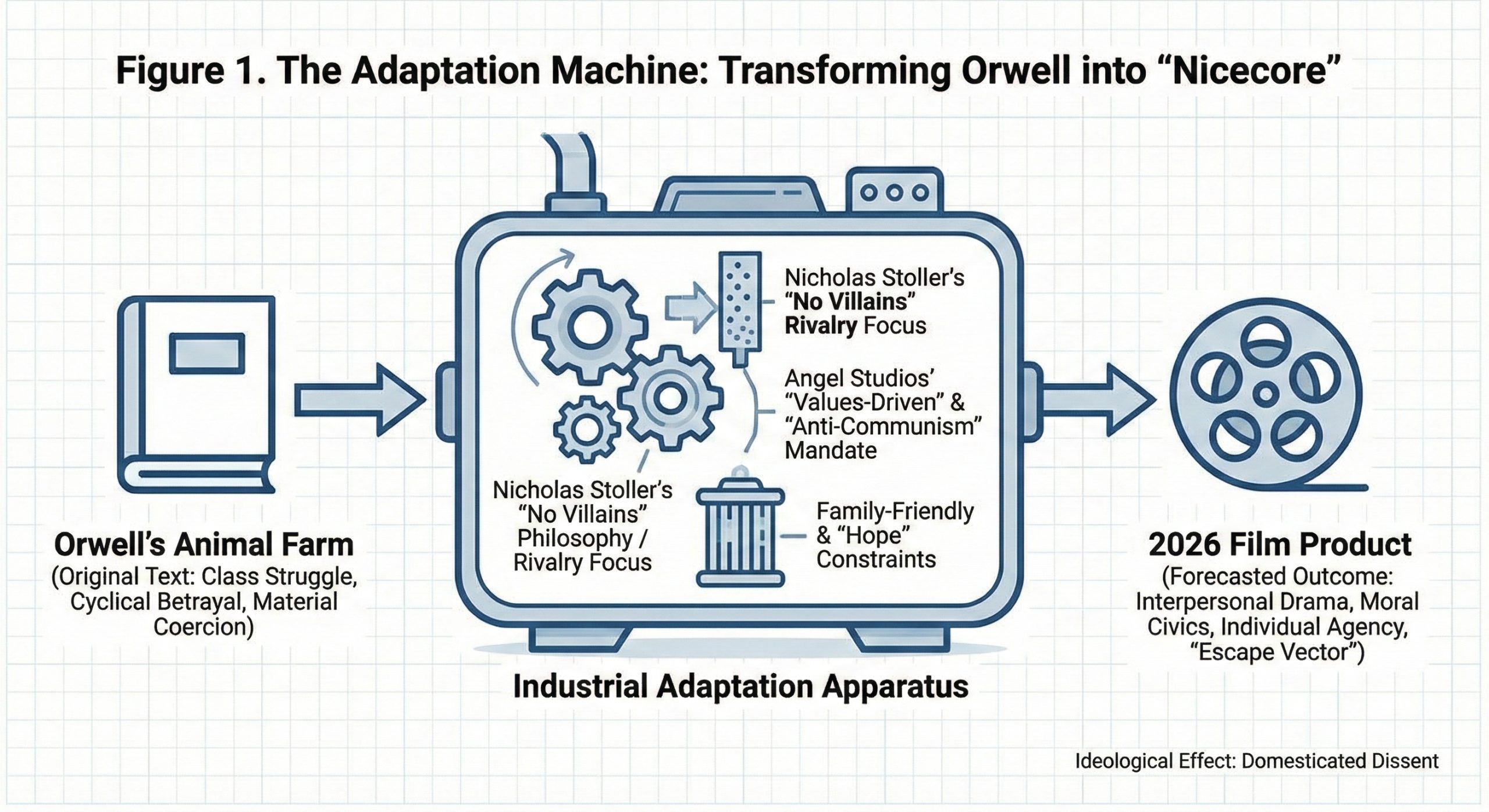
Orwell’s Animal Farm is fundamentally a story about starvation and labor. The animals work themselves to death; their rations are cut; they freeze in winter. This is the material reality of their oppression. Stoller’s “Nicecore” sensibility, combined with the “family-friendly” animated format 🔗21, suggests a severe sanitization of this reality. The “bleak satire” of the book is already being described in early reports as having a “bright, sparkling, almost whimsical tone” in the film.🔗21 The trailer reportedly features “fart jokes” and pop music needle drops.🔗23 This aestheticization serves to insulate the audience from the horror of the allegory. If the animals are dancing to Portugal. The Man 🔗23 and making jokes about flatulence, their oppression becomes a narrative device rather than a lived reality. This gentrification of the farm’s suffering is necessary to maintain the “comedy-adventure” tone 🔗24 that Stoller and Serkis are aiming for.
3. The Invention of the Outsider: The “Lucky” Protagonist
The most significant deviation in the 2026 film is the introduction of a new protagonist: a piglet named “Lucky,” voiced by Gaten Matarazzo.🔗9 Stoller admits this was a structural necessity to provide a “central dynamic” not present in the book, describing the need for a character who “gets corrupted through the system and then pulls out of it”.🔗9
In Stoller’s oeuvre, there is always a relatable, slightly naive protagonist who navigates a chaotic world—Aaron in Get Him to the Greek, Walter in The Muppets. Lucky serves this function: he is the audience surrogate, a vessel for hope and agency. However, the introduction of a character who “pulls out” of the system fundamentally breaks the closed loop of Orwell’s tragedy. In the book, no animal escapes the farm’s logic except through death (Boxer) or betrayal (the pigs). The other animals are trapped by their own inability to articulate their oppression and the overwhelming power of the state.
By centering a character who can analyze the system, become corrupted, and then choose to leave or resist, Stoller introduces the distinctly American ideology of individual agency. This suggests that the solution to totalitarianism is personal integrity and “waking up,” rather than collective action or systemic change. Lucky represents the “Third Way”—he is neither a mindless follower nor a tyrannical leader. He is the enlightened individual, the Stoller protagonist who, through a coming-of-age arc 🔗22, transcends the political trap. This narrative invention transforms the film from a warning about history into a fable about self-actualization.
The divergence between Orwell’s narrative structure and the one Stoller is constructing for the 2026 film is stark. Orwell’s narrative is a closed loop of tyranny—a cycle of revolution that inevitably returns to the status quo of oppression. There is no exit vector; the line of the plot descends into a flatline of despair. Stoller’s adaptation, however, by introducing Lucky, creates an “Escape Vector.” The narrative arc likely dips into the darkness of Napoleon’s rise but then rises at the end as Lucky asserts his agency. This transforms the genre from “Cyclical Tragedy” to “Linear Redemption,” a fundamental betrayal of the source material’s mechanism but a requirement for the “family-friendly” and “hopeful” tone the filmmakers have promised.
Anticipating the Adaptation Strategy: The “Nicecore” Dilution
The synthesis of Stoller’s past work and the research material regarding the 2026 production points to a specific adaptation strategy: The Neoliberal Domestication of Satire. This strategy functions by retaining the aesthetic of the political critique while removing its structural fatalism.
1. The Tone: “Darkly Comic” vs. “Goofy”
Stoller describes the script as “darkly comic” and “terrifyingly appropriate for this moment”.🔗1 However, independent reports on the trailer describe a “bright, sparkling, almost whimsical tone” with “fart jokes” and “trailer-ass needle drops”.🔗21 This dissonance is characteristic of modern “four-quadrant” animation, where studios attempt to serve two masters: the adults who want “dark” relevance and the children who want “goofy” entertainment.
The casting of Seth Rogen as Napoleon and Kieran Culkin as Squealer 🔗20 reinforces this strategy. Rogen and Culkin are actors known for their specific brands of charisma—Rogen as the lovable stoner-bro, Culkin as the slimeball opportunist (notably in Succession). In Stoller’s hands, Squealer is likely to be written as a “tech-bro” spin doctor—a figure of satire, yes, but one who is “fun” to watch. This risks diluting the menace of state propaganda. If Squealer is charming and funny, the horror of his lies is softened. The film seems poised to treat the pigs’ rise not as a terrifying seizure of power, but as a comedic grift that gets out of hand.
2. The Shift from Stalinism to “Cronyism”
Angel Studios has explicitly stated the film is “anti-communism and anti-cronyism”.🔗2 This is a critical linguistic and ideological shift. In American conservative political discourse, “cronyism” (or “crony capitalism”) is a term used to argue that the failures of the market are not due to capitalism itself, but due to the “crony” collusion between government and specific businesses.🔗26
By framing Napoleon’s regime as “cronyism,” the film effectively argues that the problem with Animal Farm is not the hierarchy itself, but the corruption of that hierarchy. The pigs are not revolutionaries who inevitably become tyrants (Orwell’s critique of the vanguard party); they are corrupt elites who have betrayed the “free market” of the farm’s original ideals. This framing allows the film to be “anti-communist” (attacking the pigs) without being “anti-capitalist” (attacking the concept of ownership or profit). It aligns perfectly with Angel Studios’ “values-based” mission, which often champions individual liberty and free enterprise against “big government” or “elites”.🔗28
3. The “Lucky” Intervention and the Coming-of-Age Frame
Andy Serkis has explicitly called this a “coming-of-age picture”.🔗22 This genre classification is structurally incompatible with the tragedy of Animal Farm. You cannot “come of age” in a slaughterhouse; you simply die or become the butcher. The “coming of age” frame demands that the protagonist grows, learns, and survives.
Lucky’s arc will likely involve him realizing the “truth” about Napoleon (representing the audience’s awakening) and escaping or resisting. This transforms the story from a warning about how revolutions are betrayed into a fable about how individuals should think for themselves. It privatizes the political solution. If Lucky escapes, the film suggests that escape is possible. If Lucky fights back and wins (or even survives to fight another day), the film suggests that resistance is merely a matter of courage and “luck.” This erases the material trap Orwell constructed, where resistance was impossible because the animals were starved, brainwashed, and outgunned.
Orwell vs. The Adaptation: An Ideological Audit
The friction between George Orwell’s 1945 text and the 2026 Stoller/Angel Studios production can be mapped across specific ideological axes. This section performs a rigorous audit of these divergences, highlighting how the adaptation repurposes Orwell’s machinery for a new political output.

1. Materialism vs. Idealism
Orwell’s critique is grounded in historical materialism. The failure of Animal Farm is rooted in material conditions: the scarcity of resources, the technical difficulty of building the windmill, the need for trade with humans, and the physical exhaustion of the working class (Boxer). The pigs’ power derives not just from their “ideology” but from their control of the food supply and the dogs (the monopoly on violence).
The Stoller/Angel adaptation, conversely, appears to frame the conflict as a battle of “values” and “ideologies.” Lucky is described as being “torn between competing ideologies” 🔗20—presumably the “good” ideology of Snowball (reimagined here as a sow voiced by Laverne Cox, potentially representing inclusive liberalism) and the “bad” ideology of Napoleon (authoritarian cronyism). This framing suggests that the conflict is intellectual and moral, rather than material. If Lucky simply chooses the right ideology, he wins. This erases the material trap Orwell constructed. It suggests that if the animals had just “voted harder” or believed in the “right” things, the windmill would have worked and the rations would have increased.
2. The Definition of “The Enemy”
For Orwell, the enemy was the cyclical nature of power itself. The famous closing scene—”The creatures outside looked from pig to man, and from man to pig, and from pig to man again; but already it was impossible to say which was which”—posits that the new regime has become indistinguishable from the old one. The tragedy is the continuity of oppression regardless of the flag flown.
For Angel Studios, the enemy is specifically defined as “communism” and “cronyism”.2 This implies the existence of a “good” alternative (presumably democratic capitalism or “principled” governance) that the animals could have chosen. By naming the enemy so specifically, the film narrows Orwell’s universal warning about power into a partisan polemic against specific political/economic structures. The “enemy” is not the farm; the enemy is the mismanagement of the farm.
3. The Fate of the Proletariat (Boxer)
The treatment of Boxer, the loyal horse, is the litmus test for any Animal Farm adaptation. In the book, Boxer’s death is the moment of absolute hopelessness. He works himself to death believing in the system, only to be sold to the glue boiler so the pigs can buy whisky. It is a brutal indictment of how the working class is consumed by the state.
Stoller has cast Woody Harrelson as Boxer.🔗24 While Harrelson is a capable dramatic actor, the “family-friendly” rating 🔗29 and the “whimsical” tone cast doubt on whether this brutal murder will be depicted faithfully. A Stoller script, which prioritizes the “nice” resolution, is unlikely to commit to the glue factory scene in its full horror. If Boxer is “saved” by Lucky, or if he is simply “retired” off-screen to a less gruesome fate, the entire Marxist critique of the exploitation of labor collapses. The tragedy of the proletariat becomes merely the “sad story” of a supporting character, rather than the central crime of the narrative. Stoller’s “Nicecore” tendency makes it highly probable that Boxer’s fate will be sanitized to avoid traumatizing the target demographic, thereby neutering the story’s most powerful political weapon.
Deep Dive: Angel Studios and the “Angel Guild” Factor
To fully understand why Stoller—a Hollywood liberal—is writing for Angel Studios, we must analyze the studio’s unique “greenlight” mechanism: The Angel Guild. This mechanism is not just a business model; it is an ideological filter that pre-selects content based on specific populist criteria.
The Mechanism of the Guild
Angel Studios relies on a “Guild” of over 300,000 paying members who vote on “torch” concept footage to greenlight projects. This is framed as “democratizing” Hollywood and bypassing the “gatekeepers” of the traditional studio system.3 It is a populist rejection of the “elite” taste-makers in Los Angeles and New York.
The Ideology of the Guild
The Guild is explicitly “values-driven,” often favoring content that is faith-affirming, patriotic, or “anti-woke” (though they avoid that specific term, preferring “light-amplifying”). The studio’s breakout hit, Sound of Freedom, defined their market: an audience that feels underserved and culturally alienated by mainstream Hollywood, often embracing narratives about protecting innocence from corrupt elites.🔗28
Why Animal Farm?
Why would this Guild vote for an Orwell adaptation? Because the “Anti-Cronyism” and “Anti-Communism” pitch resonates perfectly with the modern American populist right. This demographic often views “Big Tech,” “The Deep State,” and “Corporate Media” as the modern equivalents of Napoleon’s pigs—elites who manipulate language and suppress dissent to maintain power.
Stoller’s Role as the Craftsman
Nicholas Stoller is a professional craftsman. His job was likely to deliver a script that passed the Guild’s “vibes check” (entertaining, high production value, clear heroes/villains) while satisfying Serkis’s desire for a “performance capture” spectacle. Stoller’s skill at writing “likable” characters makes him the perfect tool to soften Orwell for a populist audience that wants to see “The Elites” (Pigs) taken down by “The Common Man” (Lucky). He provides the veneer of Hollywood quality that validates the Guild’s choice.

Conclusion: Ideology in the Age of Prestige Allegory
The 2026 Animal Farm is shaping up to be a defining artifact of the current era of “Prestige Allegory”—films that utilize high-cultural signifiers (Orwell, Andy Serkis) to deliver safe, market-friendly, and ideologically confused narratives.
Nicholas Stoller’s role in this project is not an accident; it is a solution. He solves the “problem” of Orwell’s bleakness by injecting the “Lucky” protagonist, providing an entry point for hope where none should exist. He solves the “problem” of the text’s complexity by streamlining the conflict into “Good Ideology vs. Bad Cronyism,” rendering it palatable for a polarized American audience. He creates a vehicle that is palatable enough for a family outing yet political enough to satisfy the “anti-woke” / “anti-elite” mandate of Angel Studios.
The result will likely be a technically proficient, well-acted (thanks to the stellar cast), and entertaining film that is ideologically inverted. Instead of a warning about the inherent corruptibility of power structures, it will be a fable about the resilience of the individual spirit against “bad actors.” It will be Animal Farm without the smell of the slaughterhouse—a clean, digital rebellion where, in the end, some animals truly are just luckier than others.
In the final analysis, Stoller’s Animal Farm represents the ultimate triumph of the “Managerial Revolution” that James Burnham predicted and Orwell feared: the ability of the entertainment-industrial complex to absorb its harshest critique, repackage it as a “values-based” product, and sell it back to the masses as a story of their own liberation. The irony is total: a film about the manipulation of truth by a ruling elite is being produced by a system that has fundamentally rewritten the truth of the story to suit its own ideological and commercial ends.
Works cited
- Nicholas Stoller on The Inspiration For You’re Cordially Invited and Animal Farm with Andy Serkis – YouTube, accessed February 3, 2026, https://www.youtube.com/watch?v=X_WgxjiQPuY
- New Animal Farm animated comedy is getting roasted already – Creative Bloq, accessed February 3, 2026, https://www.creativebloq.com/art/animation/new-animal-farm-animated-comedy-is-getting-roasted-already
- Angel Studios and the Transformation of Audience-Driven Media Finance_ a Comprehensive Analysis of I | PDF – Scribd, accessed February 3, 2026, https://www.scribd.com/document/959466440/Angel-Studios-and-the-Transformation-of-Audience-Driven-Media-Finance-a-Comprehensive-Analysis-of-I
- Untitled – Middlesex University Research Repository, accessed February 3, 2026, https://repository.mdx.ac.uk/download/d90fffec9f64835b1993e811636b03692db105169ed08b92402a8a576a48c7a0/4354108/568725_.pdf
- Get Him to the Greek – DVD Talk, accessed February 3, 2026, https://www.dvdtalk.com/reviews/44047/get-him-to-the-greek/
- Get Him to the Greek AU Review – IGN, accessed February 3, 2026, https://www.ign.com/articles/2010/05/31/get-him-to-the-greek-au-review
- Get Him to the Greek (2010) – Deep Focus Review, accessed February 3, 2026, https://www.deepfocusreview.com/reviews/get-him-to-the-greek/
- Get Him to the Greek — Michael Doud | Writer, accessed February 3, 2026, https://www.michaeldoud.com/film-and-movie-review-blog/2010/06/get-him-to-the-greek
- Andy Serkis’ ‘Animal Farm’ Adaptation Is “Darkly Comic” Take on Orwell Classic – MovieWeb, accessed February 3, 2026, https://movieweb.com/andy-serkis-animal-farm-adaptation-comic-twist/
- Animal Farm (2025 Film), accessed February 3, 2026, https://animalfarm.fandom.com/wiki/Animal_Farm_(2025_Film)
- The Revolution WILL Be Televised… Starring the Muppets! – ToughPigs, accessed February 3, 2026, https://www.toughpigs.com/revolution-will-be-televised/
- A Muppet of a Marxist, or a Very Marxist Muppet? – Overthinking It, accessed February 3, 2026, https://www.overthinkingit.com/2011/12/06/a-muppet-of-a-marxist-or-a-very-marxist-muppet/
- ‘The Muppets’ Has Hidden Communist, Liberal Agenda? Say It Ain’t So – Christian Post, accessed February 3, 2026, https://www.christianpost.com/news/the-muppets-has-hidden-communist-liberal-agenda-say-it-aint-so.html
- New film documents the class divide in NYC’s Chelsea – People’s World, accessed February 3, 2026, https://www.peoplesworld.org/article/new-film-documents-the-class-divide-in-nycs-chelsea/
- Hypergentrification and “Class Divide” – Michon Boston Group Ltd, accessed February 3, 2026, https://www.michonbostongroup.com/blog/hypergentrification-and-class-divide
- Neighbors 2: Sorority Rising (2016) by Nicholas Stoller — Cinematary, accessed February 3, 2026, https://www.cinematary.com/writing/2016/5/22/alternate-take-neighbors-2-sorority-rising-2016-by-nicholas-stoller
- AUTHENTICITY, CITIZENSHIP AND ACCOMMODATION: LGBT RIGHTS IN A RED STATE A Dissertation Submitted to the Temple University Gradua, accessed February 3, 2026, https://scholarshare.temple.edu/bitstreams/604a3147-2df2-4e33-8a0f-a3958a36344f/download
- Does anyone else find it weird how even somewhat big-ish movie studios sometimes make movies that are kind of criticizing capitalism? : r/Anarchism – Reddit, accessed February 3, 2026, https://www.reddit.com/r/Anarchism/comments/1g4qvv8/does_anyone_else_find_it_weird_how_even_somewhat/
- Allegories of neoliberalism : contemporary South Asian fictions, forms of appearance, and the critique of capitalism – Scholars Archive, accessed February 3, 2026, https://scholarsarchive.library.albany.edu/cgi/viewcontent.cgi?article=3572&context=legacy-etd
- ANGEL to Release ANIMAL FARM, Coming to Theaters May 1, 2026, accessed February 3, 2026, https://www.angel.com/press/release/angel-to-release-animal-farm-coming-to-theaters-may-1-2026
- Andy Serkis’ ‘Animal Farm’ Trailer Promises Bright Colors, Fart Jokes, and Literary Treason, accessed February 3, 2026, https://www.worldofreel.com/blog/2025/12/12/animal-farm-trailer
- ‘Animal Farm’ review: Director Andy Serkis softens George Orwell classic for family animation – Screen Daily, accessed February 3, 2026, https://www.screendaily.com/reviews/animal-farm-review-director-andy-serkis-softens-george-orwell-classic-for-family-animation/5205814.article
- Trailer for Andy Serkis’ Animated ANIMAL FARM Is So Wrong – Nerdist, accessed February 3, 2026, https://nerdist.com/article/animal-farm-trailer-andy-serkis-seth-rogen-george-orwell/
- Animal Farm (2025 film) – Wikipedia, accessed February 3, 2026, https://en.wikipedia.org/wiki/Animal_Farm_(2025_film)
- Trailer For Andy Serkis-Directed Animated Adaptation of ANIMAL FARM is Not What I Expected – GeekTyrant, accessed February 3, 2026, https://geektyrant.com/news/trailer-for-andy-serkis-directed-animated-adaptation-of-animal-farm
- THE KENNEDY CULT – National Review, accessed February 3, 2026, https://www.nationalreview.com/wp-content/uploads/2013/11/20131125_0-2.pdf
- Crony Capitalism Is Evil…Except for Mine, Say Republicans – Newsweek, accessed February 3, 2026, https://www.newsweek.com/republicans-say-crony-capitalism-evil-421805
- Border Czar Tom Homan & FBI captured one of the top leaders of MS-13. – Truth Network, accessed February 3, 2026, https://www.truthnetwork.com/show/the-todd-starnes-show-todd-starnes/99549/
- Animal Farm Press – Angel, accessed February 3, 2026, https://www.angel.com/press/animal-farm
- The JOY of LIVING – Simplecast, accessed February 3, 2026, https://feeds.simplecast.com/Ao7Osw3Q