
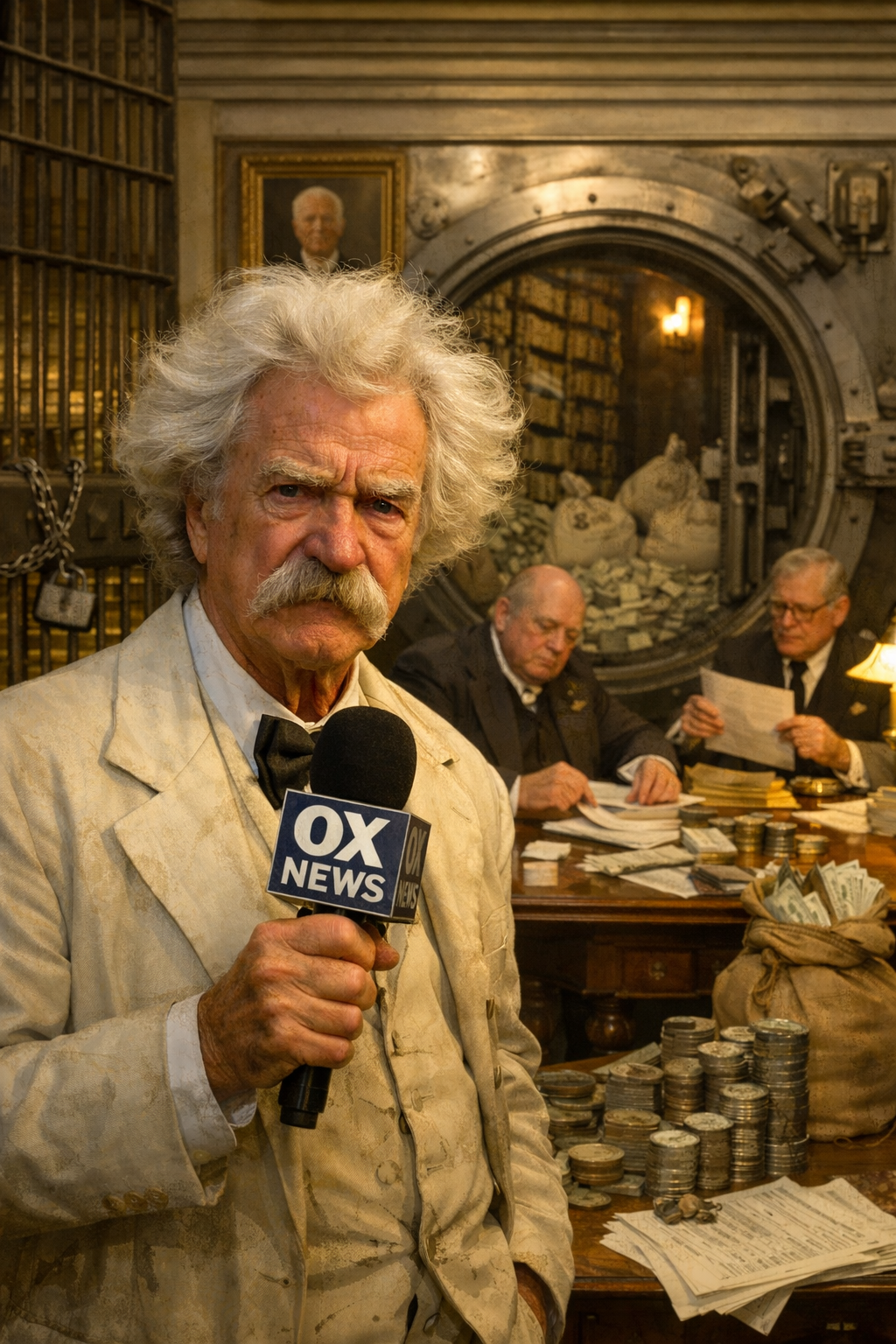
or, The Holy Art of Washing a Tithe Through Time
(in the manner of Mark Twain)
There are communities which make a reputation for virtue as a banker makes one for solvency: by publishing it. There are also churches which acquire a fame for sacrifice, humility, and consecration by the simple device of letting other people furnish the sacrifice while they retain the humility in the annual report. The human race has always been ingenious in these economies.
I was once acquainted with a town that was proud of its incorruptibility; and because it was proud of it, it fell. Pride is the plaster saint of all such places. It stands in the niche, white and pious, and says, “See how sound I am,” while the rot is traveling up the timber behind it. The institution now before us appears to have undergone a like experience. It has long enjoyed the esteem due to thrift, discipline, sacrifice, revelation, and a superior acquaintance with the Almighty’s financial preferences; and having enjoyed that esteem, it has come to regard itself as entitled to whatever dexterities may be necessary for preserving it.
The case, stripped of its robes, is plain. A church gathers tithes from the faithful under solemn sanctions. It stores up a mighty reserve. That reserve breeds profits. Those profits are employed in commercial undertakings. When complaint arises, the answer is returned that no tithing was used—only the profits of tithing. The mother, it appears, is sacred; the child is secular. The hen belongs to God; the egg may go shopping.
This distinction has recommended itself to grave judges and prosperous consciences; and I do not wonder at it. If there is one thing mankind prefers to a plain lie, it is a lie with a ledger under it. A naked falsehood startles the blood and offends the ear; but a falsehood which arrives in the company of definitions, reserve categories, contextual qualifiers, and a memorandum from counsel has a respectable look. It wears spectacles. It speaks low. It carries figures. It has no smell of brimstone on it at all. You can dine with it.
Yet for all that, it remains what it was.
If a boy steals an apple, he is whipped. If a corporation takes the orchard and returns the apple with a sermon on usufruct, prudent persons are disposed to call it policy. If a common rogue picks your pocket and afterward invests the proceeds and spends only the interest, no magistrate is likely to be moved by his metaphysics. He would say, and very properly, “The interest is your pocketbook in a taller hat.” But if the same feat is performed in the name of stewardship, and under the shelter of ecclesiastical immunity, and with a pious preface concerning rainy days and providential prudence, then society becomes thoughtful and begins to split hairs where previously it had hanged men.
The present excuse is of that admirable sort. It says: “We did not spend the tithes; we spent what the tithes earned.” This is as if a gentleman, having planted a vineyard with your labor and your money, were to drink the wine in your presence and assure you with dignity that he had not consumed your grapes. It is as if one were to seize a man’s horse, breed a stable from it, sell the colts, and then insist that no injury had been done to the horse, which remains, after all, in the pasture and may be viewed by appointment.
Cause and effect are old companions in every district but theology and law. There they are often introduced and fail to recognize each other.
The matter becomes blacker when one remembers whose money it was and how it was got. These were not idle dollars gathered from the surplus merriment of the rich. They were offerings exacted as duty—exacted under the eye of heaven, under the discipline of belonging, under promises of blessing and intimations of loss. The poor paid them. The widow paid them. The clerk, the mechanic, the student, the father of many children and one salary, the mother economizing a pantry into a sacrament—these paid them. A tithe is never merely a contribution when preached from authority. It is tribute levied upon conscience. It is the only tax whose collector can hint that eternity takes notice of the receipt.
And what became of this consecrated surrender? Was it sent abroad in search of hunger? Was it poured in rivers through the deserts of want? Did it run toward sores, cold rooms, unpaid rents, broken machinery of life, and the old shames of the world? Some of it may have. Institutions always do some good, as fires always give some heat. But the system here described did something more deliberate and more characteristic: it stored. It accumulated. It compounded. It allowed the sacrifice to pass from offering into asset, from asset into instrument, from instrument into abstraction, and from abstraction into a principle of self-justification. The storehouse ripened into a vault, and the vault discovered a gospel of its own.
This is the transformation which interests me. A storehouse is a moral thing. It implies motion delayed for the sake of need anticipated. It has in it the idea of bread. A vault is a psychological thing. It implies possession intensified for the sake of power preserved. It has in it the idea of exclusion. One may stand at the door of a storehouse and expect distribution; one stands at the door of a vault and expects a guard.
The defenders say the reserve was for a rainy day. This is a venerable plea. It has excused many a meanness. A prudent man keeps an umbrella; a prudent church keeps something by against distress. But here the umbrella appears to cover a continent. The reserve is said to be so immense, and its productive powers so liberal, that the storm for which it is held in readiness would need to be not meteorological but apocalyptic. When a church continues collecting sacrifice at full rigor after it has secured itself against every ordinary adversity known to commerce, agriculture, government, war, pestilence, locust, fire, flood, and dull seasons in the stock market, one begins to suspect that the rainy day is not a forecast but a mascot. It is brought out whenever generosity threatens to break in.
The most poisonous feature of the business is not the accumulation itself, but the language by which it is preserved. Language is the final sanctuary of every abuse. Once a thing can be renamed, it can be baptized; once baptized, it can be defended; once defended long enough, it can be mistaken for virtue. So the old blunt sentence, “We used member money to fund a commercial project,” is marched into a side room, washed, ironed, and returned as, “Earnings on invested reserves, rather than principal tithing funds, accommodated the program.” This second statement has all the moral warmth of a tombstone and about the same intention to communicate with the living.
A promise, in plain society, means what the hearer may fairly understand by it. But in institutional society, a promise means what the promisor can afterward survive by proving he secretly meant. This is why simple people so often find themselves at odds with experts. The simple man remembers the assurance; the expert remembers the clause. The common member heard, “not one penny of tithing will be used”; the superior intelligence afterward explained that the pennies themselves had been carefully preserved, and only their descendants had been put to work. This is like promising the public that no sheep shall be eaten at table, and then serving lamb.
I am aware that a court of law has lent its grandeur to this distinction and has concluded that no reasonable juror could have found fraud in it. That is one of those triumphs of jurisprudence which make the layman wish to lie down until the republic improves. It appears that because the institution had once spoken of reserves, and because reserves had once been described as containing portions of annual income, and because annual income included tithes, and because earnings on those reserves were later named as a funding source, therefore the congregant who heard “tithing funds have not and will not be used” ought to have brought to the pew not only faith, but a forensic accountant, a portfolio analyst, and a glossary of ecclesiastical derivatives.
I do not deny that the sentence can be made to bear the official meaning, if enough weight is piled upon it. A wagon may be made to carry a cathedral if one is willing to crush the horse. But the question in morals is not whether a phrase can be defended; it is whether it was meant to enlighten. A man who speaks to be understood uses the language of his listener. A man who speaks to retain future deniability uses his own.
Here the beauty of the system reveals itself. The institution asks for sacrifice in the language of Zion and defends its uses in the language of corporate separations. At the front door it speaks of covenant, obedience, blessings, and the windows of heaven. At the back door it speaks of principal, earnings, allocation, internal accounts, segregated appropriations, and the innocence of offspring assets. Thus religion gathers the money and law launders the explanation. Between the two, the donor is converted into raw material.
There is, too, something exquisitely American in the effort to make intelligence itself a defense against deception. Because the complainant was a businessman, because he came from a family acquainted with the church, because he might reasonably be expected to understand investment concepts, therefore he should have known that “no tithing funds” did not really mean no money resulting from tithes. That is magnificent. The common believer is expected to hear with the ears of a securities lawyer. We have improved vastly upon the old gospel. Once it was said, “Blessed are the pure in heart.” We have corrected that into, “Blessed are the financially sophisticated, for they shall not misunderstand the euphemisms of the kingdom.”
But the real injury is deeper than one lawsuit, and larger than one shopping center. The true scandal is not that commercial property was funded from the increase of sacred contributions. The true scandal is that the whole arrangement depends upon asymmetry of knowledge. One class is asked to surrender; another class is permitted to define. One class hears the appeal; another keeps the books. One class brings the sacrifice in trust; another afterward instructs them that the trust they thought they entered was grammatically defective. This is the oldest machine in the world. It has turned in monarchies, banks, parties, empires, and charitable boards. It is powered by reverence below and vocabulary above.
When exposure comes, as sooner or later it always must, institutions of this type never confess the thing in the language by which they obtained it. They do not say, “You were right; the distinction was against common understanding; we profited by obscurity.” No. They retreat into exactness. They produce records. They produce charts. They produce a sequence of accounts so internally polished that the moral point is made to look vulgar beside them. The citizen says, “My donation was used in spirit if not in particle,” and the institution replies, “Particle governs.” Thus does the microscope defeat the conscience.
Hadleyburg was corrupted because it cherished a reputation and loved it more than it loved truth. That is always the danger. The church or town or man that says, “We are incorruptible,” has already begun to make provision for the day when corruption will be discovered and must be called by another name. Once reputation becomes capital, truth becomes an expense. Then every criticism is persecution, every inquiry an ambush, every whistleblower a Judas, every plain inference a regrettable misunderstanding, and every uncomfortable arithmetic a sign that the critic lacks spiritual context.
One hears also the loftier defense: that courts must not intrude upon doctrine; that the meaning of tithing belongs to the church; that a prophet may define holy funds according to the necessities of revelation and administration. Very good. Let the church define its doctrines as it pleases. Caesar has no title in the temple. But when doctrine is so arranged that language to the faithful bears one household meaning while money under management bears another, and the gap between the two is defended as sacred, then doctrine has ceased to be merely theology and has become a species of weatherproofing for institutions. It is no answer to say, “The church may define tithe.” The moral question remains: did it define it in the collection plate one way and in the courtroom another?
There is no need here to accuse every officer of base intention. Great systems do not require villains; they require habits. A man may sincerely believe he is preserving the Lord’s kingdom when in fact he is preserving the kingdom’s appetite. He may honestly call it stewardship while it is ripening into idolatry. He may even come to think that protecting the reserve is itself a sacred labor, and that distribution must forever wait upon some larger and later justification. That is how institutions become majestic and cold. They do not set out to worship money. They merely set out to manage it prudently, and one day discover that prudence is the name of their god.
So I return to the little distinction, the holy boundary between a dollar and its children. It is a petty thing on paper, but empires hide in such trifles. If the child of a tithe is not a tithe, then language has become fertile in strange ways. Then obligation may breed profit, profit may breed power, power may breed secrecy, and secrecy may breed definitions, and the original sacrifice—made by real hands out of real need—may be left standing in the doorway like a country relative whom the family is no longer disposed to acknowledge.
The defense may succeed in court. Many things do. Law is often a lantern carried behind the procession. But outside the courthouse, where cause still begets effect and words are expected to travel in daylight, the matter remains indecently plain: the profits existed because the tithes were first taken; the commercial grandeur existed because the profits were spent; and the members who were told that no tithing would be used were entitled, at the very least, not to require a post-graduate education in ecclesiastical finance in order to discover that the promise had been kept only in the narrow, refrigerated sense by which institutions preserve their virtue after consuming it.
Hadleyburg lost its good name because its goodness was theatrical and its temptation was cleverly wrapped. Here the wrapping is legal instead of gold-leaf, but the mechanism is cousin to the old one. A people are taught to admire sacrifice; an institution accumulates the sacrifice; the increase of it is spent in ways the sacrificers were never encouraged to picture; and when they object, they are informed that what they meant by their own language is not what authority meant by it. That is corruption in a mature form. It does not stagger drunk through the alley. It sits upright, signs memoranda, cites precedent, and thanks heaven that the principal remains untouched while the conscience is drawn down to the last cent.
And this, I suppose, is the final elegance of the arrangement: the widow’s mite is kept so pure that it may go on reproducing forever, while the widow herself may continue paying into its immortality under the impression that she has joined a storehouse, when in truth she has been admitted to a mint.