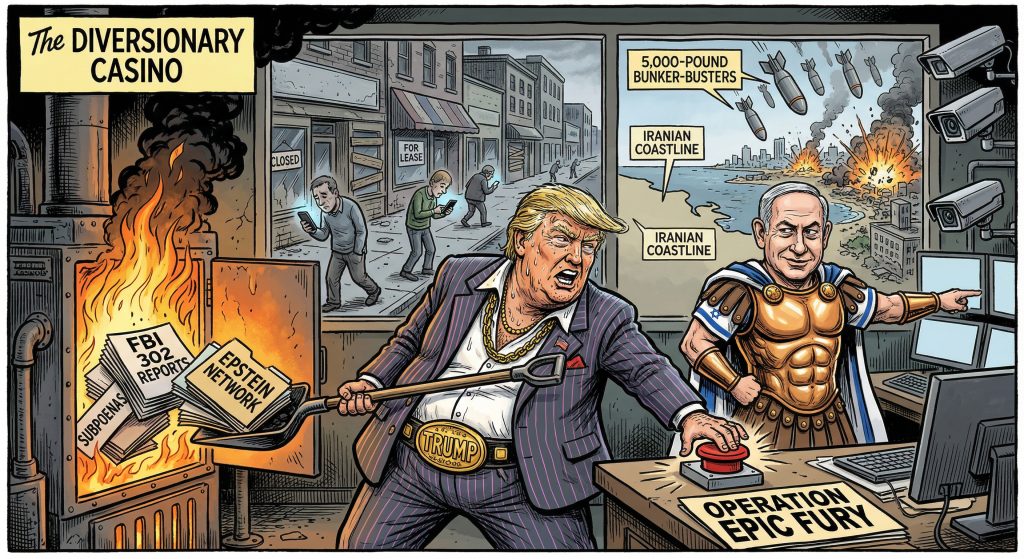
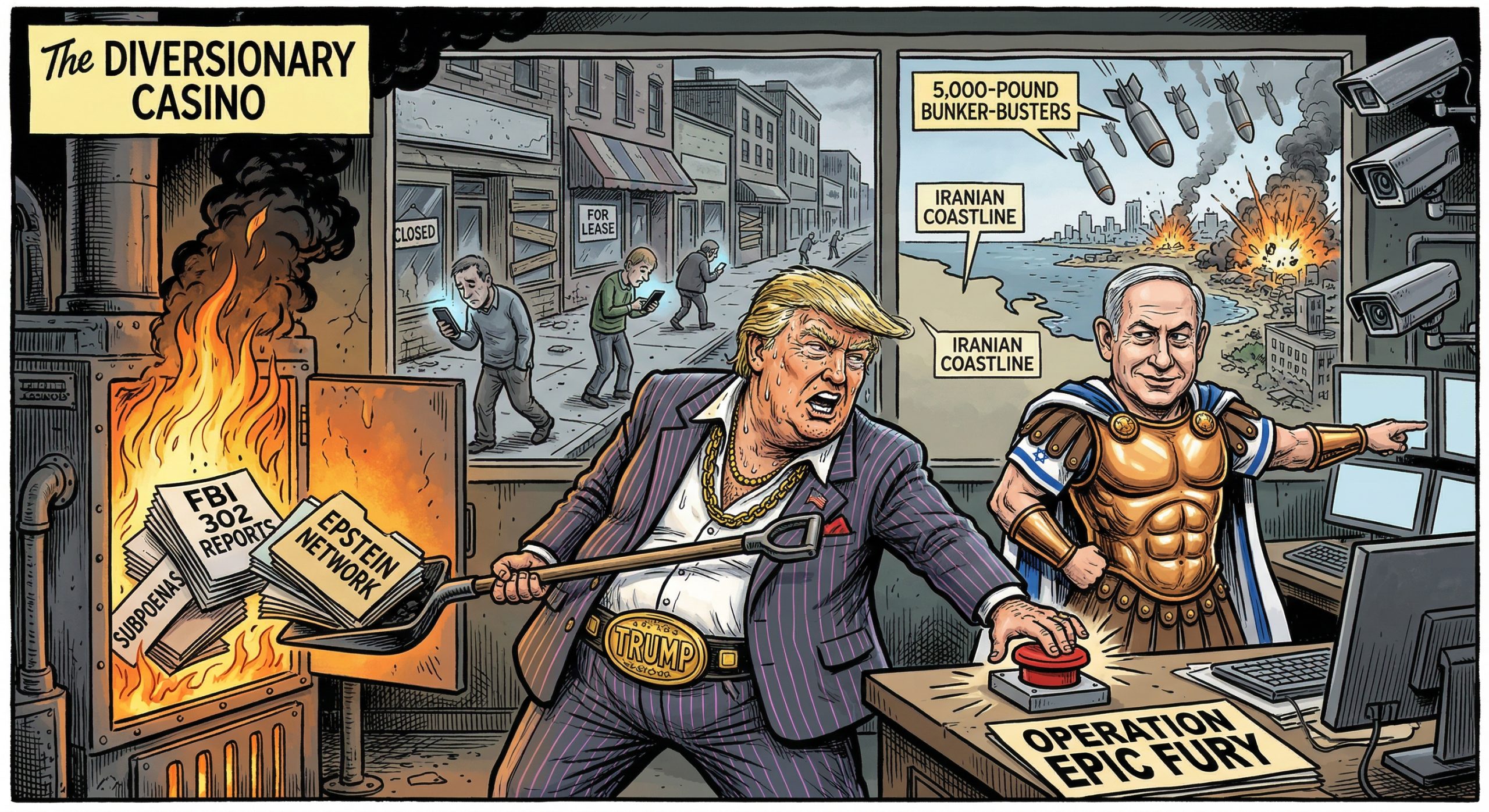
I. The Swerve
In Book II of De Rerum Natura, Lucretius poses a problem that appears, at first, to be about physics. If all atoms fall through the void in parallel streams — identical in velocity, undisturbed by collision — then nothing new can ever come into being. No world. No weather. No war. For creation to occur, something must deviate. Lucretius calls this the clinamen: the smallest possible swerve, unpredictable in time and place, by which one atom departs from its vertical fall, strikes another, and initiates a cascade of collisions from which form, structure, and eventually destruction emerge. The swerve is not chaos. It is the precondition of every organized system. And every organized system carries within itself the memory of the swerve that made it — and the inevitability of the next one that will unmake it.
On February 28, 2026, the United States and Israel launched simultaneous military operations against the Islamic Republic of Iran. The American campaign, designated Operation Epic Fury, had conducted over nine thousand combat flights and struck more than nine thousand targets across Iranian military infrastructure by late March. The Israeli campaign, Operation Roaring Lion, employed more than twelve thousand munitions across eighty-five hundred strike points, destroyed eighty to eighty-five percent of Iran’s air-defense architecture, and killed Supreme Leader Ali Khamenei in the opening hours. Israeli Defense Minister Israel Katz later confirmed that the operation had originally been planned for mid-2026 but was accelerated by months following consultations with the Trump administration. Within three weeks, the International Energy Agency reported that eleven million barrels per day of oil had been removed from global markets — a supply shock that exceeded the 1973 and 1979 energy crises combined.
This was not the swerve.
The swerve happened thirty years earlier, in a study group convened by the Institute for Advanced Strategic and Political Studies in Jerusalem, when a small number of American neoconservative strategists drafted a policy paper for Israel’s newly elected prime minister, Benjamin Netanyahu. The document was titled A Clean Break: A New Strategy for Securing the Realm. It proposed that Israel abandon the Oslo peace process, reject the principle of land for peace, and instead pursue a strategy of regional dominance through the systematic weakening, containment, and rollback of hostile states — beginning with the removal of Saddam Hussein in Iraq. Its authors included Richard Perle, Douglas Feith, and David Wurmser, men who would within five years occupy positions at the center of American war-making authority. Everything that followed — the 2003 invasion of Iraq, the 2006 Israeli assault on Lebanon, the NATO destruction of Libya, the covert destabilization of Syria, and now the joint annihilation campaign against Iran — has been laminar flow along the trajectory that document established.
What shattered on February 28, 2026 was not the trajectory. It was the illusion that it could continue without consequence — the assumption, held by financial markets, energy planners, NATO allies, and perhaps the architects themselves, that the Middle East’s maritime corridors would remain uninterrupted conduits, that American kinetic superiority would translate automatically into strategic dominance, that the global order would absorb the destruction of yet another regional state the way it had absorbed the destruction of the six before it. That illusion broke, and the cascade began: an invisible financial blockade erected by the global insurance market, a fertilizer freeze threatening the food supply of entire continents, a NATO alliance that categorically refused to participate, and a set of non-Western powers — India, China, Turkey — that bypassed American force entirely by negotiating passage directly with Tehran.
This essay traces the arc from the swerve to the cascade. It begins with the 1996 document and its explicit prescriptions. It reaches back further, into the foundational logic of Zionism’s staged territorial program as articulated by David Ben-Gurion. It anatomizes the structural relationship between the United States and Israel — what Noam Chomsky has called the partnership between an imperial patron and “a Middle East Sparta” — and follows the operational thread from the study group’s conference table through the rubble of seven dismantled states to the burning skies above Tehran. It examines the philosophical architecture — descended from Henry Kissinger’s reading of Spengler and Metternich — that permits leaders to manufacture reality through force and rename the devastation as order. And it argues that the war’s timing is inseparable from two closing political windows: the U.S. midterm elections in November 2026, which threaten to end the Republican congressional majority that shields the operation from institutional restraint, and the Israeli election due by October 2026, which threatens to end the far-right coalition that conceived it.
The atoms are in motion. The swerve was thirty years ago. What we are witnessing now is the collision.
II. The Blueprint
In the summer of 1996, a study group convened by the Institute for Advanced Strategic and Political Studies in Jerusalem produced a six-page policy paper for Israel’s newly elected prime minister, Benjamin Netanyahu. The group was led by Richard Perle, then affiliated with the American Enterprise Institute. Its participants included Douglas Feith, an attorney at the Washington firm of Feith and Zell Associates who specialized in defense contracts and joint ventures with aerospace manufacturers; David Wurmser, a policy analyst at the Institute for Advanced Strategic and Political Studies; Meyrav Wurmser, an academic at Johns Hopkins University’s School of Advanced International Studies; James Colbert of the Jewish Institute for National Security Affairs; Charles Fairbanks Jr., also of Johns Hopkins; Robert Loewenberg, the Institute’s president; and Jonathan Torop of the Washington Institute for Near East Policy. The paper was titled A Clean Break: A New Strategy for Securing the Realm.
The document opened with a diagnosis. Labor Zionism, the paper argued, had generated “a stalled and shackled economy” and led Israel into “strategic paralysis.” The Oslo-era peace process had obscured what the authors called “eroding national critical mass” — a condition they described as “a palpable sense of national exhaustion.” The previous government’s reliance on the United States to sell unpopular policies domestically, its willingness to negotiate sovereignty over Jerusalem, and its resigned acceptance of sustained terrorist violence had, in the study group’s assessment, forfeited Israel’s strategic initiative. Netanyahu’s incoming government, the authors proposed, had the opportunity to make a clean break — not merely from specific policies, but from the entire intellectual foundation of the peace process.
The replacement framework was explicit. Where Oslo had pursued “land for peace,” the Clean Break proposed “peace through strength” and “self-reliance: the balance of power.” Where the previous government had sought a comprehensive settlement involving all parties, the Clean Break advised a return to what it called “a traditional concept of strategy based on balance of power.” The document rejected the premise that peace could be achieved through concession. Instead, it argued, Israel should “shape its strategic environment” through active intervention — weakening, containing, and where possible rolling back states that opposed Israeli dominance.
The paper then laid out a specific geographic sequence. On the northern border, Israel should seize “the strategic initiative” by “engaging Hizballah, Syria, and Iran, as the principal agents of aggression in Lebanon.” This included striking Syrian military targets in Lebanon; establishing the precedent that Syrian territory itself was “not immune to attacks emanating from Lebanon by Israeli proxy forces”; and using Lebanese opposition elements “to destabilize Syrian control of Lebanon.” The authors proposed that Israel draw attention to Syria’s weapons of mass destruction program and abandon the slogan “comprehensive peace” in favor of a posture of containment.
The strategic centerpiece, however, was Iraq. The document stated that Israel could “shape its strategic environment, in cooperation with Turkey and Jordan, by weakening, containing, and even rolling back Syria.” It then specified the mechanism: “This effort can focus on removing Saddam Hussein from power in Iraq — an important Israeli strategic objective in its own right — as a means of foiling Syria’s regional ambitions.” The removal of Saddam Hussein was not presented as a response to any particular provocation or an imminent threat. It was framed as a structural prerequisite — a necessary first step in a larger campaign of regional reorganization. The logic was geographic: an Israeli-Jordanian-Turkish axis, with Iraq under Hashemite influence, would “squeeze and detach Syria from the Saudi Peninsula,” potentially serving as “the prelude to a redrawing of the map of the Middle East which would threaten Syria’s territorial integrity.”
The document also addressed the Palestinian question, though with notably less strategic ambition. Israel, the authors wrote, should uphold “the right of hot pursuit for self defense into all Palestinian areas” and cultivate “alternatives to Arafat’s exclusive grip on Palestinian society.” The Palestinian Authority was to be held to “minimal standards of accountability,” and if it failed to comply, Israel would have “no obligations under the Oslo agreements.” The framing was diagnostic, not transformative: the Palestinian issue was a problem to be managed, not a conflict to be resolved. The transformative energy was directed entirely at the regional level — at the destruction or subjugation of states.
Finally, the paper proposed a reframing of the U.S.-Israel relationship. Israel should “make a clean break from the past and establish a new vision for the U.S.-Israeli partnership based on self-reliance, maturity and mutuality.” Concretely, this meant terminating economic aid, which the authors argued “prevents economic reform,” while maintaining military assistance. The document suggested that Netanyahu use his forthcoming visit to Washington to announce that Israel was “now mature enough to cut itself free immediately from at least U.S. economic aid and loan guarantees.” The proposed independence, however, was selective. The Clean Break did not envision Israel acting alone in the regional campaign it prescribed. It envisioned Israel setting the strategic agenda while the United States provided the enabling conditions — military technology, diplomatic cover, and, when necessary, the kinetic force that a small nation could not sustain on its own.
What made the Clean Break historically consequential was not its publication — it was dismissed or ignored by most analysts in 1996 — but the subsequent careers of its authors. Within five years, the same individuals who had drafted a policy paper for an Israeli prime minister occupied positions at the center of American war-making authority. Richard Perle was appointed chairman of the Defense Policy Board Advisory Committee under Defense Secretary Donald Rumsfeld in 2001 — an advisory body with direct access to the Pentagon’s senior leadership and significant influence over war policy. Douglas Feith was appointed Undersecretary of Defense for Policy in July 2001, the number-three civilian position at the Pentagon, where he supervised the Office of Special Plans — a unit that generated intelligence assessments on Iraq’s alleged relationship with al-Qaeda that contradicted the consensus of the CIA and the broader intelligence community. A Pentagon Inspector General report later found that Feith’s office had “developed, produced, and then disseminated alternative intelligence assessments” that “included some conclusions that were inconsistent with the consensus of the Intelligence Community.” David Wurmser served as a Middle East adviser to Vice President Dick Cheney and later to National Security Adviser John Bolton. General Tommy Franks, the commander of the Iraq invasion, described Feith — the man who had proposed removing Saddam Hussein in a 1996 Israeli policy paper and then oversaw the Pentagon office that manufactured the intelligence justification for doing so — as “the dumbest fucking guy on the planet.”
The trajectory from the study group’s conference table to the situation room was not accidental, and the policy prescriptions were not theoretical. The 2003 invasion of Iraq executed the Clean Break’s most explicit recommendation: the removal of Saddam Hussein as a structural prerequisite for regional reorganization. The rationale offered to the American public — weapons of mass destruction, links to al-Qaeda — was fabricated in significant part by offices overseen by a co-author of the document that had first proposed the invasion seven years earlier, for entirely different and explicitly stated reasons: Israeli strategic dominance. The intelligence was new. The objective was not.
The Clean Break’s significance, then, is not that it predicted the future. It is that its authors built the future it prescribed. A policy paper written for an Israeli prime minister became the operational blueprint for American war in the Middle East — not through the force of its ideas alone, but through the placement of its authors in positions where those ideas could be converted into military orders, intelligence assessments, and presidential directives. The document remains publicly available. Its prescriptions are a matter of record. And the distance between its 1996 recommendations and the 2026 campaign against Iran — the last major regional power the Clean Break’s logic requires to be neutralized — is not an inference. It is a sequence.
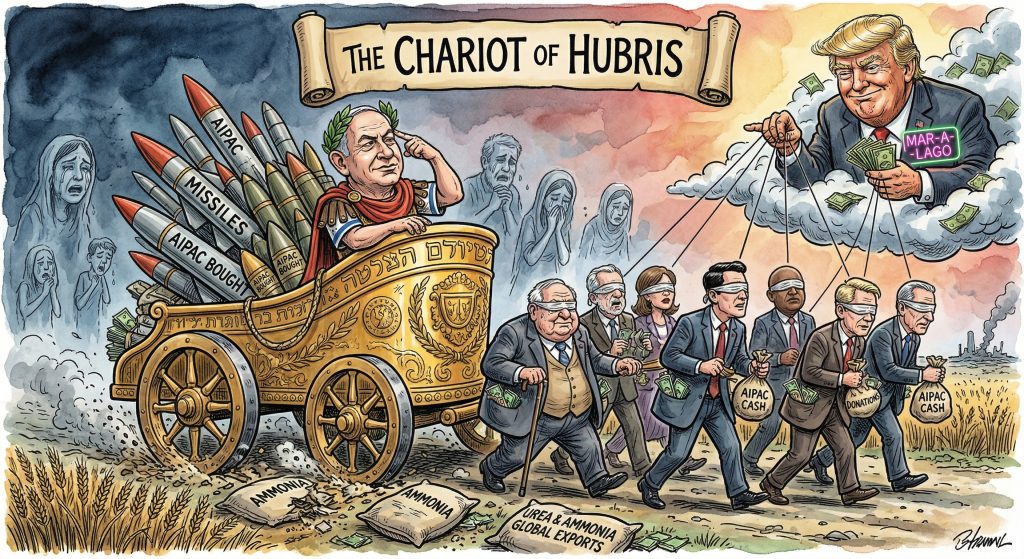
III. The Deep Root
The Clean Break’s logic of incremental territorial expansion through the sequential destruction of regional obstacles did not originate in a 1996 Jerusalem conference room. It was inherited. The same operational grammar — accept partial gains now, consolidate, then expand from a position of strength — was articulated six decades earlier by the man who built the institutional infrastructure of the Israeli state and served as its first prime minister: David Ben-Gurion.
In 1937, the British Royal Commission headed by Lord Peel concluded that Jewish-Arab coexistence in Mandatory Palestine was impossible and recommended partition into two independent states. The commission proposed limiting Jewish immigration to twelve thousand per year over the following five years. For many Zionist leaders, the proposal was a bitter disappointment — a truncated state, hemmed in, dependent on British goodwill. Ben-Gurion saw something else entirely. As his biographer Tom Segev documents, the partition proposal triggered in Ben-Gurion not resignation but what he called a “burning enthusiasm.” In his diary, he wrote: “I see the realization of this program as an almost decisive stage at the beginning of our full redemption and the strongest possible impetus for the step-by-step conquest of Palestine as a whole.”
The key phrase is step-by-step. Ben-Gurion did not regard the proposed partition as a final settlement. He regarded it as a staging area. He explained this to his son Amos with characteristic directness: “A partial Jewish state is not the end but the beginning.” To his political colleagues, he was equally transparent: “We presume that this is only a temporary situation. We will settle first in this place, become a major power, and then find a way to revoke the partition.” And in a formulation that could serve as an epigraph for the Clean Break itself, he stated: “Just as I do not see the proposed Jewish state as a final solution of the Jewish question, so I do not see partition as a final solution to the Palestine question.”
This was not ambiguity. It was method. Ben-Gurion called it the staged program — and it had guided the Zionist movement, in his assessment, since its inception. Each phase of territorial acquisition was to be treated as a platform for the next. No boundary was permanent. No agreement was final. Every concession by the other side was a ratchet that could not be reversed, while every concession by the Zionist movement was provisional, to be revisited once the balance of power had shifted sufficiently.
The most revealing moment in Segev’s account comes when Ben-Gurion received the Peel Commission report’s summary from Moshe Sharett. Reading it for the first time, he immediately grasped that the commission was proposing to remove the Arabs from the territory of the proposed Jewish state, but he did not dare believe what he saw. Only upon a second reading was he persuaded. His reaction was two words, underlined in his diary: “compulsory transfer.” The commission estimated that 225,000 Arabs would be affected. Ben-Gurion’s response was not moral discomfort. It was strategic elation — the recognition that a British Royal Commission had just endorsed, however cautiously, the demographic prerequisite for a Jewish-majority state. What had been an aspiration discussed in private among Zionist leaders was now embedded in an official international document.
This logic — accept the partial, plan for the whole; treat every agreement as a staging area; regard the removal of the indigenous population as a structural necessity rather than a moral problem — is the DNA of the Clean Break doctrine. When Perle, Feith, and Wurmser proposed in 1996 that Israel abandon the Oslo framework, reject the principle of negotiated compromise, and instead pursue regional dominance through the sequential destruction of hostile states, they were not inventing a new strategy. They were translating Ben-Gurion’s staged program into the idiom of American neoconservatism and projecting it onto a regional canvas. Where Ben-Gurion’s stages were territorial — partition, then consolidation, then expansion — the Clean Break’s stages were geopolitical: Iraq first, then Syria, then the isolation of Iran. The method was identical. The scale had changed.
The political scientist Ian Lustick has described the Oslo peace process itself as an “inefficient equilibrium” — a system in which the appearance of negotiation functions as a stalling mechanism, providing diplomatic cover while facts on the ground become irreversible. Settlements expand. Infrastructure is built. Borders harden. The peace process does not fail; it succeeds — at something other than peace. It succeeds at buying time for the staged program to advance another phase. Lustick’s analysis applies with equal force to the broader regional strategy. The intervals between the Clean Break’s prescribed interventions — between Iraq in 2003 and Libya in 2011, between Syria’s destabilization and Iran’s bombardment — were not pauses in a program. They were phases of consolidation. Each destroyed state created the conditions for the next intervention: new basing rights, new intelligence corridors, new precedents for preemption, and the progressive elimination of regional counterweights that might have constrained Israeli freedom of action.
Ben-Gurion died in 1973, more than two decades before the Clean Break was written. He never read the document. But the document’s authors did not need to read his diary to absorb his method. The staged program was not a personal philosophy; it was an institutional inheritance, embedded in the operational culture of the Israeli state, transmitted through its military doctrine, its settlement policy, its negotiating posture, and its strategic relationship with the United States. The Clean Break did not depart from this inheritance. It extended it — from the territorial to the regional, from the bilateral to the imperial, from the management of a single conquered population to the systematic dismantlement of an entire arc of sovereign states. The method remained: accept the stage you are given, plan for the stage you intend to take, and never treat any agreement as anything other than a platform for what comes next.
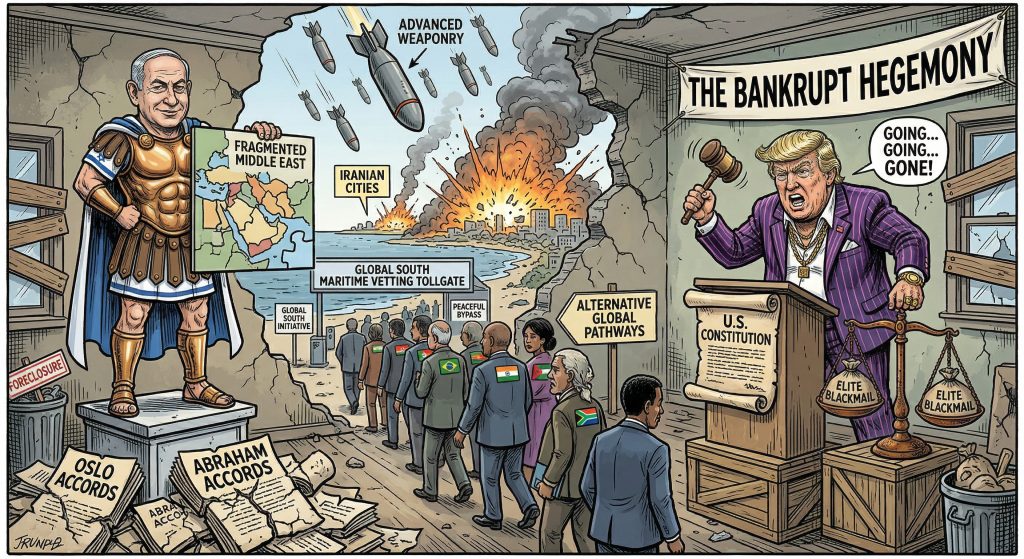
IV. The Enforcement Arm
The Clean Break was a strategy written for Israel by Americans. It prescribed the reorganization of a region that only the United States had the military capacity to reorganize. This asymmetry — between the ambition of the strategy and the resources of the state for which it was written — is not a flaw in the document. It is its most revealing structural feature. The Clean Break assumed, without stating it explicitly, that the United States would perform the kinetic work. That assumption rested on a relationship whose architecture Noam Chomsky spent decades documenting — a relationship he characterized not as an alliance of equals pursuing shared interests, but as a structural dependency in which Israel functions as what he called “a Middle East Sparta in the service of American power.”
The origins of this arrangement are traceable to a specific moment. In the early 1950s, the U.S.-Israel relationship was decidedly uneasy. Washington was considering closer relations with Egyptian President Gamal Abdel Nasser, who had some CIA support, and the Eisenhower administration had not yet settled on Israel as its primary regional instrument. The shift began in the late 1950s. A declassified 1958 National Security Council memorandum noted that a “logical corollary” of opposition to radical Arab nationalism “would be to support Israel as the only strong pro-West power left in the Near East.” Israel simultaneously concluded a secret periphery pact with Turkey, Iran under the Shah, and Ethiopia — an arrangement encouraged by Secretary of State John Foster Dulles. Through the 1960s, American intelligence regarded Israel as a barrier to Nasserite pressure on the Gulf oil-producing states. The doctrine was reinforced by Israel’s overwhelming victory in the 1967 war and confirmed again in September 1970, when Israel moved to block Syrian support for Palestinians being massacred by Jordan at a moment when the United States was unable to intervene directly. Each demonstration of Israel’s utility as a regional enforcer led to a substantial increase in American aid.
What crystallized over these decades was not merely an alliance but a division of labor. The United States provided the financial subsidy, the military technology, the diplomatic shield at the United Nations, and the domestic political architecture that insulated the relationship from democratic accountability. Israel provided the regional intelligence, the forward basing, the operational willingness to act in theaters where American domestic politics made direct intervention difficult, and — critically — the capacity to perform military functions that congressional restrictions prevented the United States from performing in its own name.
Chomsky documented this proxy function with granular specificity. After the 1982 invasion of Lebanon, Israel moved immediately to reinforce its utility as a strategic asset. Foreign Minister Yitzhak Shamir visited General Mobutu in Zaire, offering military and technical support while also promising to leverage Jewish organizations in the United States to improve the dictator’s image — a service Mobutu valued, given that his regime’s most vocal American critics sat in Congress. Defense Minister Ariel Sharon followed with a visit to restructure Zaire’s armed forces. Weeks earlier, Sharon had visited Honduras, where Israel had helped build what was regarded as the strongest air force in Central America. A top-level Honduran military source confirmed that the agreement involved jet fighters, tanks, Galil assault rifles — the standard-issue weapon of state terrorists across the region — and training for officers, troops, and pilots. A Honduran government functionary observed that Sharon’s visit was “more positive” than President Reagan’s shortly before, since Sharon “sold us arms” while “Reagan only uttered platitudes, explaining that Congress was preventing him from doing more.”
That formulation — Congress was preventing him from doing more — captures the structural logic with uncomfortable precision. Congressional human rights restrictions, a product of the post-Vietnam reassertion of legislative authority, impeded direct American military aid to regimes engaged in mass killing. Israel faced no equivalent domestic constraint. It could therefore perform the military functions — arming Guatemalan death squads, training Honduran pilots, restructuring Zairian armed forces — that the United States wanted performed but could not perform openly. This was not a marginal byproduct of the relationship. It was a core function. Chomsky documented Israel’s services in Nicaragua under Somoza, in Guatemala, El Salvador, Honduras, and Costa Rica; in Zaire, Ethiopia, and South Africa; in supplying American jets to Indonesia as it massacred the population of East Timor; and in the deepening alliance with Taiwan and apartheid South Africa that the Israeli press itself referred to as the “Fifth World” — a network of technologically advanced states engaged in weapons development, including nuclear weapons, beyond the reach of international oversight.
The political scientist Michael Klare proposed a taxonomy that Chomsky found analytically useful: the distinction between “Prussians” and “Traders.” Both factions within the American policy establishment shared the same goals — American dominance over the Middle East’s energy reserves and the political arrangements of the region. They differed on means. The Prussians advocated the threat or use of violence to achieve these ends. The Traders believed peaceful means would be more effective. Critically, both positions were tactical, not moral — and individuals could shift between them as circumstances changed. What Chomsky observed was that the Prussians had won every major round of the internal policy debate since the late 1960s, and that Israel’s perceived utility as a strategic asset was the cornerstone of that victory. Those who viewed Israel as a regional Sparta — capable of projecting force on behalf of American interests without the political costs of direct American intervention — consistently prevailed over those who argued that a political settlement of the Palestinian conflict would better serve long-term American interests.
The structural consequence of this pattern was a progressive fusion of Israeli strategic objectives with American military capacity. The fusion was not total — Chomsky was careful to note, citing the former head of Israeli military intelligence General Shlomo Gazit, that Israel functioned as “effectively an extension of the U.S. military and economic interests” while remaining not entirely under control. “Client states commonly pursue their own paths, to the chagrin of the masters,” Gazit observed. The contradiction was built into the relationship from the beginning: the patron needed the client to perform functions it could not perform itself, which meant granting the client operational autonomy, which meant the client could use that autonomy to pursue objectives the patron had not authorized or even desired.
In the 1980s, this paradox manifested as Israeli arms deals in Central America and Africa that occasionally embarrassed Washington. In the 2000s, it manifested as the Clean Break authors — now installed in the Pentagon and the Vice President’s office — pursuing Israeli strategic objectives through the machinery of American war-making. In 2026, the paradox has reached what may be its terminal expression. Operation Roaring Lion — conceived by the Israeli security establishment, framed from the outset as a campaign of regime change, and accelerated on a timeline set by Israeli political needs — is being executed with decisive American kinetic support under Operation Epic Fury. The patron did not conceive the war. The patron did not set its objectives. The patron is providing nine thousand combat flights, five-thousand-pound bunker-buster munitions, A-10 Warthog attack aircraft, and the logistical infrastructure of United States Central Command. The client set the agenda. The patron provided the capacity. The division of labor that Chomsky documented in Honduras and Zaire in the 1980s — Israel selling arms while Reagan uttered platitudes about what Congress would not allow — has scaled from proxy wars in the periphery to a direct, joint military campaign against a nation of ninety million people.
Chomsky wrote in the early 1980s, before the Clean Break existed, before the invasion of Iraq, before the destruction of Libya and Syria, before the bombing of Tehran: “As long as the United States remains committed to an Israeli Sparta as a strategic asset, blocking the international consensus on a political settlement, the prospects are for further tragedy: repression, terrorism, war, and possibly even a conflict that will engage the superpowers, eventuating in a final solution from which few will escape.” The passage was written as a warning. It reads now as a structural prediction — not because Chomsky foresaw the specific events of 2026, but because he understood the logic of the system well enough to know where it led. The structural relationship he described has not changed. It has only intensified, and the consequences he identified have only materialized with greater and greater precision, across a wider and wider geography, at a higher and higher human cost.
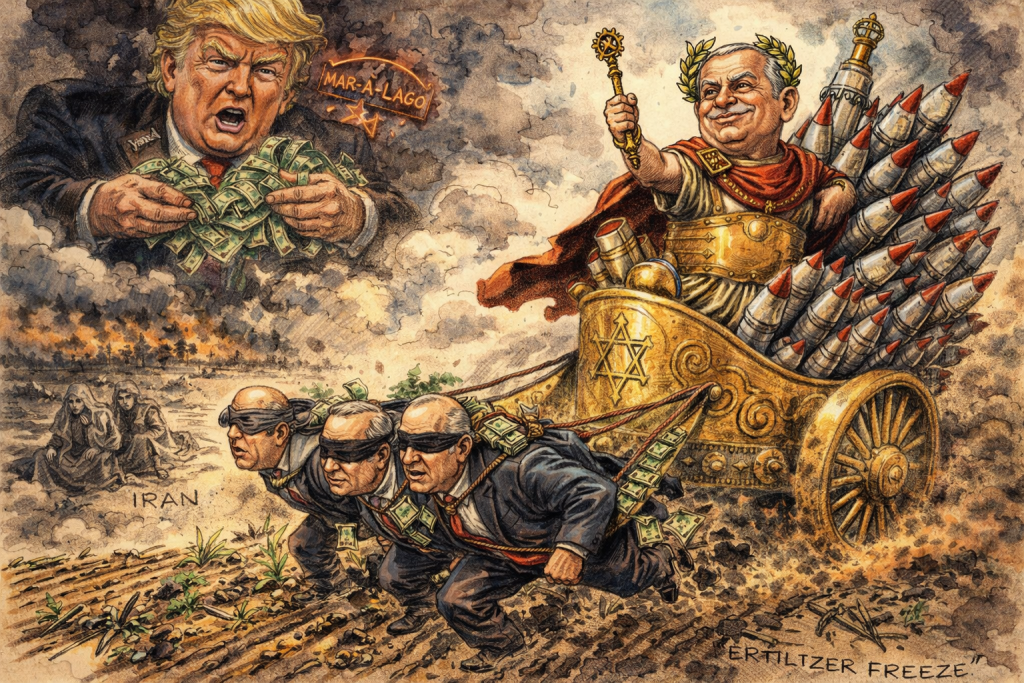
V. The Sequence
In March 2007, retired four-star General Wesley Clark — former Supreme Allied Commander of NATO, recipient of the Presidential Medal of Freedom, and 2004 Democratic presidential candidate — described on the program Democracy Now! a conversation he had at the Pentagon shortly after September 11, 2001. Clark recounted visiting a senior general at the Joint Chiefs of Staff, who told him the United States had made the decision to go to war with Iraq. When Clark returned weeks later, the same officer showed him a classified memorandum from the office of Secretary of Defense Donald Rumsfeld. Clark recalled the officer’s words: “This is a memo that describes how we’re going to take out seven countries in five years, starting with Iraq, and then Syria, Lebanon, Libya, Somalia, Sudan and, finishing off, Iran.”
Clark also described an earlier conversation, in May 1991, with Paul Wolfowitz, then the third-ranking civilian at the Pentagon. According to Clark, Wolfowitz lamented that the United States had failed to remove Saddam Hussein during the Gulf War, but drew a broader lesson from the experience: “With the end of the Cold War, we can now use our military with impunity. The Soviets won’t come in to block us. And we’ve got five, maybe ten years to clean up these old Soviet surrogate regimes like Iraq and Syria before the next superpower emerges to challenge us.”
These were not the revelations of a marginal figure or an anonymous source. Clark was a four-star general who had commanded NATO forces in combat. He presented the seven-country list not as speculation but as his account of a classified document he was shown by a serving officer at the Pentagon, attributed to the office of the Secretary of Defense. The list he named — Iraq, Syria, Lebanon, Libya, Somalia, Sudan, Iran — maps with extraordinary precision onto the Clean Break’s 1996 prescriptions and onto the subsequent three decades of American and Israeli military interventions.
The sequence, as it unfolded, proceeded as follows.
Iraq, 2003. The Clean Break’s most explicit recommendation — the removal of Saddam Hussein as “an important Israeli strategic objective in its own right” — was executed through a direct American invasion, justified by intelligence claims that Iraq possessed weapons of mass destruction and maintained an operational relationship with al-Qaeda. Both claims were later determined to be false. The intelligence assessments supporting them were generated in significant part by the Office of Special Plans, overseen by Clean Break co-author Douglas Feith in his capacity as Undersecretary of Defense for Policy. The invasion shattered Iraqi state capacity, dissolved its military, ignited a sectarian civil war that killed hundreds of thousands, and — precisely as critics had warned and Clean Break advocates had desired — removed the most significant Sunni Arab counterweight to Israeli and Iranian power simultaneously.
Lebanon, 2006. The Clean Break had specified that Israel should seize “the strategic initiative along its northern borders by engaging Hizballah, Syria, and Iran, as the principal agents of aggression in Lebanon.” In July 2006, Israel launched a thirty-four-day war against Hezbollah in Lebanon, bombing infrastructure across the country and killing over a thousand Lebanese civilians. The stated trigger was a Hezbollah cross-border raid. The structural context was the Clean Break’s prescription: degrade Hezbollah’s capacity and demonstrate that the northern border could not be used as a platform for resistance to Israeli dominance. The war failed to destroy Hezbollah but inflicted severe damage on Lebanese civil society and infrastructure — a pattern that would repeat in subsequent interventions, where the destruction of state capacity, rather than the achievement of any stated political objective, appeared to be the functional outcome.
Libya, 2011. NATO forces, led by the United States, France, and the United Kingdom, launched a bombing campaign that overthrew the government of Muammar Gaddafi. The intervention was justified under a United Nations authorization to protect civilians. It produced instead a state collapse that persists to this day — competing governments, militia rule, open slave markets, and the transformation of Libya into a corridor for weapons trafficking and migration across the Mediterranean. Libya was not named in the Clean Break document, but it appeared on Clark’s seven-country list and on the broader neoconservative map of regional transformation articulated through the Project for the New American Century.
Somalia and Sudan. Both states have been subjected to sustained destabilization across decades — Somalia through a U.S.-backed Ethiopian invasion in 2006 and continuous drone warfare, Sudan through support for the secession that produced South Sudan in 2011 and the internal destabilization that culminated in the ongoing civil war. Neither state functions as a coherent sovereign entity. Both appear on Clark’s list. Both occupy strategic positions along the Red Sea corridor and the Horn of Africa.
Syria, 2011–2024. The Clean Break had prescribed the use of “Israeli proxy forces” to strike Syrian military targets and the destabilization of Syrian control over Lebanon through opposition elements. Beginning in 2011, the CIA ran a covert program known as Timber Sycamore, channeling weapons and training to armed opposition groups fighting the government of Bashar al-Assad. The program, which operated alongside overt support from Turkey, Saudi Arabia, and Qatar, fueled a civil war that killed hundreds of thousands, displaced half the population, and created the conditions for the rise of the Islamic State. Israel conducted hundreds of airstrikes on Syrian territory throughout the conflict. In December 2024, the Assad government fell. Israel immediately launched more than five hundred airstrikes against Syrian military targets, destroying air defenses and establishing what military analysts described as a safe air corridor toward Iran.
Iran, 2025–2026. The final entry on Clark’s list. The final state on the Clean Break’s implicit horizon. In June 2025, Israel launched Operation Rising Lion — a limited campaign targeting Iranian nuclear infrastructure and missile production during the Twelve-Day War. In February 2026, the campaign escalated to Operation Roaring Lion — an explicit regime-change operation — alongside the concurrent American Operation Epic Fury. The combined campaign has employed over twenty-one thousand munitions, killed the Supreme Leader, and destroyed the vast majority of Iran’s air-defense architecture, missile production capacity, and command-and-control infrastructure. Netanyahu has framed the operation in terms that mirror the Clean Break’s language with striking fidelity: not a reactive defense against a specific threat, but a campaign to reshape the regional environment and remove the final obstacle to Israeli strategic supremacy.
The seven-country list has now been completed. Not in five years, as the Rumsfeld memo apparently envisioned, but in twenty-three. The timeline slipped. The sequence held.
What makes this sequence structurally significant — rather than merely a coincidence of geography — is the personnel continuity that bridges the 1996 document to the 2026 campaign. The institutional vehicle for this continuity is the Vandenberg Coalition, a neoconservative foreign policy organization founded in 2021 by Elliott Abrams. Abrams served as Trump’s Special Envoy for Iran and Venezuela during the first Trump administration, as Special Assistant to the President for Near East and North African Affairs under George W. Bush — where he helped shape the policy framework for the Iraq invasion — and as Assistant Secretary of State under Reagan, where he was convicted of unlawfully withholding information from Congress during the Iran-Contra affair before being pardoned by George H.W. Bush.
The Vandenberg Coalition’s leadership and advisory structure constitute a direct institutional bridge between the Clean Break era and the present. The coalition’s advisory board, as documented by the investigative outlet Byline Times, includes Lewis “Scooter” Libby, who co-signed PNAC’s 1997 founding statement of principles alongside Abrams, Dick Cheney, Donald Rumsfeld, and Paul Wolfowitz, and who served as Cheney’s chief of staff until his 2005 indictment and conviction on four felony counts related to the exposure of CIA officer Valerie Plame — a conviction later pardoned by Trump. It includes Paula Dobriansky, another PNAC co-signatory who served as Under Secretary of State for Global Affairs under George W. Bush. It includes Eric Edelman, who succeeded Douglas Feith as Under Secretary of Defense for Policy in 2005.
And it includes David Feith — the son of Douglas Feith, Clean Break co-author and architect of the Iraq War’s intelligence fabrication apparatus. The younger Feith served in Trump’s first administration as Deputy Assistant Secretary of State. In January 2025, he was appointed as a senior director on Trump’s National Security Council, where he oversees national security and technology issues. His father, Douglas Feith, continues to publish on Middle East policy at the Hudson Institute, where he has co-authored work with fellow Vandenberg advisory board member Lewis Libby.
The generational dimension of this continuity is difficult to overstate. The son of a man who co-authored a 1996 Israeli policy paper recommending the removal of Saddam Hussein — and who then manufactured the intelligence that justified doing so — now sits on the National Security Council of the administration that launched the final war on the final country that his father’s document implicitly targeted. The strategy has not merely persisted across three decades. It has been inherited.
VI. The Dual Campaign
On the night of June 13, 2025, the Israeli Air Force launched five waves of airstrikes against Iran, deploying more than two hundred fighter jets to drop over three hundred munitions on approximately one hundred targets in the opening hours alone. The operation, which Israel designated Rising Lion — a name Netanyahu said he chose personally, after a biblical prophecy that the people of Israel would rise like lions from adversity — targeted nuclear enrichment facilities at Natanz, Isfahan, and Arak; ballistic missile production infrastructure; air defense networks; and senior military commanders and nuclear scientists, many killed in their homes or in meetings. Within twelve days, Israel had destroyed or severely damaged the core of Iran’s declared nuclear program, eliminated three chiefs of staff, and degraded more than half of Iran’s ballistic missile arsenal. The United States, which had initially greenlighted the operation as a unilateral Israeli action, joined on June 22 with Operation Midnight Hammer, striking three deeply buried nuclear facilities that required American ordnance to penetrate. Iran retaliated with over five hundred ballistic missiles and a thousand drones, killing twenty-eight Israeli civilians and injuring nearly fifteen hundred. On June 24, under American pressure, a ceasefire was declared.
Netanyahu declared a historic victory. He announced that Israel had removed two existential threats: nuclear weapons and ballistic missiles. But the ceasefire was not a resolution. It was an intermission. The IDF acknowledged that Iran retained residual capabilities — command structures, reconstitution capacity, the institutional knowledge to rebuild. Israeli defense analysts at the Institute for National Security Studies warned that Iran’s motivation to acquire nuclear weapons had likely increased, not decreased, as a result of the war. The Foreign Policy Research Institute assessed that the pause in combat could be “a prelude to a major, wider, and longer-lasting conflict.” Within months, Israeli intelligence identified that Iran had resumed efforts to advance missile production, fortify and conceal elements of its nuclear program, and rehabilitate air defense systems degraded during the Twelve-Day War.
Eight months later, on February 28, 2026, the intermission ended. Israel launched Operation Roaring Lion — the second phase of a campaign whose naming sequence was deliberate. Rising, then Roaring. The escalation was not merely rhetorical. Where Rising Lion had been framed as a limited preemptive operation targeting specific military and nuclear capabilities, Roaring Lion was framed from its first hour as a campaign of regime change. Netanyahu’s public communications wove military triumphalism with explicit calls for the Iranian people to overthrow their government. The operation’s opening strikes killed Supreme Leader Ali Khamenei — a target that Rising Lion had explicitly avoided, with Israel’s National Security Council chief stating during the Twelve-Day War that Iranian political leadership was not being targeted. That restraint was abandoned.
The scale was commensurate with the ambition. By late March, the Israeli Air Force had conducted approximately fifty-seven hundred combat sorties and more than five hundred forty strike waves across central and western Iran. Over twelve thousand munitions had been employed, including roughly thirty-six hundred in the Tehran region alone, generating approximately eighty-five hundred strike points across the country. Israeli officials assessed that eighty to eighty-five percent of Iran’s air defense architecture — radars, interceptors, detection systems — had been destroyed. Iran’s ballistic missile production capacity, estimated at one hundred per month before the war, had been reduced to zero. Operational flexibility allowed real-time targeting of senior figures at ranges of fifteen hundred kilometers. In the opening phase, Israel reportedly eliminated forty individuals within forty seconds.
Concurrent with Roaring Lion, the United States launched Operation Epic Fury. The American campaign, while coordinated with Israel, served a distinct strategic logic. Where Roaring Lion targeted the regime’s survival — its command structures, its symbols, its leadership — Epic Fury targeted Iran’s capacity to project force beyond its borders and to threaten the maritime corridors that carry the world’s energy supply. By late March, United States Central Command reported over nine thousand combat flights and nine thousand targets struck, including IRGC command and control centers, ballistic missile manufacturing facilities, weapons storage bunkers, and naval assets. More than one hundred forty Iranian naval vessels had been damaged or destroyed, along with forty-four dedicated mine-laying watercraft. The U.S. Air Force authorized the combat debut of the GBU-72 Advanced 5K Penetrator — five-thousand-pound bunker-buster munitions delivered by stealth bombers and F-15E Strike Eagles — to destroy coastal defense cruise missile sites built into rocky shorelines. A-10 Thunderbolt II attack aircraft used thirty-millimeter Gatling guns and Maverick missiles to hunt IRGC fast-attack boats attempting swarming tactics in the narrow waters of the Strait of Hormuz.
The two operations were distinct but interlocking. Epic Fury could not have been launched without Roaring Lion’s prior degradation of Iranian air defenses. Roaring Lion could not sustain its intensity without Epic Fury’s suppression of Iran’s retaliatory capacity and its logistical infrastructure. The United States provided the platform — the carrier strike groups, the aerial refueling, the intelligence architecture of Central Command. Israel provided the strategic direction — the target lists, the intelligence penetration, the regime-change framing. Defense Minister Israel Katz confirmed the relationship explicitly: the operation had been planned for mid-2026 but was accelerated by months following consultations with the Trump administration. The consultations did not produce the strategy. They accelerated its execution. The strategy itself — the systematic destruction of Iran’s state capacity as the culmination of a regional campaign of dismemberment — had been written thirty years earlier, in a study group in Jerusalem, by men whose intellectual and institutional heirs now occupied positions on both sides of the operation.
The transition from Rising Lion to Roaring Lion reveals the staged program at work in real time. The first phase — limited, deniable, framed as defensive — established the operational precedent, degraded the target set, and tested both Iranian and international responses. The ceasefire that followed was not a commitment to peace. It was, in Ben-Gurion’s formulation, a temporary situation — a platform from which to launch the next phase. When that next phase came, it came with expanded objectives, expanded force, and the explicit abandonment of the restraints that had defined the first operation. The pattern is structurally identical to the staged program Segev documented in Ben-Gurion’s diaries: accept the partial gain, consolidate, and then move to the next stage from a position of strength. The only difference is scale. Ben-Gurion’s stages were measured in square kilometers of Mandatory Palestine. Netanyahu’s are measured in sovereign states.
VII. The Philosopher of Force
The operational logic that permits a state to launch a war of regional annihilation without legislative authorization, to assassinate the head of a sovereign government in the opening hours, and to frame the resulting devastation as a necessary act of civilization — this logic did not materialize in 2026. It has a philosophical genealogy, and that genealogy runs through Henry Kissinger.
Kissinger’s worldview was forged in the aftermath of the Holocaust and refined through an undergraduate thesis at Harvard titled “The Meaning of History: Reflections on Spengler, Toynbee, and Kant.” Drawing on the tragic pessimism of Oswald Spengler’s The Decline of the West, the young Kissinger became fascinated by what Spengler called the “men of blood” — statesmen who do not wait for moral consensus but who feel the pulse of historical necessity and actualize it through force and will. In Spengler’s framework, civilizations are organisms that pass through cycles of growth and decay, and the great statesmen are those who recognize the phase they inhabit and act accordingly, without illusion and without apology. Kissinger absorbed this framework and fused it with a Kantian inwardness: the conviction that reality does not exist independently of our perception of it, and that the statesman’s task is therefore not to respond to reality but to create it.
This synthesis hardened into a practical doctrine in Kissinger’s subsequent study of Metternich and Castlereagh in A World Restored, where the statesman is defined as a tragic actor operating in the space between what is considered just and what is considered possible. The true test of statesmanship, Kissinger argued, is the ability to recognize the real relationship of forces and to manipulate that relationship without becoming a prisoner of events. The tragic statesman understands that preserving order often requires actions that procedural law or polite society will deem criminal. He acts in the void of meaning. He finds the sanction for his actions only within himself. And he relies on the dominance that force produces to dictate the vocabulary of peace and stability after the fact.
As historian Niall Ferguson noted in his biography Kissinger: 1923–1968: The Idealist, Kissinger was not a crude Machiavellian realist but a philosophical idealist who believed that the supreme act of statecraft was the imposition of form on chaos. The statesman acts on intuition before others can validate it, creating the reality that the rest of the world must subsequently navigate. Greg Grandin, in Kissinger’s Shadow, identified the lethal consequence of this philosophy: it produces a system in which power acts first, shatters the existing paradigm, and then relies on its dominance to rename the devastation as necessity. Grandin observed that Ferguson’s defense of Kissinger ultimately rested on weighing the loss of life in “strategically marginal” countries against the macro-outcome of great-power competition — a calculus in which Cambodian or Chilean or Palestinian lives register only as inputs to a cost-benefit analysis whose terms are set by the powerful.
The philosophical framework matters because it was not merely theoretical. Kissinger’s practical application of these ideas produced specific, documented consequences that created the structural conditions for everything the Clean Break would later prescribe.
In February 1971, Egyptian President Anwar Sadat offered Israel a full peace treaty on the pre-June 1967 borders, with security guarantees and recognized boundaries — an offer more favorable to Israel than what he would propose six years later on his celebrated trip to Jerusalem. The offer caused what the Israeli writer Amos Elon described as “panic” within the Israeli establishment — not because it was unreasonable, but because it threatened to succeed. Kissinger blocked it. He took pride, in his memoirs, in his steadfastness in overriding the State Department’s efforts toward a peaceful settlement. His aim, as he wrote, was “to produce a stalemate until Moscow urged compromise or until, even better, some moderate Arab regime decided that the route to progress was through Washington.” As Chomsky observed, the account was “remarkable for its ignorance and geopolitical fantasies”: Sadat had already decided that the route to progress was through Washington, and Saudi Arabia did not even have diplomatic relations with the Soviet Union. The conditions Kissinger claimed to be waiting for already existed. He blocked the settlement anyway.
The consequences were direct. American ambassadors across the Middle East warned unanimously that if the peace process was perceived to have ended, there would be a disastrous war. Sadat himself warned repeatedly that he would be forced to resort to military action if his diplomatic efforts were rebuffed. Both warnings were dismissed with contempt — on the assumption, shared by Kissinger and the Israeli establishment, that Israeli military supremacy was unchallengeable. In October 1973, Sadat made good on his warning. The resulting war — which came perilously close to a nuclear confrontation when Kissinger called a strategic alert to prevent Soviet intervention — demonstrated exactly what the tragic statesman’s philosophy produces when applied to reality: not the stable order it promises, but escalating catastrophe born of the refusal to accept that other actors have legitimate interests and the capacity to act on them.
After the 1973 war forced a reassessment, Kissinger undertook his celebrated shuttle diplomacy. But the purpose of that diplomacy, as Chomsky documented, was not to achieve a comprehensive peace. It was to accept Egypt as an American client state, remove it from the Arab-Israeli conflict through a bilateral Sinai agreement, and thereby free Israel to continue integrating the occupied territories and concentrating its forces for future wars on the northern border — which it did, invading Lebanon in 1978 and again in 1982. Kissinger’s diplomacy did not produce peace. It produced the structural conditions for the next phase of expansion: a neutralized Egypt, a discredited Arab coalition, and an Israel freed from its most powerful military constraint to pursue the agenda that the Clean Break would later formalize.
The connective tissue between Kissinger and the 2026 crisis is not merely intellectual. It is structural. Kissinger’s rejectionism — his systematic blocking of every diplomatic initiative that might have produced a comprehensive settlement — created the conditions in which the Clean Break’s prescription for unilateral dominance through force became thinkable. If peace had been achieved in 1971, or 1976, or at any of the dozens of moments when it was within reach, there would have been no strategic vacuum for the Clean Break to fill. The thirty-year program of regional dismemberment was built on the ruins of the diplomatic possibilities that Kissinger, more than any single individual, ensured would never be realized.
And the philosophy persists. The behavior of the American executive in 2026 — launching a massive military campaign without congressional authorization, assassinating a head of state, plunging a volatile region into multi-front war, and framing the resulting devastation as a necessary preemptive defense of civilization — is the operational expression of the Kissingerian doctrine at its most terminal. The administration does not wait for moral clarity or legislative consensus. It strikes to maximize media coverage, relies on the shock of overwhelming force to seize the narrative, and renames the resulting chaos as order. It is the doctrine of the men of blood brought to its logical conclusion: the conviction that impunity is not a byproduct of power but its essence, and that the crimes of the present can always be dissolved in the spectacle of the next crisis.
VIII. The Broken Machine
The Clean Break required two things to reach its terminal phase: a strategy and a vehicle. The strategy existed on paper since 1996. The vehicle — an American government sufficiently dysfunctional to serve as an instrument of a client state’s strategic ambitions without exercising independent judgment about whether to do so — materialized in stages over the subsequent decades and reached its fullest expression in early 2026.
The most direct indicator of institutional breakdown is the absence of constitutional process. Operation Epic Fury was launched on February 28, 2026 without congressional authorization. The War Powers Resolution of 1973 requires the president to notify Congress within forty-eight hours of committing armed forces to military action and to withdraw those forces within sixty days unless Congress authorizes the use of force or extends the deadline. The administration provided no such authorization and sought none. When a bipartisan war powers resolution — led by Democratic Representative Ro Khanna and Republican Representative Thomas Massie — was brought to the House floor, it failed by a vote of 212 to 219. Only two Republicans, Massie and Representative Warren Davidson, voted in favor. The remaining Republican caucus voted to ratify a fait accompli: a war already underway, launched by executive decree, against a nation of ninety million people. Senate Republicans simultaneously refused to schedule public hearings with the Secretary of Defense, the Secretary of State, or other cabinet officials. Senator Mike Rounds of South Dakota conceded that public support for the war remained tepid but argued that classified briefings were sufficient for congressional oversight.
The legislative branch did not authorize the war. It did not meaningfully oversee it. It did not even require the executive to justify it in public. The constitutional mechanism designed to prevent precisely this scenario — a president unilaterally committing the nation to a major foreign war — was bypassed with a four-vote margin in the House and procedural obstruction in the Senate. The institutional check did not fail because it was overpowered. It failed because the majority party chose not to exercise it.
Beyond congressional abdication, the executive branch itself entered the crisis under extraordinary domestic pressure. In late 2025, the 119th Congress passed the Epstein Files Transparency Act by a vote of 427 to 1 in the House and by unanimous consent in the Senate, mandating that the Department of Justice release all unclassified documents related to the Jeffrey Epstein and Ghislaine Maxwell investigations, including an unredacted list of government officials and politically exposed persons named in the corpus. The president signed the legislation on November 19, 2025. The statutory deadline for compliance was December 19, 2025. The Department of Justice, under Attorney General Pam Bondi and Deputy Attorney General Todd Blanche, missed the deadline, releasing only a partial and heavily redacted tranche of documents. In late February 2026 — days before the launch of military operations against Iran — independent journalists and congressional investigators discovered that the DOJ had withheld specific FBI interview reports containing severe allegations against the president himself, involving the alleged abuse of a minor. The Department claimed the documents had been “incorrectly coded as duplicative.” Representative Robert Garcia, the ranking Democrat on the House Oversight Committee, publicly accused the administration of orchestrating a cover-up.
The temporal proximity between the Epstein revelations and the launch of Operation Epic Fury did not escape the American public. A comprehensive survey conducted by the polling firms Drop Site, Zeteo, and Data for Progress between March 6 and 8, 2026, found that fifty-two percent of Americans believed the president had launched the war on Iran in part to distract from the Epstein scandal. Among Democrats, the figure was eighty-one percent. Among independents — the voters who determine midterm elections — it was fifty-two percent. Even among Republicans, twenty-six percent agreed. The widespread public characterization of the campaign as “Operation Epstein Distraction” proliferated across social media and international press.
This essay does not assert that the Iran war was launched solely or primarily as a diversionary tactic. The structural analysis of the preceding sections demonstrates that the strategy to destroy Iran predated the Epstein crisis by three decades and was embedded in an institutional architecture — the Clean Break, PNAC, the Vandenberg Coalition — that operated independently of any single domestic scandal. What the Epstein chronology demonstrates is something different and arguably more significant: the degree of institutional decay in which the American executive operates. A government that is actively breaking its own transparency laws to shield the president from allegations of child abuse, that launches a major war days later without congressional authorization, and that refuses to subject its war-making to public legislative scrutiny is not a government exercising independent strategic judgment. It is a government in a state of capture — captured not by a foreign power in the conspiratorial sense, but by a convergence of domestic legal crisis, institutional corruption, and the structural dependency on an allied state whose strategic agenda has been decades in the making.
The media environment completed the circuit. The war commanded the news cycle. Congressional inquiries into missing FBI documents were displaced by urgent briefings on Iranian retaliation, the closure of the Strait of Hormuz, and the global economic fallout. The spectacle of military operations — emergency addresses, troop mobilizations, missile interceptions — consumed the bandwidth that investigative reporting and legislative oversight require to function. This is not a novel dynamic. The political science literature has long documented the “rally-around-the-flag” effect, in which leaders facing severe domestic crises benefit from foreign conflicts that redirect public attention and suppress dissent. What is novel about the 2026 case is the transparency of the mechanism. The majority of the American public could see it happening and named it as such — and the war proceeded anyway.
The structural consequence is a terminal inversion. Chomsky had described a partnership in which the United States set the strategic framework and Israel performed subsidiary services — proxy wars in Central America, arms deals in Africa, intelligence operations beyond the reach of congressional oversight. By 2026, the directionality has reversed. Israel set the strategic objective: the destruction of Iran as the final obstacle to regional supremacy. Israel determined the operational timeline: the acceleration from mid-2026 to February 28. Israel defined the campaign’s ambition: regime change, a target the United States had not publicly adopted as policy. The United States provided the kinetic capacity, the logistical infrastructure, and — most critically — the institutional passivity that permitted all of this to occur without democratic deliberation.
A government that cannot enforce its own transparency laws, that cannot exercise its constitutional war powers, that cannot subject its most consequential foreign policy decision to public debate, and whose executive operates under the shadow of suppressed allegations of personal criminality — such a government is not a partner in an alliance. It is an instrument. And the actors who understand this most clearly are not the critics of the war but its architects, who have spent thirty years building the institutional conditions under which the instrument could be used.
IX. The Closing Windows
If the Clean Break provided the strategy and American institutional dysfunction provided the vehicle, the question remains: why now? The strategy has existed for thirty years. The vehicle has been available, in varying degrees of disrepair, since at least 2003. Why was February 2026 the moment the final phase was launched? The answer lies in two closing windows — one American, one Israeli — whose convergence created a narrow aperture of political possibility that is visibly expiring.
The American window is defined by Republican control of Congress. In November 2026, all 435 seats in the House of Representatives and 35 of 100 Senate seats will be on the ballot. Republicans currently hold both chambers by slim margins — margins that every historical precedent, every polling indicator, and every structural analysis suggests they will lose. The president’s job approval rating, as measured by an NPR/PBS/Marist poll in early March 2026, stands at thirty-nine percent. Among independents, it has collapsed to thirty percent. Among Latinos — a demographic pillar of the 2024 coalition — it has fallen to thirty-eight percent. Among voters under thirty, to thirty percent. Historical data is unambiguous: every president since Harry Truman whose approval was below fifty percent in the month before a midterm election lost House seats. When approval falls below forty percent, average seat losses climb to thirty-four.
The war itself has compounded the structural headwinds. Only approximately a quarter of Americans approve of the president’s decision to go to war with Iran, according to a Reuters poll conducted shortly after operations began. More revealing for the Republican calculus is that only fifty-five percent of Republicans approve — a figure that should alarm any strategist familiar with the Iraq precedent. When George W. Bush launched the invasion of Iraq in March 2003, Republican approval exceeded ninety percent. It took three years of grinding occupation before Republican opposition crept into the high teens. In 2026, opposition within the president’s own base has reached that level within weeks.
The fracture runs through the heart of the coalition that defines Republican power. Figures who command tens of millions of social media followers within the MAGA movement — including commentators, media personalities, and political influencers — have condemned the war as a betrayal of “America First” principles. They have resurrected the president’s own pre-election statements opposing foreign military entanglements, alongside similar statements from the Secretary of State, the Vice President, and the Director of National Intelligence, to demonstrate the contradiction between the administration’s rhetoric and its actions. Some have gone further, suggesting that their followers vote for Democrats rather than Republicans in the midterm elections. A CNN analysis observed that the speed at which Republican base opposition has emerged far exceeds the Iraq precedent — a war that did not become a decisive political liability until the 2006 midterms, three years after it began.
The analytical consensus is stark. The Cook Political Report has identified multiple Republican-held House seats as competitive. The Brookings Institution has assessed twenty-nine Republican-held seats as being in some degree of jeopardy. Republicans can afford to lose only two Senate seats and five House seats to cede control. The Al Habtoor Research Centre has assessed that if the conflict stretches into summer and fall with no resolution, the 2026 cycle “would increasingly resemble 2006, when Republican losses of 31 House seats and six Senate seats were driven in large part by” public opposition to war. Al Jazeera’s analysis concluded that the midterms “may not only serve as a referendum on Trump and Republicans, but also on the ‘special relationship’ that the US has with Israel.”
A Congress reshaped by these losses would not provide the institutional passivity that Operation Epic Fury requires. A Democratic majority — or even a significantly narrowed Republican majority — would hold hearings, invoke war powers authorities, condition military aid, and subject the U.S.-Israel relationship to the kind of democratic scrutiny it has not faced in decades. The American window is not merely narrowing. It has a date: November 3, 2026.
The Israeli window is defined by a different set of pressures operating on a parallel timeline. Israeli elections must occur by October 27, 2026. Netanyahu’s coalition — built on an alliance with the far-right parties of Itamar Ben-Gvir and Bezalel Smotrich — holds a razor-thin parliamentary majority that has been sustained since 2022 through emergency provisions, budget negotiations, and the indefinite extension of wartime declarations. The coalition partners who give Netanyahu his majority are projected in most polling scenarios to lose seats or fail the electoral threshold entirely in the next election. Former Prime Minister Naftali Bennett, running on a broad opposition platform, has led or placed close to Likud in nearly every major poll.
Netanyahu faces pressures that have no parallel in Israeli political history. He carries an International Criminal Court indictment for war crimes in Gaza — a warrant issued in 2024 that he denies but that constrains his international movement and his domestic legitimacy. A majority of Israelis have consistently told pollsters that he bears responsibility for the intelligence and operational failures that preceded the October 7, 2023 Hamas attack. The demand for a reckoning — for a formal commission of inquiry, for accountability, for elections — has been deferred by the continuous state of war that has now persisted for more than two and a half years.
The war against Iran serves this deferral. Under Israeli law, a “special home front situation” declaration grants the IDF extraordinary powers and the government expanded latitude. Such declarations have been continuously in effect since October 2023. The launch of Roaring Lion triggered a new declaration covering the entire territory of the state, subsequently extended by the Knesset’s Foreign Affairs and Defense Committee. As long as the war continues, elections can be delayed, accountability can be deferred, and the coalition can survive on the wartime solidarity that is the oldest political currency in the democratic world.
But the war also functions as a campaign platform. Israeli Science and Technology Minister Gila Gamliel stated publicly that elections may be brought forward to late June or July 2026 — not in spite of the war but to leverage it. A decisive military victory would allow Netanyahu to call early elections from a position of strength, claiming credit for the destruction of Israel’s existential threat and the reshaping of the regional order. The INSS survey conducted March 1–2, 2026, found that eighty-one percent of the Israeli public supported Operation Roaring Lion, and sixty-three percent believed the campaign should continue until the fall of the Iranian regime. These are numbers that any politician would want to take to the ballot box.
The convergence is the point. Netanyahu has visited the American president seven times in less than a year. The war was accelerated from its planned mid-2026 timeline. Both leaders face the same structural pressure: act now, while the configuration of power permits it, because the configuration is expiring. For Netanyahu, the configuration is a far-right coalition that will likely not survive its next election, an allied American president whose party controls both chambers of Congress, and a continuous state of war that defers the accountability he has spent two and a half years evading. For the American president, the configuration is a base that has not yet fully fractured, a congressional majority that has not yet been lost, and a news cycle that can still be commanded by military spectacle.
Both windows are closing. The American midterms will close one. The Israeli election will close the other. And the Clean Break’s architects, operating through the Vandenberg Coalition, the Israeli security establishment, and the structural dependency that three decades of the “special relationship” have produced, understood that the final phase had to be launched before both windows shut. The war’s timing is not explained by Iranian provocation, nuclear threshold, or imminent threat. It is explained by a calendar. The atoms are falling toward November. Everything before that date is possible. Everything after it is uncertain. And thirty years of strategic planning have been compressed into the space between February 28 and the first Tuesday in November.
X. The Paradox
The Clean Break promised that Israel could “shape its strategic environment” through the application of force. Thirty years later, the force has been applied at a scale the document’s authors could not have imagined — over nine thousand American combat flights, twelve thousand Israeli munitions, the assassination of a supreme leader, the destruction of an entire nation’s air-defense architecture. And the strategic environment has been shaped. But not in the direction the doctrine prescribed.
Iran’s most consequential weapon in the 2026 crisis was not a ballistic missile or a nuclear warhead. It was an insurance regulation. On March 3, 2026, the London-based Joint War Committee — the body that advises the global maritime insurance market — issued circular JWLA-033, formally designating the waters of Bahrain, Djibouti, Kuwait, Oman, Qatar, the entirety of the Persian Gulf, and the Gulf of Oman as extreme high-risk zones. Protection and Indemnity clubs, which collectively insure approximately ninety percent of the world’s ocean-going tonnage, moved to cancel standard war-risk cover. Underwriters began demanding additional premiums ranging from one and a half to three percent of a vessel’s hull value for a single transit. For ships with a perceived American, British, or Israeli connection, rates spiked to five percent. For a standard Very Large Crude Carrier valued at one hundred million dollars, this translated to an immediate surcharge of three to five million dollars per voyage — a figure that eliminated any operational profit margin and rendered transit commercially unviable.
Iran did not need to physically block the Strait of Hormuz. It needed to deploy enough unmapped mines and execute enough selective strikes on peripheral commercial vessels to shatter the calculus of the global insurance market. This is what Iranian strategic discourse calls “actuarial warfare” — the recognition that in a financialized global economy, risk perception is more powerful than physical interdiction. The five-thousand-pound bunker busters that the United States deployed to clear coastal missile sites cannot dismantle an insurance regulation. The A-10 Warthogs hunting IRGC fast-attack boats in the strait cannot restore the confidence of an underwriter in London. Kinetic superiority and financial blockade operate in different dimensions. The Clean Break’s architects planned for the former. They did not model the latter.
The consequences cascaded. The International Energy Agency reported that eleven million barrels per day of oil had been effectively removed from global markets — a supply shock that the IEA’s Executive Director characterized as worse than the 1973 and 1979 energy crises combined. The Federal Reserve Bank of Dallas projected that a sustained closure through the second quarter of 2026 would push West Texas Intermediate crude to ninety-eight dollars per barrel. If the blockade extended through two quarters, the price would reach one hundred fifteen dollars. If it persisted three quarters, one hundred thirty-two dollars — a level that would trigger severe global recession. The Dallas Fed’s GDP modeling projected a staggering 2.9-percentage-point contraction in global real growth for the initial quarter of disruption.
Below the headline energy figures, a slower and more insidious crisis was unfolding. Persian Gulf nations account for approximately forty-three percent of global seaborne urea exports, forty-four percent of seaborne sulfur trade, and more than twenty-five percent of global ammonia exports. These bulk agricultural inputs — the feedstocks of the nitrogen fertilizers on which industrial agriculture depends — were physically trapped behind the maritime chokepoint. Australia sources seventy-two percent of its urea from the Gulf. India relies on the region for eighty-one percent of its ammonia. The blockade of forty-four percent of the world’s sulfur directly disrupted the production of downstream phosphate fertilizers worldwide. Farmers, facing prohibitively expensive nitrogen inputs, began abandoning corn and wheat in favor of legumes and soybeans — crops that fix their own nitrogen but produce far less caloric output. The adaptive response at the farm level guaranteed structural protein shortfalls at the global level.
Iraq, a non-combatant, suffered collateral economic violence that illustrated the indiscriminate nature of the chokepoint weapon. Deprived of its maritime export routes and lacking sufficient pipeline capacity or domestic storage, Iraq was forced to curtail oil production by seventy percent — from 4.3 million barrels per day to 1.3 million. The Iraqi state budget, dependent on oil revenue, was functionally crippled. The weaponization of maritime geography inflicted systemic economic damage on a state that was not party to the conflict — a state that the Clean Break’s first phase had already shattered in 2003 and that now absorbed the consequences of the doctrine’s final phase as well.
The diplomatic fracture was equally devastating. Despite urgent demands from the American president for NATO and allied nations to contribute naval assets to forcibly reopen the strait, the response was categorical refusal. Germany, Spain, Italy, the United Kingdom, Australia, South Korea, and Japan explicitly rejected the request. German Defence Minister Boris Pistorius stated with unusual directness: “This is not our war. We have not started it.” European naval strategists recognized the geographic reality — a thirty-four-kilometer-wide channel utterly vulnerable to asymmetric tactics, coastal missiles, and cheap drones — and concluded that participation would produce casualties without strategic benefit.
While NATO refused to participate, non-Western powers simply bypassed the crisis. India, exercising what its foreign policy establishment calls strategic autonomy, negotiated directly with Tehran for the safe transit of its energy shipments. Indian-flagged LPG carriers successfully crossed the strait under bilateral diplomatic protection and Indian naval escort. China utilized its status as Iran’s most vital economic partner to secure protected shipping corridors for Chinese-flagged vessels. Turkey leveraged its geography to secure both transit rights for its ships and the reopening of the Kirkuk-Ceyhan pipeline, providing an overland bypass for Iraqi crude. Meanwhile, Russia — the undisputed structural beneficiary of the crisis — generated an estimated one hundred fifty million dollars per day in additional oil revenue as global buyers scrambled for non-Gulf crude, effortlessly bypassing Western price caps and providing a vital lifeline to its wartime economy.
The most structurally significant development was the IRGC’s transition from an attempted blockade to a formal vetting and registration system for foreign vessels. Ships from non-hostile nations were required to declare ownership, cargo manifests, and final destinations to IRGC-affiliated intermediaries in order to secure passage. This system — a de facto sovereign tollgate over a vital international waterway — fundamentally rewrote the rules of commercial transit in the region. It positioned Iran not as a degraded power but as a selective gatekeeper. The assassination of Ali Larijani, Secretary of Iran’s Supreme National Security Council, in an Israeli airstrike on the night of March 16–17, destroyed the most reliable interlocutor within the Iranian security apparatus for the non-Western nations that had been successfully negotiating bilateral transit. India’s diplomatic channels to the SNSC ran directly through Larijani’s office. His killing did not advance the campaign’s objectives. It removed the person most likely to manage the crisis short of total escalation.
The Clean Break doctrine assumed that military dominance was convertible into strategic control. In 2026, the conversion has failed. Overwhelming force has degraded Iran’s conventional military capacity. It has not restored commercial shipping, stabilized energy prices, preserved agricultural supply chains, maintained alliance cohesion, or prevented the emergence of a multipolar bypass system in which the United States is increasingly marginal. The doctrine assumed a unipolar world in which kinetic superiority was the ultimate currency. It is producing a multipolar fracture in which regional gatekeepers, bilateral agreements, and insurance regulations determine who can trade and who cannot — and in which the patron state’s power is visibly declining even as its military expenditure accelerates.
XI. What Clean Break Actually Broke
Lucretius understood that the same mechanism that creates also destroys. The clinamen — the swerve that departs from laminar flow and initiates the cascade of collisions from which form and structure emerge — is also the mechanism by which those structures dissolve. Atoms that collide to build a world continue moving after the world is built. New swerves produce new collisions. The stability of any system is temporary, contingent, sustained only as long as the internal motions remain below the threshold of disruption. When the threshold is crossed, the cascade does not pause to consult the architects. It follows the physics.
The Clean Break was a swerve. It was a deliberate departure from the diplomatic trajectory of the Oslo era, introduced by a small group of strategists who believed that the pursuit of peace was a sign of exhaustion and that the pursuit of dominance through force was the path to security. The document they produced in 1996 prescribed a specific sequence: reject the peace process, remove Saddam Hussein, destabilize Syria, contain Iran, and reshape the Middle East into a constellation of weakened states incapable of resisting Israeli supremacy. The authors of that document moved into positions of American power and executed the first phases of the sequence through the machinery of the world’s most powerful military. Their institutional heirs, organized through the Vandenberg Coalition, carried the strategy into its terminal phase in 2026.
The sequence was executed with extraordinary fidelity. Iraq was invaded. Lebanon was bombed. Libya was destroyed. Somalia and Sudan were fragmented. Syria was dismembered. Iran — the final entry, the last sovereign state on the arc of destruction — is now under sustained bombardment by a combined American-Israeli force employing over twenty-one thousand munitions. The strategy has been implemented. The realm has not been secured.
What the Clean Break actually broke was the system that sustained the power it was designed to protect. The laminar equilibrium of global maritime commerce — the foundational assumption on which energy markets, agricultural supply chains, and the financial architecture of the post-Cold War order were built — has been permanently fractured. Eleven million barrels per day of oil have been removed from global markets. A fertilizer freeze threatens the food security of entire continents. The insurance market has erected a financial blockade that kinetic force cannot dismantle. NATO has refused to participate. India, China, and Turkey have bypassed American power entirely by negotiating directly with Tehran. Russia is reaping a hundred and fifty million dollars a day in windfall revenue. The IRGC is operating a de facto sovereign tollgate over one of the world’s most critical waterways. The multipolar order that the Clean Break was designed to prevent has been accelerated by the very campaign intended to forestall it.
The domestic architecture is equally fractured. The American government that launched this war cannot enforce its own transparency laws, cannot exercise its constitutional war powers, and cannot command the support of its own political base. The president’s approval stands at thirty-nine percent. Only fifty-five percent of his own party supports the war. The midterm elections in November threaten to strip the congressional majority that shields the operation from democratic scrutiny. In Israel, the prime minister faces an ICC indictment, an electorate that holds him responsible for the worst security failure in the nation’s history, and a coalition that will likely not survive its next encounter with the ballot box. Both leaders are racing against calendars that their own actions cannot stop.
Chomsky wrote, decades before any of this occurred, that “as long as the United States remains committed to an Israeli Sparta as a strategic asset, blocking the international consensus on a political settlement, the prospects are for further tragedy: repression, terrorism, war, and possibly even a conflict that will engage the superpowers, eventuating in a final solution from which few will escape.” The passage was a structural prediction, not a prophecy. It identified a trajectory and described where the physics of that trajectory led. The trajectory was not altered. The prediction materialized — not in every detail, but in its essential architecture: a thirty-year escalation from proxy wars to direct assault, from the periphery to the center, from the destruction of weak states to the bombardment of a regional power of ninety million people, undertaken by a patron state that can no longer govern itself and a client state that has mistaken military supremacy for security.
Ben-Gurion’s staged program assumed that each phase of expansion would produce a platform for the next. The Clean Break assumed that the sequential destruction of regional obstacles would produce unchallenged dominance. Kissinger’s tragic statesman assumed that the imposition of form on chaos would produce order. Each assumption contained the same structural flaw: the belief that force, applied with sufficient precision and at sufficient scale, can produce outcomes that only politics — negotiation, compromise, the recognition of other actors’ legitimate interests — can sustainably achieve. Lucretius saw this clearly twenty-one centuries ago: the atoms do not stop moving when the builder is satisfied with the structure. They keep moving. And the structure, however imposing, is always temporary.
The windows are closing. The atoms are in motion. And what was designed to secure the realm has shattered it.