

On February 28, 2026, the United States and Israel launched simultaneous military operations against the Islamic Republic of Iran — and against the untold numbers of innocent human beings beneath thei...

The Rupture of Laminar Equilibrium The global macroeconomic architecture has long relied upon the foundational assumption of uninterrupted, laminar flow (laminar: taking place along constant streamlin...
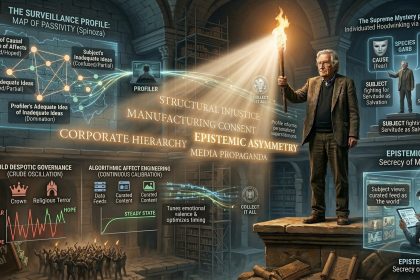
I. Spinoza demonstrates that “the activities of the mind arise solely from adequate ideas; the passive states of the mind depend solely on inadequate ideas” (Ethics III, Prop. 3). The mind...

The Specter of Disillusionment:A Psychoanalytic and Ideological Analysis of Paul Thomas Anderson’s One Battle After Another Introduction: The Cinematic Apparatus and the Architecture of CrisisIn...
“One Battle After Another” and the Prestige Capture of Anti-Fascism « Créer, c’est résister. » / “To create is to resist.”— L’Abécédaire / The ABC Primer, “R comme résistance.” The officia...

The first thing is to get clear about the object. One Battle After Another is officially presented as the story of Bob, a “washed-up revolutionary” living off-grid with his daughter Willa until an old...

The surface level Official materials describe the film as centering on Bob, a “washed-up revolutionary” living off-grid in “stoned paranoia” with his daughter Willa; when an “evil nemesis” resurfaces ...
“We should not forget the standard Hollywood censorship of the political dimension.” This brief formulation by Slavoj Žižek in For They Know Not What They Do provides the indispensable theoretical arc...
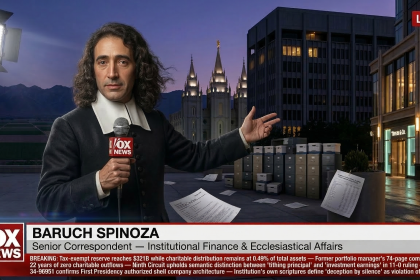
I. The Temple as Theatre I have often wondered that persons who make a boast of professing the Christian religion—namely, love, joy, peace, temperance, and charity to all men—should quarrel with such ...

or, The Holy Art of Washing a Tithe Through Time (in the manner of Mark Twain) There are communities which make a reputation for virtue as a banker makes one for solvency: by publishing it. There are ...